
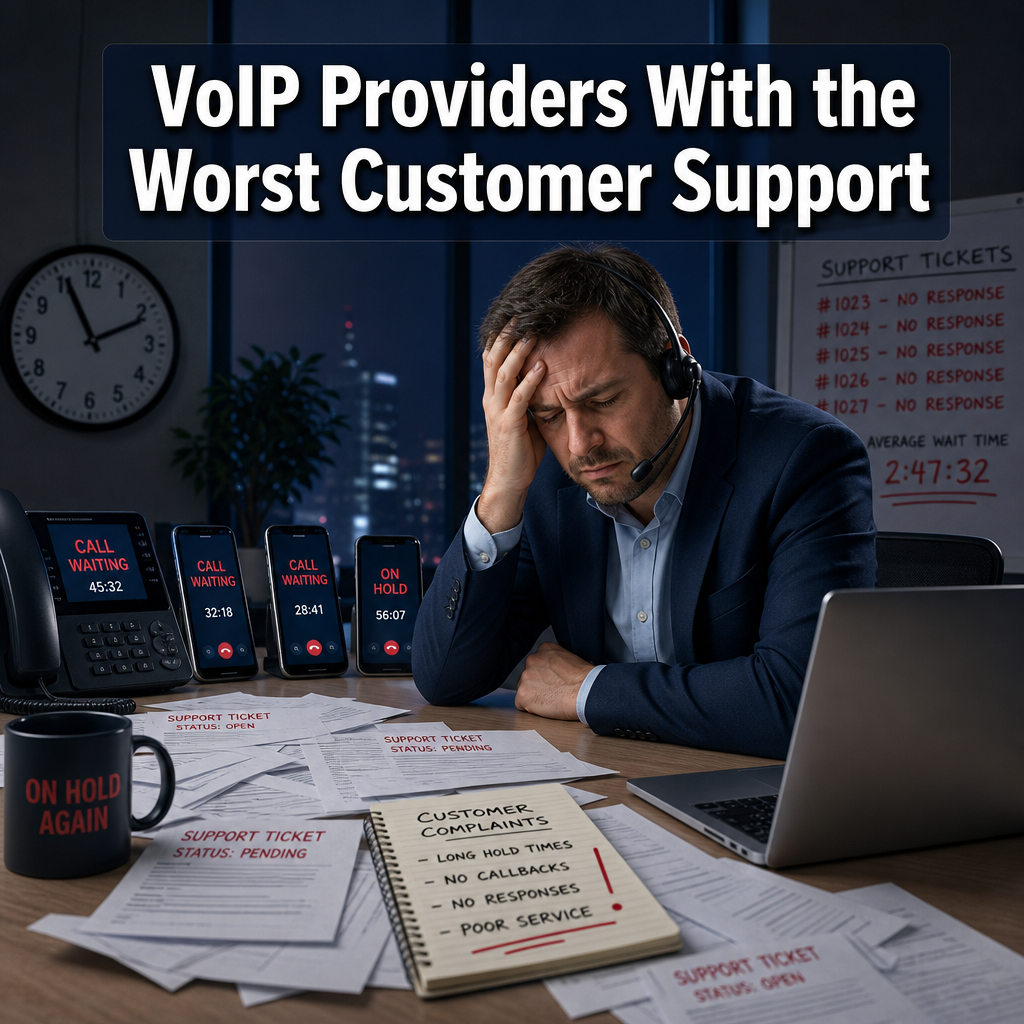
A 2025 study by Metrigy found that 68% of businesses switching VoIP providers cited poor customer support as their primary reason for leaving, ranking higher than price, features, or call quality. When your business phone system goes down at 3 PM on a Tuesday, the difference between a provider with solid support and one with voip provider poor customer support can mean lost revenue, frustrated customers, and hours of downtime.
This isn’t about naming and shaming specific companies. Provider performance shifts, support teams change, and what works for a 500-seat enterprise might fail a 10-person startup. Instead, this guide identifies the warning signs, common patterns, and red flags that signal voip provider poor customer support, so you can avoid costly mistakes before signing a contract.
Key Takeaways:
- 68% of businesses switch VoIP providers primarily due to poor customer support, not pricing or features
- Warning signs include tier-gated support, offshore-only teams with no escalation paths, and providers charging extra for phone support
- Response time matters more than availability: a provider open 24/7 with 45-minute hold times is worse than one with limited hours but 5-minute response
- Contract terms reveal support quality: look for guaranteed SLA response times, not vague “best effort” language
- Small business buyers face the biggest risk: many providers prioritize enterprise accounts, leaving SME customers with skeleton support crews
Understanding What Makes VoIP Provider Poor Customer Support
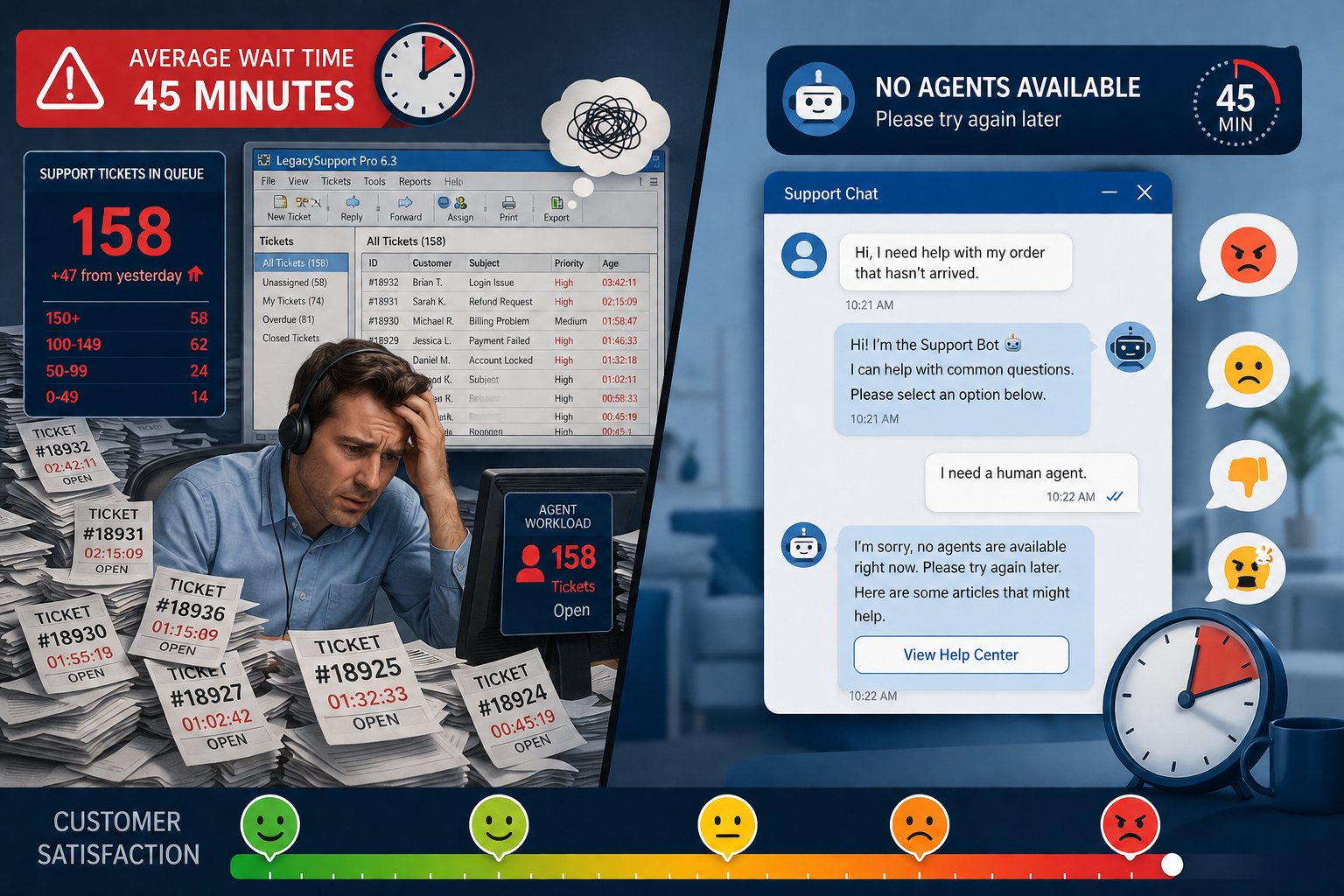
Customer support quality isn’t just about friendliness or politeness. For business phone systems, support determines whether a technical issue costs you 10 minutes or 10 hours of downtime. Poor support manifests in specific, measurable ways that directly impact your operations.
Response time versus resolution time creates the first major gap. A provider might answer your ticket in 15 minutes (good response time) but take 72 hours to actually fix the problem (terrible resolution time). Many providers advertise their response metrics while burying resolution statistics. When evaluating business VoIP providers, ask for both numbers.
Tier-gated support structures force customers through multiple levels before reaching someone who can actually help. You explain your problem to a Level 1 agent reading from a script, get escalated to Level 2 who asks the same questions, then finally reach Level 3, two hours later. Quality providers empower front-line support to solve problems or escalate immediately.
Offshore support without proper training represents another common failure point. Geographic location matters less than technical knowledge and authority to act. The problem emerges when providers staff overseas call centers with undertrained agents who lack access to backend systems or escalation paths. You end up repeating “I need to speak to someone in engineering” while the agent insists you reboot your router for the fifth time.
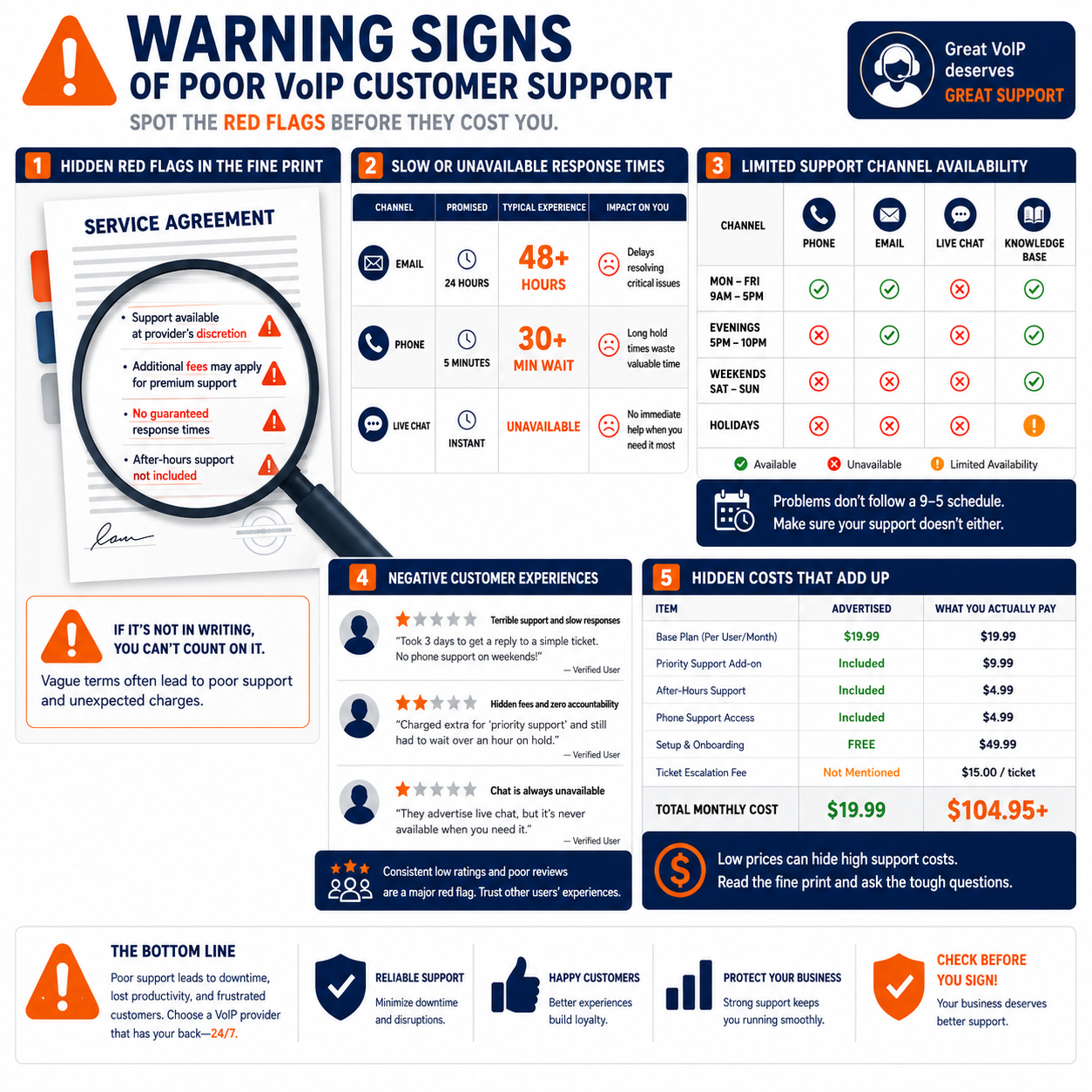
Limited support channels restrict how you can reach help. Some providers offer only email support, useless when your phones are down. Others charge extra for phone support, creating a perverse incentive where you pay more to report problems with the service you’re already paying for. Modern cloud-based communications should offer multiple contact methods: phone, email, chat, and ticketing systems.
Knowledge base quality reveals how much a provider invests in customer success. Poor providers maintain outdated documentation with broken screenshots from 2019 and instructions for deprecated features. Quality providers treat documentation as a product, updating it regularly and including video tutorials, troubleshooting flowcharts, and real-world examples.
SLA enforcement separates promises from reality. Service Level Agreements mean nothing if providers don’t honor them or make claims processes deliberately difficult. Check whether the SLA includes automatic credits for violations or requires you to manually request compensation. The latter rarely gets paid out. For more on this topic, read about the importance of SLA in VoIP services.
Red Flags That Signal Poor Customer Support Before You Sign
Identifying voip provider poor customer support during the sales process saves you from contractual headaches later. Sales teams always promise excellent support, your job is to verify those claims before committing.
The sales-to-support handoff reveals organizational priorities. Quality providers introduce you to your account manager and technical contact during onboarding. Poor providers ghost you after the contract signature, leaving you to navigate a generic support queue. Ask during sales: “Who will be my point of contact after we go live?” Vague answers are red flags.
Support cost structures hidden in pricing tiers indicate trouble. Some providers charge $50 to $200 per month extra for “premium support” that should be standard, phone access, faster response times, dedicated account management. If basic support means email-only with 48-hour response times, you’re looking at a provider that views support as a profit center rather than a service obligation. Compare this to VoIP pricing models to understand what’s reasonable.
Trial period support quality predicts long-term experience. During your free trial or pilot, note response times, agent knowledge, and problem resolution. Providers sometimes staff trials with their best support team to close deals, but patterns emerge. If you wait 30 minutes for chat support during a trial, expect worse after you’re a paying customer.
Contract exit clauses tell you how confident a provider is in their service. Providers with strong support offer reasonable cancellation terms, 30 to 90 days notice, prorated refunds. Those with poor support lock you into multi-year contracts with hefty early termination fees because they know you’ll want to leave. Before signing, understand how to cancel your VoIP contract without paying fees.
Online review patterns across multiple platforms reveal consistent issues. One negative review might be an outlier. Fifty reviews mentioning “impossible to reach support” or “waited hours for help” indicate systemic problems. Check Trustpilot, G2, Capterra, and Reddit. Look specifically for reviews from businesses similar to yours in size and industry.
Support hours and holiday coverage matter more than you think. A provider advertising “24/7 support” might staff nights and weekends with a skeleton crew of junior agents who can’t access engineering. Ask specific questions: “How many support agents work the overnight shift?” and “What’s your average response time at 2 AM on Sunday?”
Onboarding process complexity signals how much hand-holding you’ll get. Providers with poor support dump you into a self-service portal with minimal guidance. Quality providers assign an onboarding specialist, schedule training calls, and check in during your first month. If setting up a virtual phone system feels like navigating a maze alone, support won’t improve later.
Common Support Failures That Impact Business Operations
Real-world support failures cost businesses money, customers, and reputation. Understanding common failure modes helps you ask better questions and set realistic expectations.
Number porting disasters rank among the most damaging support failures. Porting your number to a VoIP provider requires coordination between carriers, precise timing, and immediate troubleshooting if something breaks. Poor providers submit incorrect paperwork, miss porting windows, or leave you without phone service for days. A quality provider assigns a porting specialist, confirms every detail, and monitors the port in real-time.
Emergency outage response separates adequate support from excellent. When your phones go down, you need someone who can diagnose the issue in minutes, not hours. Poor providers make you wait in the general support queue while your business loses money. Quality providers offer emergency hotlines with immediate escalation to network engineers. Ask potential providers: “What’s your process when a customer reports a complete service outage?”
Integration support gaps emerge when connecting VoIP to your CRM, helpdesk, or other business tools. Many providers advertise integrations but offer zero support for actually configuring them. You’re left reading API documentation and troubleshooting alone. This becomes critical when integrating your CRM with VoIP systems or setting up call center operations.
Billing dispute resolution tests support quality when money is involved. Errors happen, unexpected charges, incorrect usage calculations, failed credits. Poor providers make disputing charges nearly impossible, requiring multiple escalations and weeks of back-and-forth. Quality providers resolve billing issues within one or two business days with clear explanations. Watch for hidden costs that providers don’t disclose.
Feature configuration assistance becomes critical as you scale. Adding users, setting up call routing, configuring auto-attendants, these tasks should be straightforward, but poor documentation and unhelpful support turn simple changes into multi-hour projects. Providers with strong support offer configuration assistance, video tutorials, and templates for common setups.
Quality troubleshooting requires support agents who understand VoIP technology, not just customer service. When you report choppy calls or one-way audio, poor support blames your internet connection and closes the ticket. Quality support runs diagnostic tests, checks your network configuration, and works with you to identify the actual cause, whether it’s QoS settings, codec mismatches, or provider-side issues. Learn more about troubleshooting VoIP call drops.
Account management continuity matters for growing businesses. Poor providers assign you a new account manager every six months, forcing you to re-explain your setup and requirements repeatedly. Quality providers maintain consistent relationships, with account managers who understand your business and proactively suggest improvements.
What Good VoIP Customer Support Actually Looks Like
Understanding quality support helps you evaluate providers accurately and set appropriate expectations. Good support isn’t about perfection, it’s about responsiveness, competence, and accountability.
Proactive monitoring and alerts mean the provider often knows about problems before you do. Quality providers monitor your service 24/7, detect anomalies, and reach out when they spot issues. You might receive an email: “We noticed increased packet loss on your connection at 2 PM today. We’ve identified the cause and implemented a fix. Please let us know if you experience any issues.”
Multi-channel accessibility with consistent quality across all channels. Whether you call, email, chat, or submit a ticket, you reach knowledgeable agents who can access your account and help immediately. Response time targets are published and met: under 5 minutes for phone, under 15 minutes for chat, under 2 hours for email during business hours.
Technical competence at every level eliminates the frustration of explaining technical issues to non-technical support. Front-line agents understand SIP, codecs, QoS, and network architecture. They can interpret diagnostic data, run remote tests, and escalate intelligently when needed. You never hear “have you tried turning it off and on again” for complex technical problems.
Transparent status communication during outages or issues. Quality providers maintain real-time status pages, send proactive updates, and provide estimated resolution times. They admit when something is their fault and explain what they’re doing to fix it. Poor providers go silent during outages, leaving customers to wonder what’s happening.
Documentation that actually helps includes step-by-step guides, video tutorials, troubleshooting flowcharts, and real-world examples. The knowledge base is searchable, current, and written for your technical level, not overly simplified or unnecessarily complex. When you search for “configure call forwarding,” you find clear instructions with screenshots, not a vague overview.
Dedicated account management for business customers means having a specific person who knows your setup, understands your needs, and proactively checks in. They schedule quarterly reviews, suggest optimizations, and serve as your advocate within the provider organization. This becomes especially valuable when switching to VoIP or scaling operations.
SLA guarantees with teeth include specific uptime commitments (typically 99.9% or higher), response time guarantees, and automatic service credits when targets are missed. The SLA is clear, measurable, and enforced without requiring you to fight for compensation.
How to Evaluate Support Quality During Provider Selection
Smart evaluation during the selection process prevents expensive mistakes. These practical steps help you assess real support quality, not marketing promises.
Test support during your trial period by submitting realistic support requests. Don’t just test the service, test the support. Submit a ticket asking a technical question. Call support with a configuration issue. Use chat to request help with a feature. Track response times, agent knowledge, and resolution quality. Do this multiple times at different hours to get a representative sample.
Request references from similar businesses and ask specific support questions. Don’t accept generic testimonials. Ask the provider to connect you with 2-3 current customers in your industry and size range. When you speak with them, ask: “How often do you contact support?” “What’s your typical response time?” “Have you ever had a critical issue? How was it handled?” “Would you choose this provider again knowing what you know now?”
Review the support SLA in detail before signing anything. Request the actual SLA document, not a marketing summary. Look for specific commitments: “Response within 15 minutes for critical issues” not “fast response times.” Check whether the SLA includes financial penalties for violations. Understand what qualifies as “critical” versus “standard” support requests.
Examine the customer portal and documentation during your trial. Can you easily find answers to common questions? Is the documentation current and accurate? Can you submit tickets, track their status, and access your account history? A poorly designed portal indicates a provider that doesn’t prioritize customer experience.
Ask about support team structure and training. How many support agents do they employ? What’s the agent-to-customer ratio? How long is the training program for new support staff? What percentage of support requests are resolved by first-line agents versus requiring escalation? Providers with strong support can answer these questions confidently.
Test emergency escalation procedures by asking: “If I have a complete service outage at 10 PM on Saturday, what’s the exact process to get immediate help?” Quality providers have clear emergency procedures with dedicated hotlines and guaranteed response times. Poor providers tell you to submit a ticket and wait.
Compare support costs across providers to understand what’s included in base pricing versus add-ons. Create a spreadsheet comparing: base support hours, response time guarantees, available channels, account management, and any premium support costs. This reveals which providers view support as a service versus a profit center.
Protecting Your Business From Support Failures
Even with careful selection, support issues can emerge. These strategies minimize risk and ensure you’re not left stranded.
Maintain internal documentation of your VoIP configuration, including network settings, user accounts, call routing rules, and integration details. When you contact support, you can provide specific information quickly rather than relying on the provider to figure out your setup. This also protects you if you need to migrate to a different provider.
Establish escalation contacts during onboarding. Get direct email addresses and phone numbers for your account manager, technical support supervisor, and if possible, a sales contact. When standard support fails, these escalation paths can resolve issues faster.
Document every support interaction including ticket numbers, agent names, promises made, and resolution timelines. If support quality degrades or the provider fails to honor commitments, this documentation becomes critical for contract disputes or justifying early termination.
Build redundancy into critical systems so a VoIP outage doesn’t completely shut down your business. This might include backup internet connections, failover to mobile phones, or maintaining a few traditional phone lines for emergencies. The goal isn’t to avoid VoIP, it’s to ensure business continuity when problems occur.
Schedule regular service reviews with your provider, even if they don’t offer them proactively. Quarterly calls to review performance, discuss issues, and plan for growth keep you on the provider’s radar and often result in better support attention.
Join user communities and forums where customers of your VoIP provider share experiences and solutions. These communities often provide faster answers than official support for common issues, and they reveal patterns of provider problems you might not discover alone.
Plan your exit strategy before you need it. Understand your contract terms, know how to export your data and configuration, and maintain relationships with alternative providers. This isn’t pessimism, it’s smart business planning that gives you leverage if support quality deteriorates.
FAQ
How quickly should a VoIP provider respond to support requests?
For critical issues affecting service, expect response within 15 to 30 minutes during business hours and under 1 hour for 24/7 support. Non-critical requests should receive initial response within 2 to 4 hours. Resolution time varies by complexity, but providers should give you a timeline within the first contact. If you’re waiting hours for initial response to a service outage, that’s a red flag.
Is 24/7 support really necessary for small businesses?
It depends on your operations. If you only use phones during standard business hours and can tolerate occasional overnight issues waiting until morning, 24/7 support is nice but not essential. However, if you serve customers across time zones, run evening operations, or can’t afford any downtime, 24/7 support with consistent quality becomes critical. Test after-hours support during your trial period to verify it’s actually staffed adequately.
What should I do if my VoIP provider’s support quality has declined?
Start by documenting specific failures with dates, ticket numbers, and impact on your business. Escalate to your account manager or sales contact, clearly stating that support quality is affecting your decision to continue service. Request a service review meeting with management. If quality doesn’t improve within 30 days, review your contract terms and begin evaluating alternative providers. Poor support rarely improves without significant pressure or provider restructuring.
Are there specific VoIP providers known for excellent customer support?
Provider support quality changes over time as companies grow, restructure, or shift priorities. Instead of relying on reputation, evaluate current support quality through trial testing, recent reviews (within the past 6 months), and direct conversations with existing customers. Providers that excel for enterprise customers sometimes neglect small business support, and vice versa. Match the provider’s support structure to your business size and needs.
How much should I expect to pay for quality VoIP support?
Quality basic support should be included in your per-user pricing (typically $20 to $40 per user per month for business VoIP). This should include phone, email, and chat support during business hours with reasonable response times. Premium support with 24/7 availability, dedicated account management, and faster response times might cost an additional $50 to $200 per month depending on your user count. Be wary of providers charging extra for phone support or basic troubleshooting, that’s a sign of poor value.
Can I switch VoIP providers if I’m locked in a contract?
Most contracts include early termination fees, but these might be worth paying if support failures are costing you more in lost productivity and revenue. Review your contract for termination clauses, calculate the actual cost, and compare it to the ongoing cost of poor support. Some contracts include performance clauses that allow termination if the provider fails to meet SLA commitments. Document all support failures thoroughly as this strengthens your negotiating position for waiving termination fees.
Conclusion
VoIP provider poor customer support isn’t just an inconvenience, it’s a business risk that affects your revenue, customer relationships, and operational efficiency. The warning signs are identifiable before you sign a contract: tier-gated support structures, limited contact channels, vague SLA language, and poor trial-period experiences all predict future problems.
Quality support means fast response times, technically competent agents, multiple contact channels, proactive monitoring, and accountability when issues occur. It’s included in reasonable pricing rather than hidden behind premium support paywalls. Most importantly, good support treats your business communications as critical infrastructure, not just another ticket in the queue.
Take these steps now:
- Test support thoroughly during any trial period, submit real requests at different times and through different channels
- Read the actual SLA document and verify it includes specific, measurable commitments with enforcement mechanisms
- Talk to current customers similar to your business size and ask direct questions about their support experiences
- Document your requirements for response times, available channels, and technical expertise before evaluating providers
- Build contingency plans including escalation contacts, internal documentation, and backup communication methods
The right VoIP provider with strong customer support becomes a partner in your business growth, helping you improve customer experience and scale operations smoothly. The wrong provider with poor support becomes an obstacle you’ll eventually need to replace, at significant cost in time, money, and frustration.
Choose carefully, test thoroughly, and never compromise on support quality for a slightly lower monthly price. Your business communications are too important to leave in the hands of a provider that won’t be there when you need them.