
Business VoIP providers locked 68% of UK companies into contracts with exit fees averaging £1,200 to £3,500 in 2025, but most of those fees were completely avoidable. The telecom industry banks on businesses not reading the fine print, yet the same contract clauses that trap you often contain the escape routes you need.
Whether your current provider failed to deliver promised uptime, your business needs have changed, or you’ve found a more cost-effective phone solution, you shouldn’t have to pay thousands to cancel a VoIP contract. This guide walks through the legitimate strategies that work in 2026, from leveraging service failures to timing your exit perfectly, so you can switch business phone systems without hemorrhaging cash.
Key Takeaways
- Service failures are your strongest leverage: Document every outage, call quality issue, and unmet SLA commitment, providers often waive fees rather than face breach-of-contract claims
- Contract timing matters more than you think: Most VoIP agreements have 30 to 90-day notice windows and auto-renewal clauses that can trap you for another year if you miss the deadline
- Cooling-off periods offer a clean exit: UK businesses have 14 days to cancel most VoIP contracts without penalty under Consumer Contracts Regulations
- Negotiation works surprisingly often: Providers would rather keep partial revenue or avoid bad reviews than enforce full exit fees, especially if you have documented complaints
- Prevention beats cure: Reading contracts before signing and understanding VoIP contract red flags saves far more money than any exit strategy
Understanding VoIP Contract Exit Fees and Why They Exist
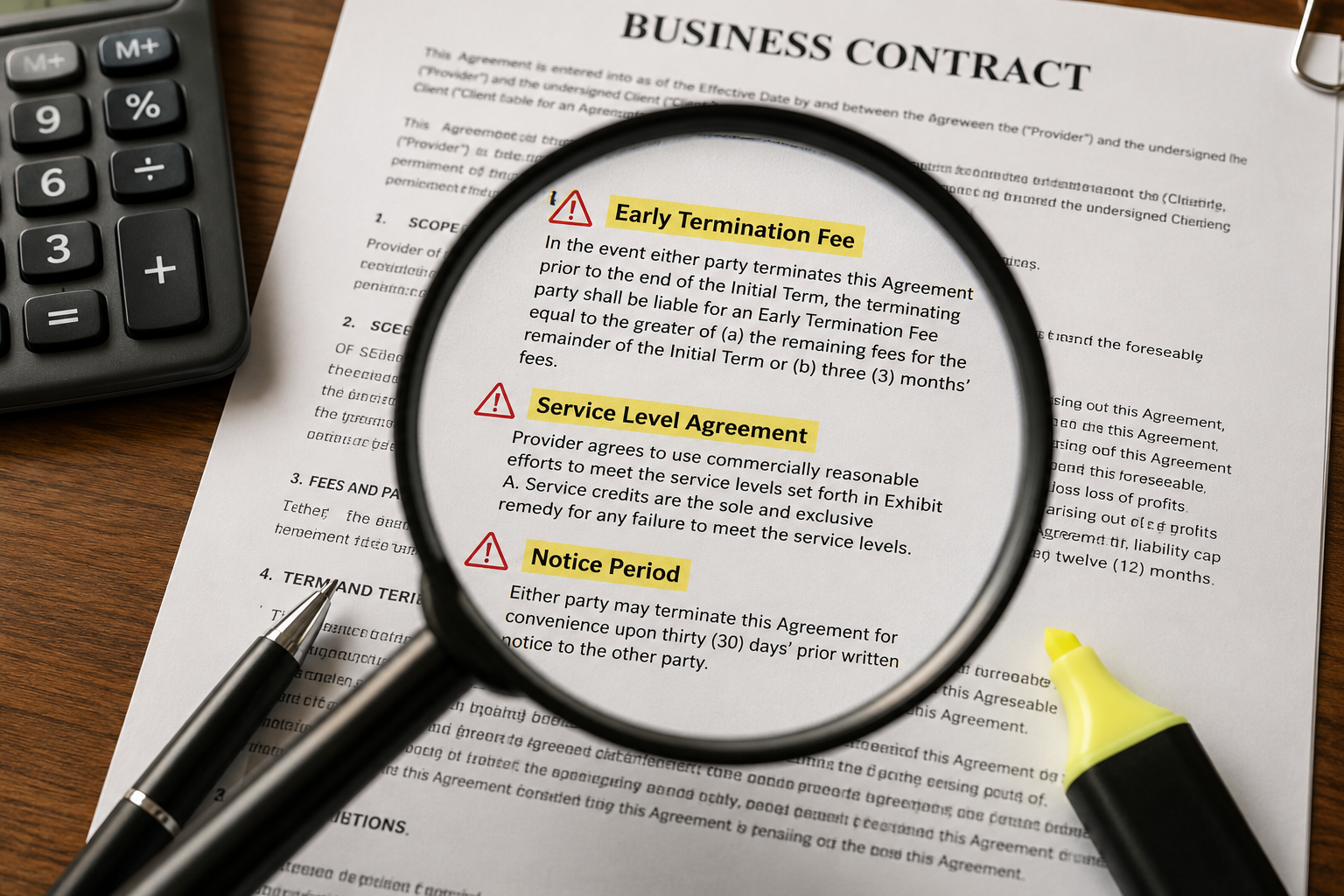
Exit fees, also called early termination fees (ETFs), exist because business VoIP providers front-load costs. When you sign up, they provision hardware, port your numbers, configure your system, and often subsidize equipment. They recoup these investments over your contract term, typically 12 to 36 months.
Common exit fee structures in 2026:
- Flat rate penalties: Fixed amounts ranging from £500 to £2,000 regardless of remaining contract length
- Remaining balance charges: You pay the full monthly cost for every month left on your contract (most expensive option)
- Declining scale fees: Penalties decrease as you approach contract end,£1,500 with 12 months remaining, £750 with 6 months left
- Equipment buyout costs: Separate charges for phones, routers, or PBX hardware you received at discounted rates
The average UK SME pays £1,800 in exit fees when canceling a three-year VoIP contract midway through. That’s money better spent on a more reliable business phone system that actually meets your needs.
The Legal Framework: What Providers Can and Cannot Charge
UK telecom regulations limit what providers can legally charge when you cancel a VoIP contract. Under Ofcom guidelines and the Communications Act 2003:
✅ Providers CAN charge for:
- Genuine losses from your early exit (proportionate to remaining contract value)
- Outstanding equipment costs if hardware was subsidized
- Reasonable administrative costs for disconnection
❌ Providers CANNOT charge for:
- Punitive fees that exceed their actual losses
- Services not yet rendered or equipment not yet provided
- Penalties if they breached the contract first (missed SLAs, unauthorized charges, service failures)
This legal framework creates your first exit strategy: if fees seem excessive or the provider failed to deliver promised service levels, you have grounds to challenge them.
When You Can Cancel a VoIP Contract Without Fees (Legally)
Several scenarios allow you to walk away from your VoIP contract without paying a penny in exit fees. These aren’t loopholes, they’re legitimate contractual and legal protections.
1. Cooling-Off Period Cancellations
The Consumer Contracts Regulations give UK businesses 14 calendar days to cancel most VoIP contracts without penalty. This applies to:
- Contracts signed remotely (phone, email, website)
- Agreements made off-premises (sales rep visits)
- Any distance selling arrangement
The clock starts the day after you sign the contract or receive written confirmation. You must notify the provider in writing before the 14 days expire. Most providers accept email, but send it to their official cancellation address (check your contract) and request read receipt.
Pro tip: If the provider didn’t clearly inform you of your cancellation rights, the cooling-off period extends to 12 months. Check your welcome email and contract documents, if cancellation rights aren’t prominently displayed, you may have a year to exit fee-free.
2. Provider Breach of Contract
When your VoIP provider fails to deliver what they promised, you’re entitled to cancel without penalty. Common breaches that justify fee-free cancellation:
Service Level Agreement (SLA) violations: If your contract guarantees 99.9% uptime but you experienced multiple outages, document every incident. Three or more significant outages in a quarter typically constitutes material breach.
Unauthorized price increases: Mid-contract price hikes beyond inflation-linked clauses (usually CPI + 3.9%) breach your agreement. Providers must give 30 days’ notice and allow you to exit fee-free if increases exceed agreed terms.
Feature removal or service degradation: If your provider removes features you paid for (call recording, integrations, number of users) without compensation, that’s breach of contract.
Persistent quality issues: Chronic call drops, poor audio quality, or failed number porting that the provider can’t resolve within reasonable timeframes.
To use breach as your exit strategy, you need documentation. Keep records of:
- Support ticket numbers and dates
- Screenshots of outages or error messages
- Call quality logs from your VoIP system
- Written complaints you’ve sent
- Any compensation or credits already received
Send a formal breach notification letter citing specific contract clauses they violated. Give them 14 to 30 days to remedy the situation (your contract should specify this “cure period”). If they don’t fix the issues, you can terminate without fees.
3. Material Changes to Terms and Conditions
When providers make significant changes to your contract terms, you typically have the right to cancel without penalty. Under Ofcom’s General Conditions, providers must:
- Give at least 30 days’ notice of material changes
- Clearly explain what’s changing and when
- Inform you of your right to cancel without penalty
Material changes include:
- Price increases beyond agreed inflation clauses
- Reduction in service features or quality
- Changes to minimum contract terms
- Modifications to fair use policies that affect your usage
Watch for “we’re updating our terms” emails, they often bury your cancellation rights in small print. You usually have 30 days from the change notification to exit fee-free.
4. Moving Premises Outside Service Area
If you’re relocating your business to an area where your current provider cannot deliver service, most contracts allow penalty-free cancellation. This applies when:
- You’re moving to a region with no coverage
- The new location lacks necessary infrastructure (fiber, broadband)
- International relocations where the provider doesn’t operate
You’ll need to prove the move is genuine (new lease agreement, business registration at new address) and that the provider truly cannot service the location. Some providers will try to retain you by offering alternative solutions, mobile VoIP apps, softphones, or cloud-based communications that work anywhere with internet. If these alternatives meet your needs, they may argue the contract should continue.

How to Cancel a VoIP Contract: Step-by-Step Strategy
When none of the automatic fee-waiver scenarios apply, you need a strategic approach to minimize or eliminate exit fees. Here’s the proven process that works in 2026.
Step 1: Review Your Contract Thoroughly
Before contacting your provider, understand exactly what you signed. Look for:
Notice period requirements: Most contracts require 30 to 90 days’ written notice before your renewal date. Missing this window can auto-renew you for another full term.
Exit fee calculation method: Find the exact formula, flat rate, remaining balance, or declining scale.
Renewal clauses: Many contracts auto-renew unless you provide notice during a specific window (often 30 to 60 days before contract end).
Service level commitments: Document any SLA guarantees around uptime, call quality, or support response times.
Price protection clauses: Check what price increases are allowed and under what circumstances.
If you’re struggling to interpret legal language, consider having a solicitor review the termination clauses. The £150 to £300 cost often saves you thousands in exit fees by identifying contractual weaknesses.
Step 2: Document All Service Issues
Even if you haven’t experienced major outages, review your service history for any issues that could strengthen your negotiating position:
- Pull reports from your VoIP system showing call quality metrics, dropped calls, or connection failures
- Review all support tickets you’ve opened
- Check your billing history for any incorrect charges or unexplained fees
- Note any features that stopped working or were removed
- Document any downtime that affected your business operations
Create a timeline of issues with dates, ticket numbers, and business impact. Even minor problems add up to a pattern of underperformance that weakens the provider’s position.
Step 3: Calculate Your Leverage Points
Before negotiating, assess your bargaining power:
Strong leverage:
- Multiple documented service failures
- Missed SLA commitments
- Unauthorized charges or billing errors
- Long tenure as a customer (3+ years)
- Multiple services with the provider (phone + internet)
- Willingness to leave negative reviews on Trustpilot, Google, or industry forums
Weak leverage:
- No service issues
- Short contract duration remaining (under 3 months)
- Small monthly spend (under £100)
- No documentation of problems
The stronger your leverage, the more aggressive you can be in negotiations. With weak leverage, focus on timing your exit perfectly or negotiating reduced fees rather than complete waiver.
Step 4: Contact the Provider Strategically
Don’t start with “I want to cancel.” Instead, frame the conversation around your concerns:
Opening approach: “I’m reviewing our business phone systems and have concerns about [specific issues]. I’d like to discuss our options.”
This opens dialogue without immediately triggering the retention team’s “save at all costs” mode. You want to:
- Speak to retentions, not general support: Ask to be transferred to the cancellations or retentions department, they have authority to waive fees
- Reference specific contract clauses: “According to section 4.2 of our agreement, you guarantee 99.9% uptime, but we’ve experienced…”
- Mention competitor offers: “We’re evaluating [competitor] who offers similar features for 30% less with no contract”
- Be prepared to escalate: If the first representative won’t budge, ask for a supervisor or complaints manager
Step 5: Negotiate Fee Reduction or Waiver
When the provider quotes exit fees, don’t accept immediately. Try these negotiation tactics:
“I’ll pay a reduced settlement”: Offer 25% to 50% of the quoted fee as a goodwill payment. Many providers accept rather than lose everything.
“Waive the fee and I’ll provide a positive testimonial”: If you’ve been a long-term customer without major issues, offer to write a case study or testimonial in exchange for fee waiver.
“I’ll stay if you match this competitor offer”: Present a genuine quote from another provider. They may match it, giving you better service at lower cost without canceling.
“I’ll pay for equipment but not service fees”: Separate hardware costs from early termination penalties. Offer to buy out subsidized equipment but refuse to pay for services you won’t receive.
“I’ll transition gradually”: Propose keeping some services (like a few lines) while canceling others, reducing their loss and your fees.
Step 6: Put Everything in Writing
Once you reach an agreement, whether full waiver, reduced fee, or scheduled cancellation, get it documented:
- Request written confirmation via email
- Save all correspondence
- Note the name and employee ID of everyone you spoke with
- Confirm the exact cancellation date and final bill amount
- Verify number porting details if you’re moving to a new VoIP provider
Send your own written cancellation notice via email and recorded delivery post to the official address in your contract. Keep proof of delivery.
Alternative Strategies to Avoid Exit Fees
If direct negotiation fails, consider these alternative approaches:
Transfer the Contract
Some VoIP contracts allow you to transfer service to another business. If you’re closing down or the service no longer fits, find another company willing to take over the contract. You’ll need provider approval, and the new business must pass credit checks, but this completely eliminates your exit fees.
Wait for the Renewal Window
If your contract end date is within 6 months, it may be cheaper to wait than pay exit fees. Mark your calendar for the exact date your notice period opens (typically 30 to 90 days before renewal) and submit cancellation then.
Critical timing tip: Set three reminders, 90 days before renewal, 60 days before, and 30 days before. Missing the notice window by even one day can auto-renew you for another full term.
Downgrade to Minimum Service
If you can’t cancel without fees but need to reduce costs immediately, downgrade to the minimum service level allowed under your contract. Keep just one or two lines active instead of your full system. This reduces monthly costs while you wait out the contract term.
File a Formal Complaint
When providers refuse to waive fees despite legitimate service failures, escalate through formal channels:
Provider’s complaints procedure: All UK telecom providers must have an Ofcom-approved complaints process. Follow it exactly, keeping records of each step.
Ombudsman Services: If the provider doesn’t resolve your complaint within 8 weeks, escalate to Ombudsman Services (for most providers) or CISAS (Communications and Internet Services Adjudication Scheme). Both are free to consumers and can order providers to waive fees if they find in your favor.
Small claims court: For exit fees over £1,000 where you have strong evidence of provider breach, consider small claims court. The £100 to £200 filing fee is recoverable if you win.
The mere threat of ombudsman involvement or legal action often prompts providers to negotiate seriously. They know defending cases costs more than waiving fees.
What to Do After Successfully Canceling Your VoIP Contract
Once you’ve canceled without paying exit fees (or minimized them significantly), take these steps to ensure a smooth transition:
Port Your Numbers Immediately
Don’t wait until the last minute to port your business numbers to your new provider. The number porting process takes 5 to 15 business days in the UK. Start the process as soon as your cancellation is confirmed to avoid any service gap.
Return Equipment Promptly
If your contract requires returning phones, routers, or other hardware:
- Get a returns authorization number from the provider
- Pack equipment securely with all original accessories
- Use tracked shipping and keep proof of delivery
- Photograph everything before shipping
- Request written confirmation once they receive it
Failure to return equipment on time can result in additional charges that undermine your fee-free exit.
Verify Final Billing
Check your final bill carefully for:
- Unexpected exit fees (despite your agreement)
- Charges for unreturned equipment
- Pro-rated service charges
- Any credits owed to you
Dispute any incorrect charges immediately in writing. If you negotiated fee waiver, reference the agreement and the employee who authorized it.
Choose Your Next Provider Wisely
Learn from this experience when selecting your next business phone system:
- Read contracts thoroughly before signing, especially termination clauses
- Avoid long-term contracts (3+ years) unless the discount justifies the commitment
- Look for providers offering month-to-month options after initial term
- Check hidden costs beyond the advertised monthly rate
- Verify SLA commitments and penalty clauses if they fail to deliver
- Test service quality during any trial period
Consider providers with strong reputations for VoIP for small business that offer flexible terms and transparent pricing.
Preventing Future Contract Problems
The best way to avoid exit fees is preventing contract problems before they start:
Before Signing Any VoIP Contract
Negotiate exit terms upfront: Ask for reduced exit fees, declining penalty scales, or fee waivers if service falls below specified levels. Get these in writing as contract amendments.
Understand auto-renewal clauses: Negotiate longer notice windows (90 days instead of 30) or automatic conversion to month-to-month after the initial term.
Request trial periods: Many providers offer 30-day trials. Use this time to test call quality, features, and support responsiveness before committing long-term.
Clarify all costs: Get written confirmation of setup fees, monthly costs, per-user charges, and any other expenses. Watch for hidden costs that appear after signing.
During Your Contract Term
Monitor service quality continuously: Use your VoIP system’s analytics to track call quality, uptime, and performance. Document issues as they occur, not when you want to cancel.
Review bills monthly: Catch unauthorized charges or price increases immediately. Challenge them within 30 days to preserve your rights.
Set renewal reminders: Create calendar alerts for 90, 60, and 30 days before your contract renewal date.
Maintain good records: Keep all contracts, amendments, correspondence, and service records in an organized file.
Build a relationship with your account manager: Regular contact makes negotiations easier if you need to cancel or modify service.
Common Mistakes That Cost You Money
Avoid these errors that make canceling a VoIP contract more expensive:
❌ Canceling verbally without written confirmation: Phone calls don’t count as official notice. Always follow up in writing.
❌ Missing the notice window: Auto-renewal clauses trap thousands of businesses into unwanted contract extensions every year.
❌ Accepting the first exit fee quote: Providers expect negotiation. The initial quote is rarely their final offer.
❌ Failing to document service issues: Without evidence, you have no leverage to argue for fee waivers based on poor performance.
❌ Not reading the contract before signing: Prevention is infinitely cheaper than any exit strategy.
❌ Porting numbers after cancellation: Once your service ends, porting becomes complicated or impossible. Start the process before your final service date.
❌ Ignoring small billing errors: Minor overcharges establish a pattern of billing problems that strengthens your negotiating position.
FAQ
Can I cancel my VoIP contract if I’m unhappy with the service?
Yes, but whether you’ll pay exit fees depends on why you’re unhappy. If the provider breached their SLA, failed to deliver promised features, or had persistent quality issues you documented, you have grounds to cancel without fees. General dissatisfaction without documented service failures typically doesn’t exempt you from exit fees, though you can still negotiate reduced penalties.
How much notice do I need to give to cancel a VoIP contract?
Most UK business VoIP contracts require 30 to 90 days’ written notice before your contract end date. The exact period is specified in your agreement. Notice must be in writing (email usually acceptable) and sent to the official address listed in your contract. Missing this window often auto-renews you for another full term.
What happens to my phone numbers when I cancel my VoIP contract?
You can port your numbers to a new provider before your service ends. Start the porting process at least 2 to 3 weeks before your cancellation date to ensure continuity. If you cancel without porting, you’ll lose the numbers permanently after a brief grace period (usually 30 days).
Can my VoIP provider refuse to let me cancel?
No. Providers cannot force you to continue service indefinitely, but they can enforce exit fees specified in your contract. If they refuse to process your cancellation or claim you can’t leave, escalate through their complaints procedure and contact Ofcom or the Ombudsman if necessary. You have the legal right to cancel, the only question is whether you’ll pay fees.
Will I get a refund if I’ve paid in advance?
If you’ve prepaid for service beyond your cancellation date, you’re entitled to a pro-rated refund for unused time. This should appear as a credit on your final bill. If the provider refuses, dispute it through their complaints process. Prepayment doesn’t extend your contract or obligate you to use the full period.
Can I cancel during the cooling-off period if I’ve already started using the service?
Yes. Using the service during the 14-day cooling-off period doesn’t forfeit your cancellation rights. However, the provider can charge you for the service you actually used during those days, calculated on a pro-rata basis. You won’t pay exit fees, but you’ll pay for the days you had active service.
Conclusion
Canceling a VoIP contract without paying exit fees is entirely possible when you understand your rights, document service issues, and negotiate strategically. The key is recognizing that exit fees aren’t inevitable, they’re negotiable charges that providers will often reduce or waive when faced with legitimate complaints, competitive pressure, or the threat of formal disputes.
Start by reviewing your contract for cooling-off periods, notice requirements, and renewal clauses. Document every service failure, billing error, or unmet commitment. When you’re ready to cancel, approach negotiations with clear evidence and specific requests, escalating through formal complaints channels if necessary.
Most importantly, learn from this experience when choosing your next business phone system. Read contracts carefully, negotiate favorable exit terms upfront, and monitor service quality throughout your contract term. The best exit strategy is choosing a provider you won’t need to leave.
Ready to switch to a more reliable business phone system? Review our guide to choosing the right VoIP provider and check for contract red flags before you sign anything new.