
Number porting failures cost businesses an average of 7 to 14 days in downtime and thousands in lost productivity. Yet most voip porting problems stem from preventable errors that business owners make before they even submit their port request.
When you’re switching to VoIP, keeping your existing business phone number isn’t just convenient, it’s essential for maintaining customer relationships and brand continuity. But the porting process involves multiple carriers, regulatory requirements, and strict data matching protocols. One mismatched character in your account information can trigger an automatic rejection.
This guide breaks down the most common voip porting problems, explains why they happen, and provides actionable fixes to get your port back on track. Whether you’re dealing with a rejected port request or trying to avoid problems before they start, you’ll find practical solutions grounded in real-world scenarios.
Key Takeaways
- Account information mismatches cause 40% of port rejections, verify every detail matches your carrier’s records exactly
- Outstanding balances and contract terms can block ports entirely until resolved with your current provider
- Missing or incorrect documentation delays ports by weeks; the Letter of Authorization (LOA) must be complete and signed
- Carrier-specific restrictions on certain number types require advance verification before initiating a port
- Timeline expectations matter, most ports take 7 to 14 business days, and rushing the process increases error rates
Understanding VoIP Porting Problems: The Most Common Issues
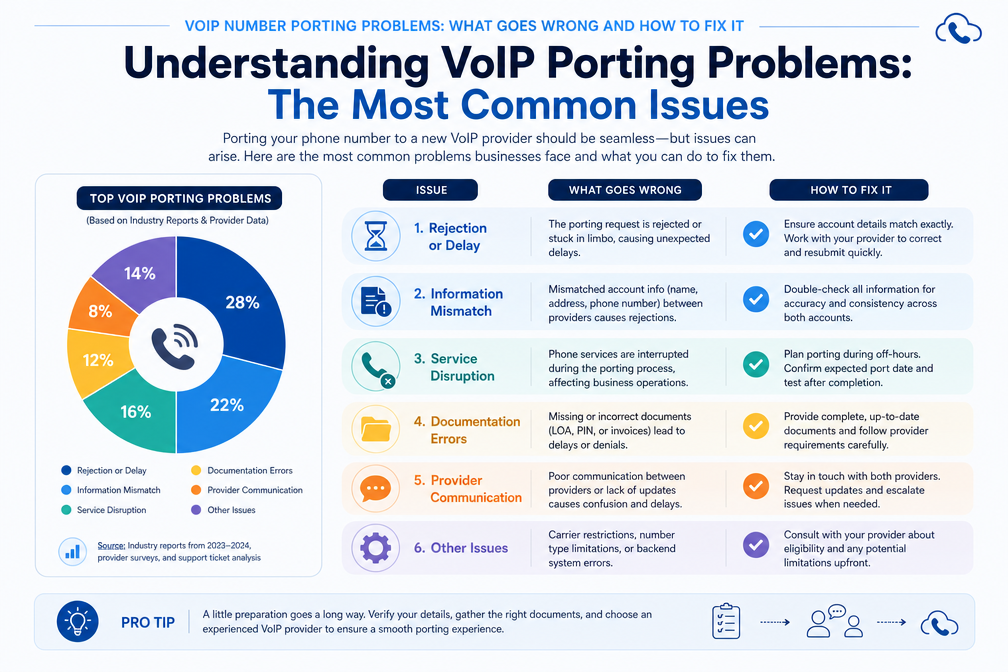
Number porting seems straightforward on paper: submit a request, wait a few days, and your number transfers to your new VoIP provider. Reality proves messier. The process involves coordination between your losing carrier (current provider), gaining carrier (new VoIP provider), and sometimes a third-party Local Number Portability Administrator.
Account Information Mismatches
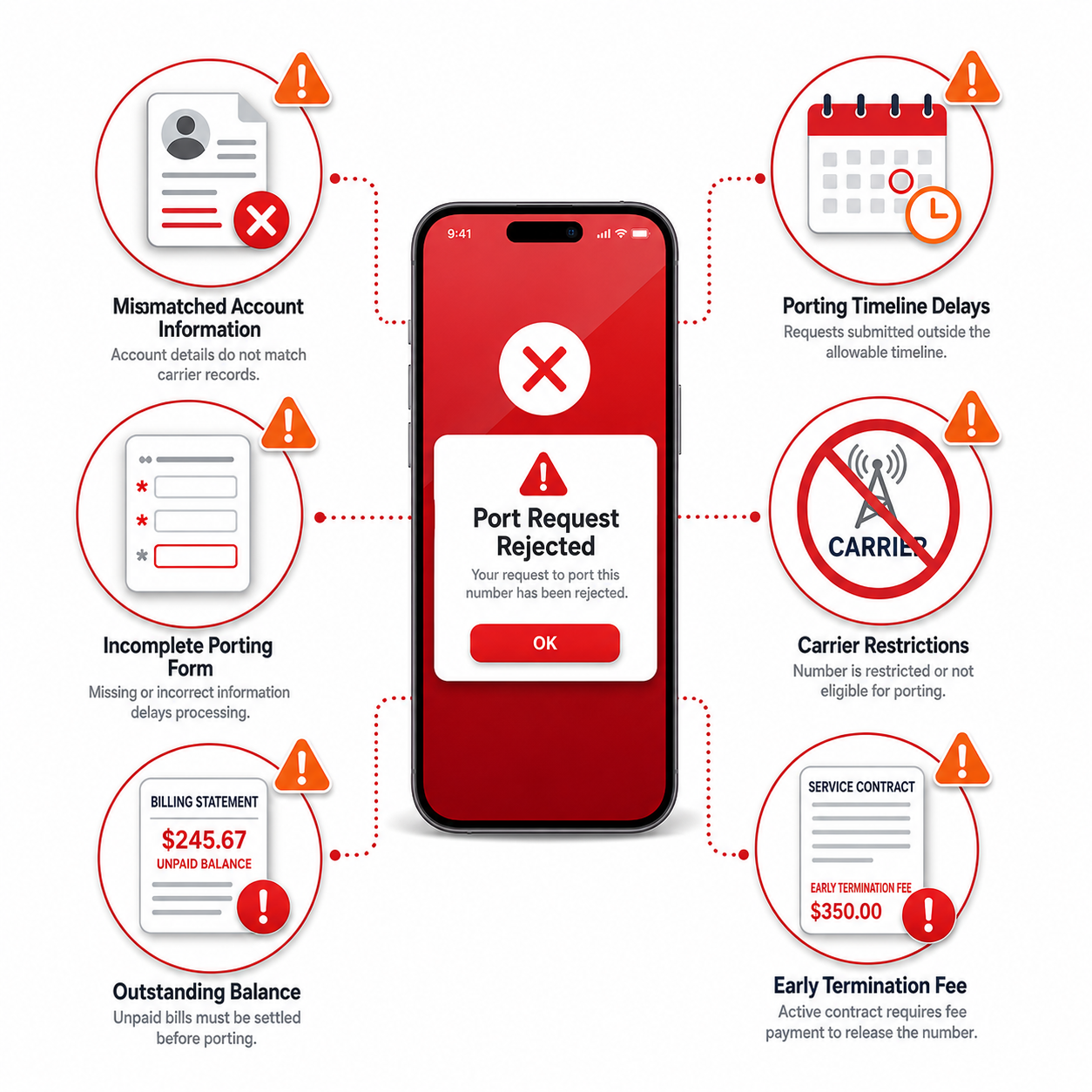
The single biggest cause of voip porting problems is data that doesn’t match your current carrier’s records exactly. The automated systems that process port requests perform character-by-character comparisons. Even minor discrepancies trigger automatic rejections.
Common mismatches include:
- Business name variations (ABC Company vs ABC Company Ltd vs ABC Company Limited)
- Address formatting differences (Street vs St, Suite vs Ste, apartment numbers)
- Account holder name discrepancies (individual vs business entity)
- Service address vs billing address confusion
- Authorized user name not matching account records
Your new VoIP provider submits the port request with the information you provide. If it doesn’t match what your current carrier has on file, the request gets rejected, no exceptions, no manual review. You’ll need to resubmit with corrected information, adding another 5 to 7 days to your timeline.
The fix: Request a Customer Service Record (CSR) from your current provider before starting the port. This document shows exactly how your account information appears in their system. Use this as your source of truth when filling out port request forms.
Outstanding Balances and Contract Obligations
Carriers won’t release numbers when accounts have unpaid balances or active contract obligations. This makes business sense, they’re protecting their revenue, but it catches many business owners off guard.
Financial blocks include:
- Unpaid monthly service charges
- Equipment rental fees or unreturned hardware charges
- Early termination fees (ETFs) for breaking contracts
- Pending dispute charges
- Auto-pay failures from expired credit cards
Some carriers require you to settle these balances before they’ll approve a port. Others will approve the port but send you a final bill afterward. The problem arises when there’s confusion about what’s owed or when charges appear that you weren’t expecting.
The fix: Contact your current provider 30 days before your planned port date. Ask for a complete account review including any early termination fees, outstanding balances, and contract end dates. Get everything in writing. If you’re still under contract, factor ETF costs into your VoIP cost analysis before proceeding.
Incomplete or Incorrect Letter of Authorization
The Letter of Authorization (LOA) is your legal permission for the new carrier to port your number. It must be complete, accurate, and properly signed. Missing information or signature issues cause immediate rejections.
LOA problems include:
- Missing authorized signer signature
- Signature from someone not authorized on the account
- Incomplete account information fields
- Wrong number format (missing area code, extra digits)
- Unsigned or undated forms
- Digital signatures when wet signatures are required
Different carriers have different LOA requirements. Some accept electronic signatures; others require original ink signatures. Some need notarization for certain account types. Your new VoIP provider should supply the correct LOA template, but you’re responsible for completing it accurately.
The fix: Review the LOA carefully before signing. Verify that the account holder name, service address, and phone numbers match your CSR exactly. Ensure the person signing is listed as an authorized user on the account. Keep a copy for your records. If you’re porting multiple numbers, double-check that all numbers are listed correctly.
Carrier-Specific VoIP Porting Problems
Not all numbers can be ported to all providers. Carrier restrictions, number type limitations, and geographic constraints create additional complications that aren’t always obvious until you’re mid-process.
Number Type Restrictions
VoIP providers have varying capabilities for different number types. What works with one provider might not work with another.
Restricted number types:
- Toll-free numbers (800, 888, 877, etc.) require special handling and different porting procedures
- Wireless numbers may need additional verification steps
- Landline numbers from legacy systems sometimes have database issues
- VoIP-to-VoIP ports can be faster but still face carrier-specific blocks
- International numbers have country-specific regulations
Some business VoIP providers don’t support toll-free number porting at all. Others charge extra fees or require separate port requests. If you’re porting a mix of local and toll-free numbers, you might need to submit multiple requests with different timelines.
The fix: Before committing to a new provider, verify they support all your number types. Ask specifically about any limitations, extra fees, or extended timelines for special number categories. Get confirmation in writing. If you have toll-free numbers, ask about local vs toll-free considerations for your business needs.
Geographic and Regulatory Constraints
Number portability regulations vary by country and sometimes by region within countries. What’s standard in one area might be impossible in another.
Geographic issues:
- Numbers can only port within their rate center (local calling area)
- Some rural areas have limited VoIP provider coverage
- International porting faces country-specific regulations
- Certain area codes have carrier restrictions
- Emergency service (E911) requirements vary by location
In the US, the FCC mandates number portability, but technical limitations still exist. You can’t port a New York City number to a Los Angeles rate center and keep the same number. The number must remain in its original geographic area.
The fix: Verify your number’s rate center before starting the port. Your current carrier can confirm this. If you’re moving to a new geographic area, you might need to get a new local number instead of porting. Consider whether maintaining your old number is worth potential connectivity and reliability issues if you’re outside its service area.
How to Fix VoIP Porting Problems: Step-by-Step Solutions
When your port request gets rejected or delayed, quick action prevents extended downtime. Here’s how to diagnose and resolve the most common issues.
Resolving Rejected Port Requests
Port rejections come with reason codes that explain what went wrong. Your new VoIP provider should share these codes with you, but they’re often technical and unclear.
Common rejection codes and fixes:
| Rejection Code | What It Means | How to Fix |
|---|---|---|
| Account mismatch | Information doesn’t match carrier records | Get CSR from current provider, resubmit with exact match |
| Invalid account number | Account number wrong or formatted incorrectly | Verify account number format with current provider |
| Unauthorized request | Signer not authorized on account | Add authorized signer or have account holder sign |
| Pending disconnect | Number scheduled for disconnection | Cancel disconnect order before resubmitting port |
| Number not portable | Number type or status prevents porting | Verify number eligibility with both carriers |
Don’t cancel your current service when you submit a port request. Your number stays active with your old provider until the port completes. If you cancel early, the number gets released back to the carrier pool, and you’ll lose it permanently.
The fix process:
- Contact your new VoIP provider immediately when you receive a rejection notice
- Request the specific rejection code and explanation
- Gather the correct information from your current provider
- Resubmit the port request with corrected details
- Confirm receipt and new estimated completion date
Each resubmission adds time to your timeline. A single rejection typically adds 5 to 7 business days. Multiple rejections can extend the process to 4 to 6 weeks.
Dealing With Carrier Delays
Even when everything is correct, ports sometimes stall. Carriers have internal processes that can cause delays beyond the standard timeline.
Delay causes:
- Manual review requirements for business accounts
- Carrier system maintenance or outages
- High volume periods (end of month, end of quarter)
- Internal approval workflows at losing carrier
- Coordination issues between carriers
The standard porting timeline is 7 to 14 business days for most numbers. If your port exceeds this without explanation, escalation becomes necessary. For detailed timeline expectations, review our complete VoIP porting timeline guide.
The fix: Contact both your current provider and new VoIP provider. Ask for a status update and specific reason for the delay. Request escalation to a supervisor if you’re not getting clear answers. Document all communications with dates, times, and representative names. If delays extend beyond 30 days without resolution, file a complaint with the FCC (in the US) or your country’s telecommunications regulator.
Preventing Problems Before They Start
The best fix is avoiding voip porting problems entirely. A methodical approach before submitting your port request eliminates most common issues.
Pre-port checklist:
✅ Verify account information – Get CSR from current provider, confirm exact spelling and formatting
✅ Check contract status – Confirm contract end date, calculate any early termination fees
✅ Review billing – Ensure account is current, no pending disputes or unpaid charges
✅ Confirm number eligibility – Verify all numbers can be ported to your chosen provider
✅ Gather documentation – Complete LOA with exact information, get proper signatures
✅ Plan timing – Allow 14 to 21 business days, avoid month-end rushes
✅ Test new system – Set up and test VoIP system with temporary numbers before porting
Start the porting process at least 30 days before you need the numbers active on your new system. This buffer accommodates unexpected delays without disrupting your business operations.
For a comprehensive walkthrough of the entire process, see our complete guide to porting your number to a VoIP provider.
Provider-Specific Porting Considerations
Different VoIP providers have varying porting processes, requirements, and success rates. Understanding provider-specific quirks helps set realistic expectations.
Enterprise vs Small Business Providers
Enterprise-grade business VoIP providers typically have dedicated porting teams and more robust processes. They handle complex multi-line ports regularly and have established relationships with major carriers.
Enterprise provider advantages:
- Dedicated porting specialists assigned to your account
- Experience with bulk ports (50+ numbers)
- Better carrier relationships for faster approvals
- Proactive communication about status and issues
- Higher success rates on first submission
Small business VoIP providers often use automated systems with less hands-on support. This works fine for simple single-number ports but can create challenges with complex scenarios.
The fix: Match your provider choice to your porting complexity. If you’re porting 2 to 3 numbers with straightforward account details, most providers handle this smoothly. For 10+ numbers, multiple locations, or complex account structures, choose a provider with proven enterprise porting experience. Ask about their porting success rate and average timeline during the evaluation process.
Self-Service vs Managed Porting
Some providers offer self-service porting portals where you submit information directly. Others assign a porting coordinator who manages the process for you.
Self-service porting:
- Faster submission (immediate vs waiting for coordinator)
- More control over information entered
- Higher risk of user error
- Better for tech-savvy users with simple ports
Managed porting:
- Expert review before submission reduces errors
- Coordinator handles carrier communication
- Slower initial submission (1 to 3 days for review)
- Better for complex ports or less technical users
The fix: Choose based on your technical comfort level and port complexity. If you’re confident in your ability to match information exactly and follow detailed instructions, self-service works well. If you want expert oversight and don’t mind waiting an extra day or two for submission, managed porting reduces stress and error rates.
Emergency Backup Plans When Ports Fail
Sometimes ports fail completely, or delays become unacceptable. Having a backup plan prevents business disruption.
Temporary Number Solutions
If your port is delayed or rejected and you need immediate service, temporary numbers bridge the gap.
Options:
- Call forwarding – Forward your old number to a temporary VoIP number until port completes
- Temporary numbers – Use new numbers temporarily, then port your original numbers later
- Parallel systems – Run both old and new systems simultaneously during transition
- Virtual receptionist – Use auto-attendant to route calls from temporary numbers
Call forwarding is the simplest solution. Keep your old service active, set up forwarding to your new VoIP system, and customers reach you without knowing anything changed. You’ll pay for both services temporarily, but you avoid business disruption.
The fix: When you first sign up with your new VoIP provider, request temporary numbers immediately. Set up your entire system with these numbers. Test everything thoroughly. Only then submit your port request. If the port succeeds, the temporary numbers get replaced with your ported numbers. If it fails or delays, you’re already operational on the temporary numbers.
When to Abandon a Port
Sometimes the smart business decision is abandoning a problematic port and moving forward with new numbers.
Consider abandoning when:
- Port has been rejected 3+ times despite correct information
- Delays extend beyond 60 days with no resolution
- Current carrier is uncooperative or blocking the port
- Cost of continued delays exceeds value of keeping the number
- Number has limited business recognition (new business, recently changed)
Abandoning a port isn’t failure, it’s pragmatic decision-making. If you’ve invested 8 weeks trying to port a number and your business is suffering, the number isn’t worth it.
The fix: Evaluate the business value of your number objectively. How many customers have it memorized? How widely is it published? What would it cost to update marketing materials, websites, and directories? Compare this to the cost of continued delays and frustration. Sometimes starting fresh with a new number is the right call.
For businesses concerned about maintaining consistent contact methods, understanding VoIP phone system problems helps prevent future issues beyond just porting.
FAQ
How long should a VoIP port take?
Standard VoIP number ports take 7 to 14 business days for local numbers and 10 to 21 business days for toll-free numbers. Wireless-to-VoIP ports are often faster at 3 to 5 business days. Delays beyond these timeframes usually indicate problems that need attention.
Can I cancel my old phone service before the port completes?
Never cancel your current service before the port completes. Your number stays active with your old provider until the port finishes. If you cancel early, the number gets released and you’ll lose it permanently. Wait until your new provider confirms the port is complete.
What happens if my port request is rejected?
Port rejections require resubmission with corrected information. Your new provider will receive a rejection code explaining the issue. Fix the problem (usually account information mismatches), resubmit, and add another 5 to 7 business days to your timeline. Your number stays with your current provider until a successful port completes.
Do I need to pay early termination fees to port my number?
Yes, if you’re under contract with your current provider. Number portability regulations require carriers to allow porting, but they don’t waive contract obligations. You’ll receive a final bill including any early termination fees after the port completes. Review your contract terms before starting the port.
Can I port a number from a cell phone to VoIP?
Yes, wireless numbers can be ported to VoIP providers. The process is often faster than landline ports (3 to 5 business days) but requires the same careful attention to account information matching. Ensure your wireless account is in good standing and not under a device payment plan that would trigger early termination fees.
What if my business can’t afford downtime during porting?
Set up your new VoIP system with temporary numbers first. Test everything thoroughly. Then submit your port request while keeping your old service active. Use call forwarding from your old numbers to your new system if needed. This ensures zero downtime regardless of porting delays or issues.
Conclusion
VoIP porting problems frustrate business owners, but most issues stem from preventable errors in the preparation phase. Account information mismatches, incomplete documentation, and carrier-specific restrictions cause the majority of rejections and delays.
Success comes from methodical preparation: verify every detail matches your current carrier’s records exactly, gather complete documentation before submitting, and allow adequate time for the standard 7 to 14 business day timeline. When problems occur, quick diagnosis and correction prevent extended delays.
Take these actions now:
- Request a Customer Service Record from your current provider showing exact account details
- Review your contract for early termination fees and obligations
- Verify your numbers are eligible for porting with your chosen VoIP provider
- Set up your new system with temporary numbers before initiating the port
- Complete the Letter of Authorization with exact information from your CSR
For businesses ready to move forward, our step-by-step VoIP porting guide walks through the entire process from start to finish. The transition to cloud-based business communications delivers significant benefits, don’t let porting problems delay your upgrade unnecessarily.