

Businesses switching to VoIP to cut phone bills are often stunned when their first invoice arrives 30–40% higher than the quoted price. The advertised “per seat” rate is rarely the full story — and understanding VoIP hidden costs what providers don’t tell you is the difference between a smart investment and a budget disaster.
This guide breaks down every fee category that routinely blindsides buyers, from regulatory surcharges baked into federal law to contract traps buried in fine print.
Key Takeaways 📌
- Regulatory fees (E911, USF, state telecom taxes) can add 15–25% on top of your base VoIP bill — and providers have limited control over them.
- Early Termination Fees (ETFs) can reach $10,000 for multi-seat business contracts; auto-renewal clauses can silently lock you in for another 1–3 years.
- Per-number (DID) fees mean your real cost scales with phone numbers, not just users — a critical distinction most sales reps skip.
- Hardware, onboarding, and “premium” feature add-ons are frequently excluded from headline pricing.
- Always request a fully itemized quote before signing anything, and read every cancellation clause carefully.
The Regulatory Fees Nobody Warns You About
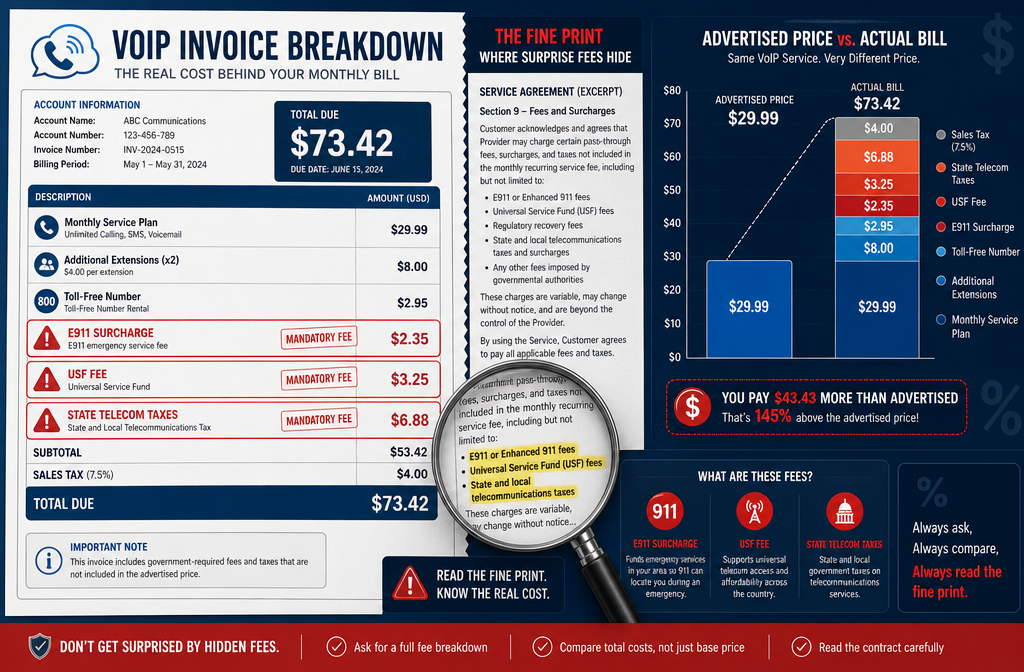
When a VoIP provider quotes “$25 per user per month,” that number almost never includes government-mandated charges. These fees are real, recurring, and non-negotiable — yet they rarely appear in marketing materials.
E911 Fees
Every VoIP line in the United States is subject to Enhanced 911 (E911) charges, which fund state and local emergency dispatch systems. In 2026, these typically run between $0.30 and $2.50 per line per month, depending on the state. New Jersey charges roughly $1.00 per line, while New York sits closer to $0.40 per line. These fees go directly to emergency infrastructure — not to the provider — but they still land on your invoice.
For a business running 50 lines, that’s potentially $25–$125 per month in E911 fees alone, on top of everything else.
Universal Service Fund (USF) Contributions
The Universal Service Fund is a federal program that subsidizes telecom access in rural and low-income areas. VoIP providers pass this cost to customers as a percentage surcharge — typically 7–12% of the pre-tax bill. The exact rate is recalculated quarterly by the FCC, so the percentage can shift without any action on the provider’s part or yours.
💡 Pull Quote: “A 10% USF surcharge on a $500/month VoIP bill adds $600 per year — money most buyers never budgeted for.”
State and Local Telecom Taxes
On top of federal fees, state and local telecom taxes pile on an additional 3.5–9% of the bill, varying dramatically by jurisdiction. A business in a high-tax metro area can easily see combined regulatory overhead of 20–25% above the base rate.
Summary of Common Regulatory Add-Ons:
| Fee Type | Typical Range | Who Receives It |
|---|---|---|
| E911 | $0.30–$2.50/line/month | State/local emergency funds |
| USF Contribution | 7–12% of pre-tax bill | Federal program |
| State/Local Taxes | 3.5–9% of bill | State/local government |
Providers aren’t hiding these fees out of malice — many are legally required to collect them. The problem is that most VoIP marketing focuses on the base rate, leaving customers to discover the full picture on invoice day.
What to do: Ask every prospective provider for a sample invoice that includes all regulatory surcharges for your specific state and number of lines. If they can’t produce one, that’s a red flag. 🚩
Contract Traps, DID Fees, and Add-On Costs That Inflate Your Bill
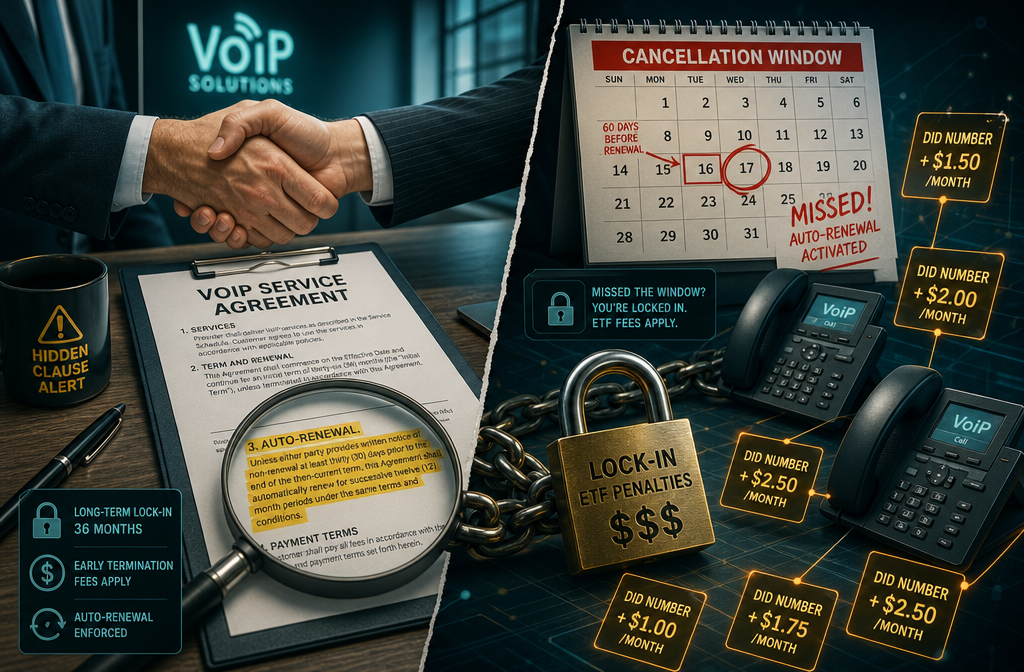
Regulatory fees are unavoidable, but the second major category of VoIP hidden costs what providers don’t tell you is entirely within the provider’s control — and far more negotiable.
Early Termination Fees and Auto-Renewal Clauses
Business VoIP contracts in 2026 commonly run 12–36 months. Buried in the fine print are two expensive traps:
1. Early Termination Fees (ETFs) ETFs for multi-seat business contracts typically range from $1,000 to $10,000, scaled to the number of seats and months remaining in the contract. These fees are rarely mentioned during the sales process and are easy to miss in a dense service agreement.
2. Auto-Renewal Clauses Many providers include automatic renewal language that rolls the contract into a new full term — sometimes 24 or 36 months — if the customer doesn’t submit a cancellation notice within a specific window (often 30–90 days before the contract end date). Miss that window by a single day, and another year or more of fees is locked in.
⚠️ Warning: Month-to-month plans avoid ETFs and auto-renewals but typically cost more per user than annual terms. Weigh the flexibility premium against the cancellation risk before committing.
Per-Number (DID) Fees
Most VoIP pricing is quoted per user — but many businesses need more phone numbers than they have users. Each Direct Inward Dialing (DID) number (a dedicated phone number on the system) often carries its own monthly fee, typically $1–$5 per number per month.
A company with 20 users but 50 published phone numbers (for departments, fax lines, toll-free numbers, etc.) is paying DID fees on 30 extra numbers that never appear in the per-seat quote.
Feature Add-Ons and Tiered Pricing
VoIP providers frequently advertise entry-level plans that exclude features most businesses actually need:
- 📞 Call recording — often a paid add-on
- 📊 Advanced analytics and reporting — premium tier only
- 🔗 CRM integrations — extra monthly fee per integration
- 📠 Efax / virtual fax — separate line item
- 🌍 International calling — per-minute rates that add up fast
The base plan looks affordable. The plan that actually fits the business’s needs can cost 50–80% more.
Hardware and Onboarding Costs
Many providers sell or lease IP desk phones separately, ranging from $80 to $400+ per device. Some charge setup and onboarding fees of $200–$1,000+ for porting existing numbers, configuring the system, or training staff. These one-time costs don’t appear in monthly rate comparisons but significantly affect the true first-year cost.
Checklist: Questions to Ask Before Signing ✅
- What is the fully loaded monthly cost including all regulatory fees for my state?
- What is the ETF if we cancel 6 months early? 12 months early?
- Is there an auto-renewal clause, and what is the notice window?
- Are DID numbers included, or billed separately?
- Which features require a higher tier or add-on fee?
- Are hardware and onboarding costs included or separate?
- Can you provide a sample invoice from a current customer of similar size?
Conclusion: How to Buy VoIP Without Getting Burned
Understanding VoIP hidden costs what providers don’t tell you isn’t about distrust — it’s about asking the right questions before committing. The VoIP market is competitive and genuinely cost-effective for most businesses, but the gap between the advertised price and the actual invoice can be substantial.
Actionable next steps for 2026 buyers:
- Request a fully itemized sample invoice that includes E911, USF, state taxes, and all surcharges for your specific location and line count.
- Calculate your true per-seat cost by adding DID fees, required feature tiers, and hardware costs to the base rate.
- Read every cancellation clause — identify the ETF amount, the auto-renewal window, and the exact notice requirements.
- Compare month-to-month vs. annual plans with the full cost picture, not just the per-seat rate.
- Negotiate — ETFs, onboarding fees, and hardware costs are often negotiable, especially for larger deployments.
The providers who surface these costs upfront are the ones worth doing business with. Transparency at the sales stage is a reliable signal of how they’ll treat you as a customer.