
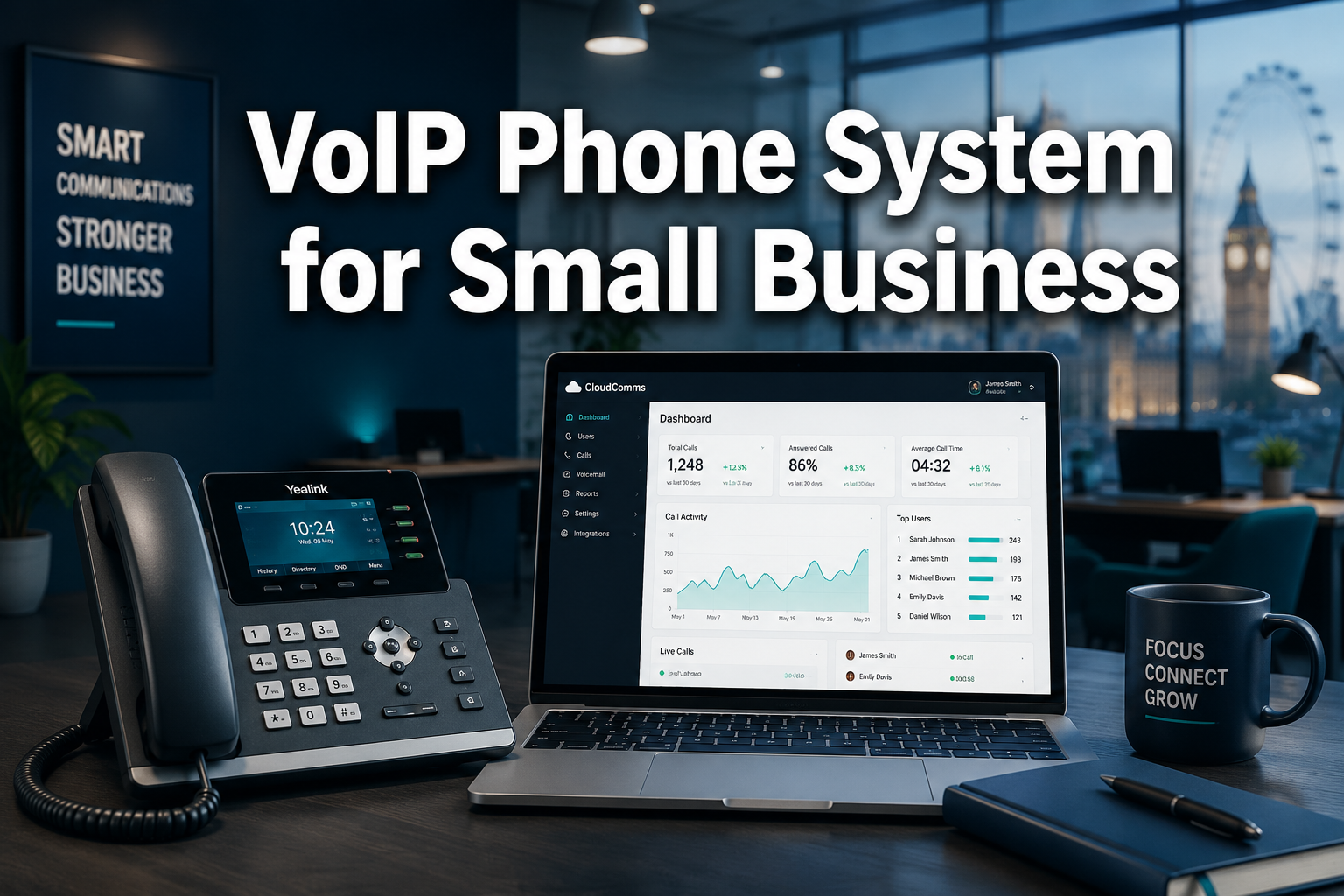
The UK’s traditional PSTN network is being switched off, and BT’s full digital migration is already underway. That means every small business still running an analogue phone line is on borrowed time. Switching to a VoIP phone system for small business isn’t just a smart move in 2026; for many, it’s now a necessity.
VoIP (Voice over Internet Protocol) sends calls over your broadband connection instead of copper phone lines. The result: lower bills, more features, and a phone system that scales with your business rather than fighting against it. The global VoIP market is on track to more than double from $144 billion to over $326 billion by 2032, and small businesses are a major driver of that growth.
This guide cuts through the noise. Whether you’re replacing an ageing desk phone setup or building a phone system from scratch, here’s what actually matters.
Key Takeaways
- 📞 VoIP replaces traditional phone lines with internet-based calling, lower cost, more features, easier to manage.
- 💷 UK small business pricing typically runs £5-£25 per user/month depending on the provider and feature tier.
- ☁️ Cloud-hosted systems require no on-site hardware investment and suit most small businesses with 1-50 users.
- ⚠️ Call quality depends on your broadband: a network audit before switching is essential.
- 🔗 Integration with CRM and helpdesk tools can dramatically improve team productivity and customer experience.
What a VoIP Phone System for Small Business Actually Does
At its core, a VoIP phone system converts your voice into data packets and transmits them over the internet. That’s the technical bit, but what matters for a small business is what you get in practice.
Compared to a traditional landline, a business VoIP system typically includes:
- Auto-attendant (virtual receptionist)
- Call forwarding and routing rules
- Voicemail-to-email transcription
- Mobile and desktop softphone apps
- Video calling and team messaging
- Call recording and analytics
- Multiple direct dial numbers (DDIs)
These aren’t premium add-ons, they’re standard features on most cloud-based communications platforms. A traditional PBX (Private Branch Exchange) system would have cost thousands of pounds to get the same functionality.
For a deeper look at how these features work in practice, see our guide on how to customise your business phone system using VoIP.
Cloud-Based vs On-Premise: Which Setup Suits Small Businesses?
Most small businesses should default to a cloud-hosted (hosted VoIP) system. Here’s why.
With a cloud system, your provider manages all the infrastructure. You pay a monthly per-user fee, log in via an app or desk phone, and you’re up and running, often within a day. There’s no server to buy, no engineer to call out, and no capital expenditure.
On-premise VoIP (where you host the PBX hardware yourself) makes more sense for larger organisations with dedicated IT staff and specific compliance requirements. For a 5-person accountancy firm or a 15-person retail operation, it’s overkill.
| Feature | Cloud VoIP | On-Premise VoIP |
|---|---|---|
| Setup cost | Low (monthly fee) | High (hardware investment) |
| Maintenance | Provider handles it | Your IT team |
| Scalability | Add users instantly | Limited by hardware |
| Remote working | Built-in | Requires extra config |
| Uptime responsibility | Provider SLA | Your infrastructure |
For a thorough breakdown of both options, our cloud vs on-premise VoIP systems guide covers the trade-offs in detail.
What Does a VoIP Phone System for Small Business Cost in the UK?
This is where UK buyers often get frustrated, most pricing guides quote US dollars and US providers. Here’s the UK picture.
Typical UK pricing in 2026:
- Entry-level plans: £5-£10 per user/month, basic calling, voicemail, mobile app
- Mid-tier plans: £12-£18 per user/month, call recording, CRM integration, analytics
- Full unified communications: £20-£30 per user/month, video, team messaging, advanced routing
For a 10-person business on a mid-tier plan, expect to pay roughly £120-£180/month, significantly less than most traditional phone contracts once you factor in line rental and call charges.
As a real-world UK reference point, Halstone Mobile & Technology’s hosted VoIP service gives a sense of what a UK B2B provider charges for a managed VoIP solution, including handsets and support. They’re one example of the kind of regional UK provider that bundles hardware, setup, and ongoing support into a single contract, useful if you’d rather not manage the technical side yourself.
Hidden costs to watch for:
- Number porting fees (moving your existing number to VoIP)
- Hardware costs if you want physical desk phones
- Premium support tiers
- International call rates (check these carefully if you call outside the UK regularly)
The 5 Features That Matter Most for Small Business VoIP
Not every feature in a VoIP brochure is worth paying for. These five consistently deliver real value for small businesses:
1. Auto-attendant Routes callers to the right person or department without a receptionist. Essential for projecting a professional image, even if it’s just you and two colleagues.
2. Mobile softphone app Lets your team take and make business calls from their smartphones using the business number. Critical for hybrid and remote working. Check out our comparison of VoIP phones vs softphones to decide which suits your team.
3. Call recording Useful for compliance, training, and resolving disputes. Many UK regulated industries (financial services, legal) require this.
4. CRM integration Automatically logs calls against customer records. If your team uses HubSpot, Salesforce, or Zoho, this saves significant admin time. Our guide on integrating your CRM with VoIP systems explains how to set this up.
5. Voicemail-to-email Transcribes voicemails and sends them to your inbox. Small detail, but it means missed calls never get missed.
Common Mistakes When Choosing a VoIP Phone System for Small Business
Switching to VoIP is straightforward, but several avoidable mistakes can cause real headaches.
Skipping the network audit. VoIP call quality depends entirely on your broadband. Packet loss above 1% or latency above 150ms will produce choppy, unreliable calls. Before you sign anything, test your connection. Many providers offer free pre-sales assessments.
Underestimating scalability needs. A system that works for 5 users today should handle 20 users in two years without a platform migration. Ask providers directly: what does scaling up cost, and how long does it take?
Ignoring security. VoIP systems are a target for toll fraud, where attackers hijack your system to make expensive international calls at your expense. Reputable providers include encryption and fraud detection as standard, but it’s worth asking. Our guide on how to avoid common VoIP phone system problems covers this in detail.
Choosing on price alone. The cheapest plan often lacks the support quality you’ll need when something goes wrong. A provider with 24/7 UK-based support is worth a few extra pounds per user per month.
Forgetting about number porting. Moving your existing business number to a new VoIP provider takes time, typically 5-10 working days in the UK. Plan ahead to avoid any gap in service.
Setting Up a VoIP Phone System: What to Expect
For most small businesses, setup follows a predictable path:
- Choose your provider and plan: based on user count, features needed, and budget
- Audit your internet connection: confirm sufficient bandwidth (roughly 100kbps per concurrent call)
- Port your existing numbers, or get new DDI numbers assigned
- Configure your system: call routing, auto-attendant, voicemail, user accounts
- Deploy devices: softphone apps, desk phones, or both
- Test before going live: internal calls, inbound calls, voicemail, forwarding rules
Most cloud providers offer onboarding support. For a step-by-step walkthrough, our guide on how to set up a virtual phone system with VoIP is a practical starting point.
💡 Quick tip: Run VoIP on a separate VLAN (virtual network segment) from your general office traffic if possible. It prioritises call quality and prevents large file downloads from degrading your calls.
Is VoIP Reliable Enough for Business-Critical Calls?
Short answer: yes, provided your broadband is solid. Modern cloud VoIP platforms routinely offer 99.99% uptime SLAs, which equates to less than an hour of downtime per year.
The weak point is almost always the local internet connection, not the provider’s platform. A backup 4G/5G router that automatically kicks in if your main broadband drops is a sensible investment for businesses where phone availability is critical.
AI is also changing what’s possible. Modern VoIP platforms increasingly support AI voice agents that handle inbound calls, answer common queries, and route complex issues to the right person, reducing pressure on small teams during busy periods.
For businesses concerned about continuity, our VoIP disaster recovery guide covers failover options in detail.
FAQ: VoIP Phone Systems for Small Business
Q: Can I keep my existing business phone number when switching to VoIP? Yes. Number porting lets you transfer your current number to a VoIP provider. It typically takes 5-10 working days in the UK. Most providers handle the process for you.
Q: Do I need new phones, or can I use existing handsets? It depends. Many modern IP desk phones work with VoIP out of the box. Older analogue handsets need an ATA (Analogue Telephone Adapter) to connect. Alternatively, softphone apps on laptops and mobiles mean you may not need desk phones at all.
Q: What internet speed do I need for VoIP? Each simultaneous call uses roughly 100kbps of bandwidth. A 10Mbps broadband connection can comfortably handle 10+ concurrent calls, most small businesses are well within this range. Latency and packet loss matter more than raw speed.
Q: Is VoIP secure for business use? Yes, when properly configured. Look for providers offering TLS/SRTP encryption, two-factor authentication, and fraud monitoring. Avoid providers that don’t mention security features at all.
Q: What happens to my calls if the internet goes down? Most providers offer call forwarding to a mobile number as a failover. Some support 4G backup routers. It’s worth configuring this before you need it.
Q: Are there VoIP-specific considerations for UK regulated industries? Yes. Financial services, legal, and healthcare businesses often have call recording and data retention obligations. Confirm your provider stores recordings on UK or EU servers and offers compliant data handling.
Conclusion: Making the Switch in 2026
A VoIP phone system for small business delivers genuine advantages over traditional phone lines: lower costs, better features, and a system that grows with your business. With the UK’s PSTN switch-off accelerating, the question for most small businesses isn’t whether to move to VoIP, but when and with which provider.
Actionable next steps:
- Audit your broadband: test for latency and packet loss before committing to any provider
- List your must-have features: auto-attendant, call recording, CRM integration, mobile app
- Get quotes from at least three UK providers: compare total cost including hardware, setup, and support
- Check our best UK VoIP provider guide for a shortlist of vetted options
- Plan your number port: give yourself 2 weeks’ lead time to avoid any service gap
The right VoIP system won’t just replace your phone line. It’ll make your business easier to reach, easier to run, and more professional from day one.