
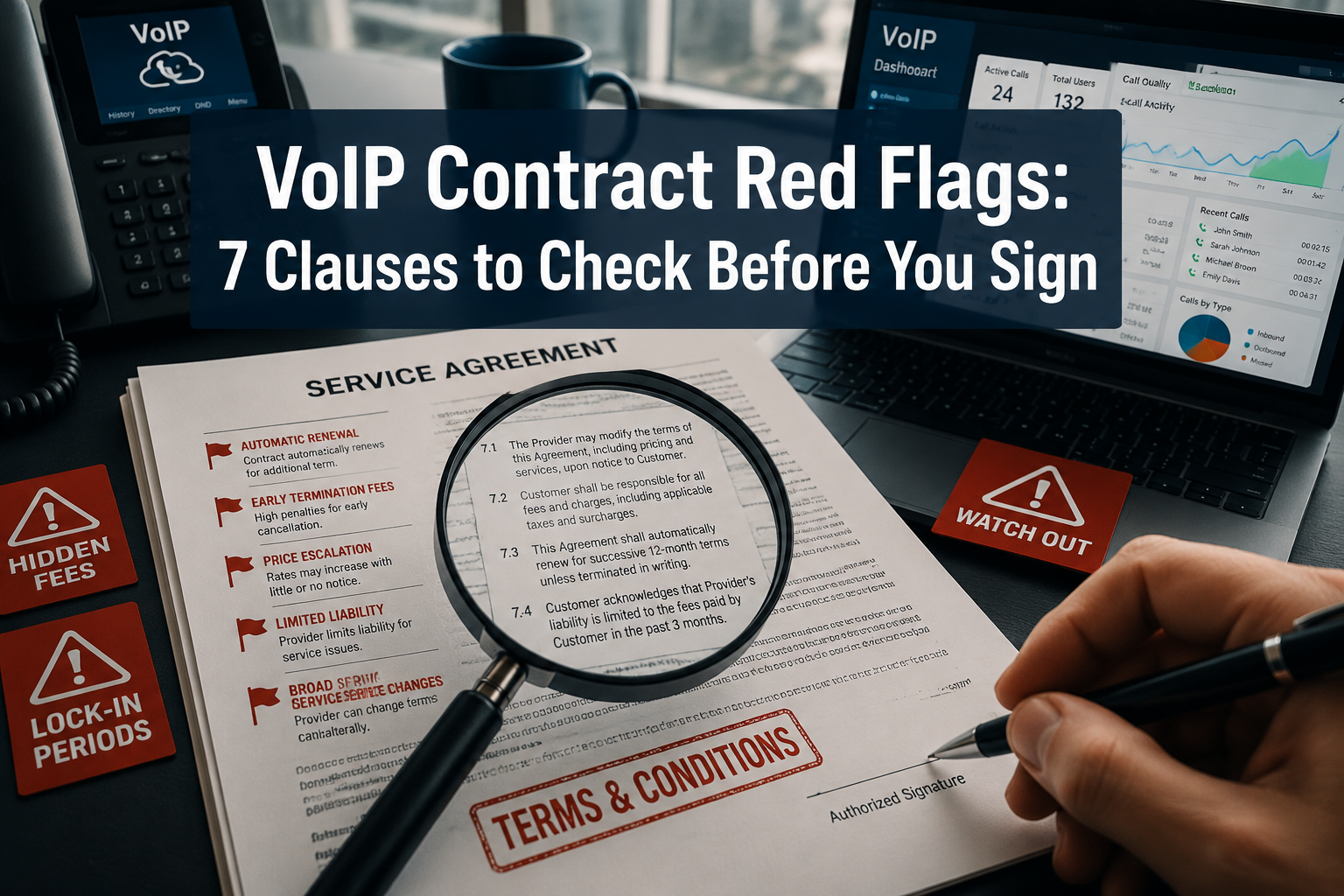
A 2024 telecommunications industry study found that 68% of businesses who switched VoIP providers cited “unexpected contract terms” as a major pain point, and 43% paid early termination fees they didn’t know existed. The contract you’re about to sign for your business phone system might lock you into years of escalating costs, poor service with no recourse, and surprise fees that weren’t discussed during the sales pitch.
VoIP contract red flags aren’t always obvious. Sales reps focus on features and monthly pricing, but the fine print determines whether you’re getting a flexible, cost-effective phone solution or a binding agreement that becomes a liability. Before you commit your business communications to any provider, understanding these critical contract clauses can save thousands of dollars and countless headaches.
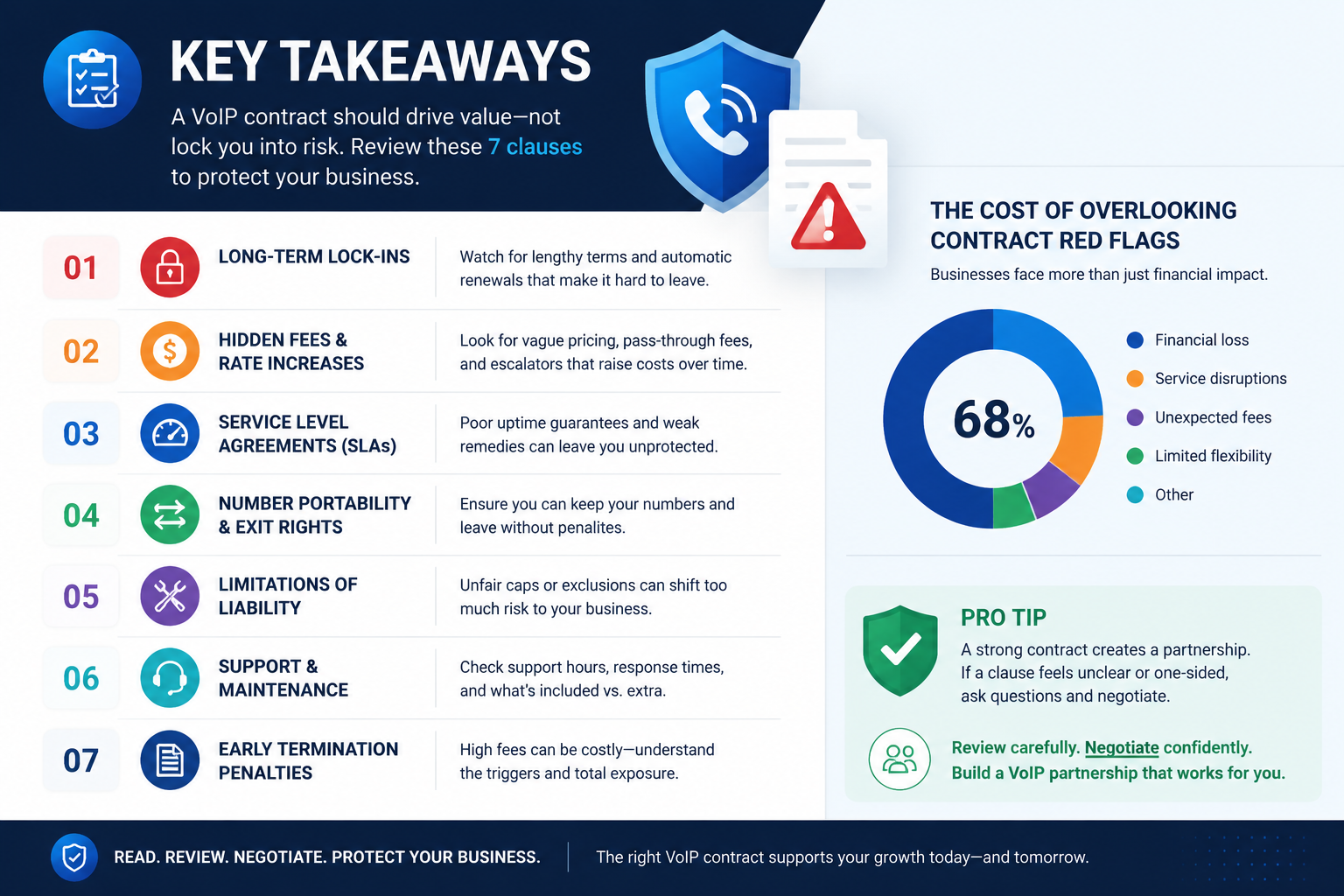
This guide breaks down the seven most important voip contract red flags that business owners and IT decision-makers need to scrutinize before signing. These aren’t theoretical concerns, they’re the actual clauses that trap businesses into unfavorable terms, limit your ability to scale, and create friction when you need to cancel your VoIP contract or switch providers.
Key Takeaways
- Auto-renewal clauses can lock you into multi-year extensions with only narrow cancellation windows, often requiring 60 to 90 days’ notice
- Vague SLA language without specific uptime guarantees, compensation structures, and exclusion limits leaves you unprotected during outages
- Hidden fees for number porting, setup, regulatory compliance, and support can add 30% to 50% to your actual monthly costs
- Restrictive termination terms including steep early termination fees and equipment buyout requirements make switching providers prohibitively expensive
- Ownership ambiguities around phone numbers, call data, and recordings can prevent you from taking your business assets when you leave
1. Auto-Renewal and Evergreen Clauses
Auto-renewal clauses automatically extend your VoIP contract for another term, often matching the original length, unless you provide written cancellation notice within a specific window. This seemingly convenient feature is one of the most common voip contract red flags that catches businesses off guard.
What makes auto-renewal problematic:
The typical auto-renewal clause requires 60 to 90 days’ advance written notice before your contract anniversary date. Miss that window by even one day, and you’re locked in for another full term, usually one to three years. Many providers send renewal notices buried in monthly invoices or generic email updates that get overlooked.
Some contracts include “evergreen” provisions that automatically renew indefinitely until you actively cancel. Unlike fixed-term renewals, evergreen agreements continue month-to-month or year-to-year without any natural endpoint, making it easy to forget you’re still bound by the original terms.
Red flags to watch for:
- Renewal notice windows shorter than 60 days
- Automatic price increases upon renewal (often 5% to 15% annually)
- Conversion from monthly to annual terms after the initial period
- Lack of clear instructions on how to provide cancellation notice
- Requirements for certified mail or specific cancellation forms
What to negotiate:
Request a 90-day cancellation window minimum, and push for 30 days if you’re signing a month-to-month agreement. Insist on email confirmation of received cancellation notices. Better yet, negotiate a fixed-term contract that converts to true month-to-month after the initial period, giving you flexibility without automatic multi-year extensions.
For businesses evaluating VoIP for small business needs, flexibility matters more than long-term commitments, especially as your communications requirements evolve.
2. Vague Service Level Agreements (SLAs)
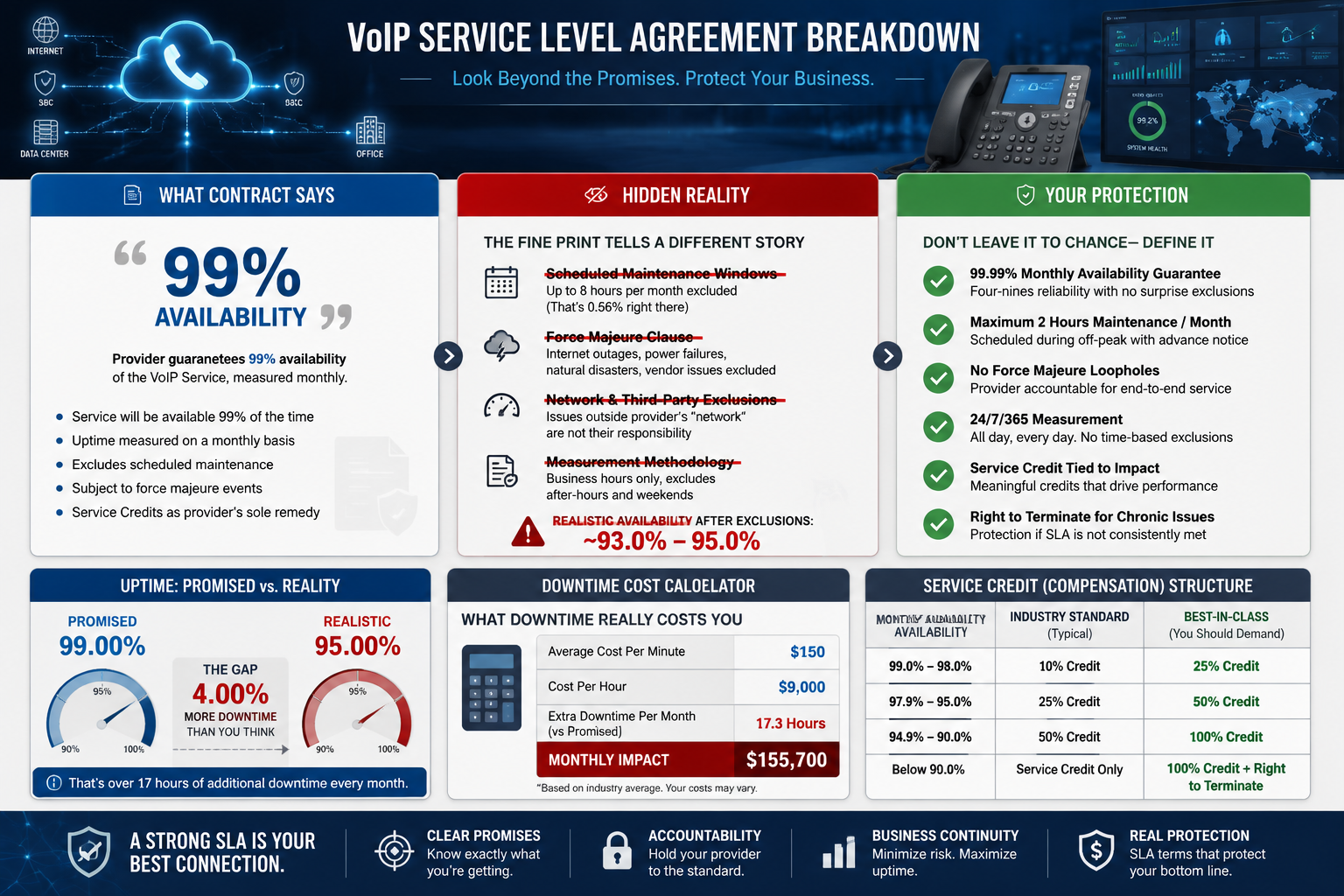
Service Level Agreements define the reliability standards your VoIP provider commits to, and what happens when they fail to meet them. Vague or weak SLA language is a critical voip contract red flag that leaves you without recourse during outages that disrupt your business operations.
What strong SLAs should include:
A legitimate SLA for business phone systems specifies:
- Uptime percentage: Industry standard is 99.9% (43 minutes of downtime per month) or better
- Measurement methodology: How uptime is calculated and what counts as an outage
- Exclusions: Scheduled maintenance windows, force majeure events, and third-party failures
- Compensation structure: Service credits or refunds when uptime falls below the guarantee
- Response times: How quickly the provider will acknowledge and address reported issues
Common SLA red flags:
Many VoIP contracts include uptime “goals” or “targets” rather than guarantees, language that sounds similar but creates no obligation. Watch for:
- Phrases like “commercially reasonable efforts” or “best endeavors” instead of specific commitments
- Uptime calculations that exclude maintenance windows without defining their frequency or duration
- SLA credits that require you to request them within unreasonably short timeframes (like 5 to 7 days)
- Compensation caps that limit total credits to one month’s service fee, regardless of outage severity
- Exclusions for “circumstances beyond our control” without defining what qualifies
Why this matters for reliable connectivity:
A business phone system outage doesn’t just inconvenience your team, it costs real money. If your sales team can’t take calls, customer support goes dark, or clients can’t reach you, every hour of downtime translates to lost revenue and damaged reputation.
Without a strong SLA, you have no leverage when service fails. The provider faces no financial consequences, and you’re left paying full price for unreliable service. For businesses relying on VoIP for customer support, this risk is unacceptable.
What to negotiate:
Push for 99.9% uptime minimum with clearly defined measurement periods (monthly, not annually). Ensure compensation is automatic, not request-based, and scales with the severity of the outage. Limit exclusions to genuinely uncontrollable events, and cap scheduled maintenance at specific hours per month with advance notice requirements.
3. Hidden Fees and Unclear Pricing Structures
The monthly per-user price your sales rep quotes rarely reflects your actual VoIP costs. Hidden fees and unclear pricing structures represent some of the most financially damaging voip contract red flags, often adding 30% to 50% to your expected monthly bill.
Common hidden fees in VoIP contracts:
- Number porting fees: $5 to $25 per number to transfer your existing business numbers to the new provider
- Setup and activation charges: One-time fees ranging from $50 to $500+ depending on system complexity
- Regulatory compliance fees: Monthly charges for E911 service, STIR/SHAKEN compliance, and telecommunications taxes
- Support fees: Charges for phone or email support beyond basic troubleshooting, or premium support tiers
- Feature add-ons: Call recording, advanced analytics, CRM integrations, and other capabilities marketed as “included” but actually requiring paid upgrades
- Equipment costs: Desk phones, headsets, and adapters that aren’t included in the base price
- International calling: Per-minute charges for calls outside your included regions
- Overage fees: Charges when you exceed included minutes, users, or call volume
How pricing ambiguity manifests:
Many VoIP providers advertise attractive per-user monthly rates but structure contracts with:
- Base pricing that only includes limited features, with essential capabilities requiring paid tiers
- “Regulatory recovery fees” that aren’t taxes but provider-imposed charges to recoup their compliance costs
- Annual price escalation clauses allowing 5% to 10% increases without requiring contract renegotiation
- Minimum user commitments that charge you for unused seats
- Separate pricing for inbound and outbound calling
What to demand in writing:
Request an itemized quote showing all fees, not just the base per-user rate. Specifically ask about:
- Total cost for your first month including all setup and activation fees
- Ongoing monthly cost including all regulatory fees and required add-ons
- Number porting costs for your existing business numbers
- Equipment requirements and associated costs
- Support tier included in base pricing and costs for premium support
Get confirmation that pricing is locked for your contract term, and understand exactly what triggers price increases. For businesses monitoring VoIP usage and costs, transparent pricing is essential for accurate budgeting.
4. Restrictive Termination Terms and ETFs
Early Termination Fees (ETFs) and restrictive cancellation terms are voip contract red flags that can trap you with an underperforming provider. These clauses make switching providers so expensive that businesses tolerate poor service rather than pay the exit costs.
How ETFs are structured:
Most multi-year VoIP contracts include early termination fees calculated as:
- Remaining contract value: You pay 50% to 100% of all remaining monthly fees through the contract end date
- Flat penalty: Fixed fee ranging from $500 to $5,000+ depending on contract size
- Per-user charges: $100 to $500 per user/line for early termination
- Equipment buyout: Full retail value of any provided hardware, even if it’s been in use for years
A three-year contract at $40 per user for 20 users ($800/month) could carry an ETF of $14,400 to $28,800 if you cancel after year one, a prohibitive cost that effectively locks you in regardless of service quality.
Additional termination restrictions:
Beyond financial penalties, watch for:
- Notice requirements: 60 to 90 days’ written notice even when paying ETFs
- Number porting restrictions: Delays or fees for porting your numbers to a new provider during the termination period
- Data access limitations: Restricted access to call logs, recordings, and analytics after notice is given
- Equipment return requirements: Strict timelines and conditions for returning hardware, with charges for missing or damaged items
Why this matters:
Business needs change. You might outgrow your current system, need features your provider doesn’t offer, or experience service quality issues that make the relationship untenable. Restrictive termination terms remove your negotiating leverage, the provider knows you can’t afford to leave, eliminating their incentive to resolve problems or offer competitive pricing.
What to negotiate:
Push for month-to-month terms after an initial commitment period, or negotiate ETFs that decline monthly (pro-rated based on time remaining). Request performance-based termination clauses that waive fees if the provider fails to meet SLA commitments. At minimum, cap ETFs at three to six months of service fees rather than the full remaining contract value.
For businesses switching to VoIP from traditional systems, understanding exit terms before you enter is crucial.
5. Number Portability and Ownership Issues
Your business phone numbers are valuable assets tied to your brand, marketing materials, and customer relationships. Ambiguous language around number portability and ownership represents a critical voip contract red flag that can hold your business hostage.
What number portability means:
Number portability is your legal right to take your phone numbers with you when switching providers. The FCC mandates this for most business numbers, but VoIP contracts can create obstacles through:
- Porting fees: Charges ranging from $5 to $50 per number to release them to a new provider
- Administrative delays: Requiring 30 to 60 days’ notice before initiating porting, extending your overlap period with two providers
- Account status requirements: Refusing to port numbers if your account has any outstanding balance, even disputed charges
- Technical restrictions: Claiming certain numbers (particularly toll-free or vanity numbers) are “provider-owned” and non-portable
Ownership ambiguities to watch for:
Some VoIP contracts include language suggesting:
- Numbers are “licensed” to you rather than owned, implying they revert to the provider when you leave
- The provider can reclaim numbers after a certain period of inactivity or non-payment
- You must maintain service for a minimum period before numbers become portable
- Porting requires completion of the full contract term or payment of ETFs
Beyond phone numbers:
Number ownership isn’t the only asset concern. Also clarify:
- Call recordings: Who owns recordings of customer calls, and can you export them when leaving?
- Call data and analytics: Can you extract historical call logs, metrics, and reports?
- Voicemail recordings: Are voicemails exportable, or do they remain on the provider’s system?
- Contact lists and directories: Can you export user directories and contact information?
What to demand in writing:
Your contract should explicitly state that you own your phone numbers and can port them at any time with reasonable notice (5 to 10 business days maximum). Porting fees should be clearly disclosed upfront, and the provider should commit to cooperating with the new carrier to complete transfers within FCC-mandated timeframes.
Ensure you have unrestricted access to export all call data, recordings, and business information at any time, with no restrictions upon termination. For businesses concerned about avoiding common VoIP problems, clear ownership terms prevent future complications.
6. Forced Equipment Purchases and Vendor Lock-In
Equipment requirements and compatibility restrictions create vendor lock-in that limits your flexibility and increases costs. These voip contract red flags tie you to specific hardware that may become obsolete or incompatible with other systems.
How equipment lock-in works:
VoIP providers use several tactics to create dependency:
- Proprietary hardware: Requiring desk phones that only work with their system, preventing you from using existing equipment or switching providers without replacing everything
- Leasing arrangements: Monthly equipment fees that continue indefinitely, often costing more than purchasing outright
- Bundled pricing: Contracts that include equipment costs in the monthly rate but require hardware return upon termination
- Firmware restrictions: Locking phone firmware to their network, making devices unusable with other providers
Financial implications:
A business with 20 users might face:
- $150 to $300 per desk phone for proprietary hardware ($3,000 to $6,000 total)
- $10 to $20 per month per phone for leasing ($200 to $400 monthly, $7,200 to $14,400 over three years)
- Replacement costs when switching providers if current hardware is incompatible
- Buyout fees if you want to own leased equipment
What to look for:
Contracts should clearly specify:
- Whether equipment is purchased, leased, or included in monthly pricing
- Ownership terms, when does leased equipment become yours?
- Compatibility with standard SIP protocols, allowing use with other providers
- Options to use your existing hardware or third-party devices
- Equipment return requirements and associated fees upon termination
The BYOD alternative:
The best VoIP contracts support Bring Your Own Device (BYOD) policies, allowing you to use:
- Standard SIP-compatible desk phones from any manufacturer
- Softphone applications on computers and mobile devices
- Your existing hardware if it meets technical requirements
This flexibility prevents vendor lock-in and reduces costs. For businesses exploring how to customize your business phone system, equipment flexibility is essential.
What to negotiate:
Push for contracts that support standard SIP devices and don’t require proprietary hardware. If equipment purchase is required, ensure you own it outright with no return obligations. For leasing arrangements, negotiate reasonable buyout terms (typically 10% to 20% of remaining lease value) and confirm equipment becomes yours after a defined period.
7. Vague Support and Maintenance Terms
When your business phone system fails, response time matters. Vague support and maintenance terms are voip contract red flags that leave you without help when you need it most, potentially causing extended outages that impact revenue and customer relationships.
What comprehensive support terms should include:
- Support hours: 24/7/365 availability for critical issues, or clearly defined business hours
- Response time commitments: How quickly the provider acknowledges support tickets by severity level
- Resolution timeframes: Target times for resolving different issue categories
- Support channels: Phone, email, chat, and portal access included in base pricing
- Escalation procedures: Clear path to escalate unresolved issues to senior technical staff
- Dedicated support contacts: Named account managers or technical contacts for larger deployments
Common support red flags:
Many VoIP contracts include support language that sounds comprehensive but lacks substance:
- “Business hours support” without defining those hours or timezone
- “Best effort” response times with no specific commitments
- Support limited to email or portal tickets, with phone support requiring premium tiers
- Charges for support beyond “basic troubleshooting” without defining what qualifies
- No guaranteed response times for critical outages affecting all users
- Maintenance windows that can occur anytime without advance notice
The premium support trap:
Some providers structure contracts with:
- Basic support that only covers account and billing questions
- Technical support requiring paid upgrades ($50 to $200+ per month)
- Per-incident charges for phone support ($100 to $300 per call)
- “Priority support” tiers that simply mean you get any support at all
This creates situations where you’re paying for cloud-based communications but can’t get help when problems arise without additional fees.
Maintenance and update terms:
Also scrutinize:
- Scheduled maintenance frequency: How often and how long will service be unavailable?
- Advance notice: How much warning do you get before maintenance windows?
- Update procedures: Are system updates automatic, or do they require your action and potentially cause downtime?
- Testing requirements: Does the provider test updates before deployment, or are you the beta tester?
What to negotiate:
Demand 24/7 phone support for critical issues (complete service outages) included in base pricing, with response time commitments of 15 to 30 minutes. For less urgent issues, business hours support with 2 to 4 hour response times is reasonable.
Require 7 to 14 days’ advance notice for scheduled maintenance, limited to off-peak hours (evenings or weekends), and capped at a specific number of hours per month. Ensure you have a dedicated account contact who understands your setup and can expedite issue resolution.
For businesses using VoIP in call centers or other mission-critical applications, comprehensive support terms are non-negotiable.
How to Protect Yourself: Contract Review Checklist
Before signing any VoIP contract, use this checklist to identify voip contract red flags:
✅ Term and Renewal
- Contract length clearly stated (month-to-month, annual, multi-year)
- Auto-renewal terms and cancellation notice window specified
- Conversion to month-to-month after initial term (if applicable)
- Price lock guarantee for contract duration
✅ Pricing and Fees
- Itemized pricing showing all fees, not just base rate
- Number porting costs disclosed
- Setup and activation fees specified
- Equipment costs (purchase or lease) detailed
- Support tier included in base pricing confirmed
- Overage charges and limits clearly defined
✅ Service Level Agreement
- Specific uptime percentage guaranteed (99.9% or better)
- Measurement methodology explained
- Compensation structure for SLA violations defined
- Exclusions and maintenance windows limited and specified
- Response time commitments for support issues
✅ Termination Terms
- Early termination fees calculated and capped reasonably
- Notice requirements for cancellation specified
- Number porting process and timeline during termination
- Equipment return requirements and fees
- Data export rights upon termination
✅ Ownership and Portability
- Phone number ownership explicitly confirmed
- Porting rights and fees clearly stated
- Call recording and data ownership specified
- Export capabilities for all business data
✅ Equipment and Compatibility
- Equipment requirements and costs detailed
- BYOD and third-party device support confirmed
- Ownership terms for purchased or leased equipment
- Compatibility with standard SIP protocols
✅ Support and Maintenance
- Support hours and channels included in base pricing
- Response time commitments by issue severity
- Escalation procedures defined
- Maintenance window frequency and advance notice requirements
FAQ
What are the biggest voip contract red flags I should watch for?
The most critical voip contract red flags are auto-renewal clauses with short cancellation windows (less than 60 days), vague SLA language without specific uptime guarantees and compensation, hidden fees that aren’t disclosed in initial pricing, and restrictive early termination fees that make switching providers prohibitively expensive. Also watch for ambiguous number ownership terms and equipment lock-in requirements.
How long should a VoIP contract be?
For most small to mid-sized businesses, one-year contracts that convert to month-to-month afterward offer the best balance of commitment and flexibility. Avoid multi-year contracts (two to three years) unless you receive significant pricing discounts and have strong confidence in the provider. Month-to-month agreements provide maximum flexibility but often come with higher per-user rates.
Can I negotiate VoIP contract terms?
Yes, most VoIP contract terms are negotiable, especially for businesses with 10+ users. You can typically negotiate cancellation notice windows, early termination fee caps, SLA specifics, pricing locks, and support terms. Providers are often willing to modify standard contracts to close deals, particularly if you’re switching from a competitor or represent a larger account.
What happens to my phone numbers if I cancel my VoIP service?
You have the legal right to port your phone numbers to a new provider under FCC regulations. However, VoIP contracts may impose porting fees ($5 to $50 per number), require advance notice (5 to 30 days), and delay the process if you have outstanding balances. Ensure your contract explicitly confirms number ownership and reasonable porting terms before signing.
Are early termination fees legal in VoIP contracts?
Yes, early termination fees are legal in commercial VoIP contracts. However, they should be reasonable and clearly disclosed before signing. ETFs typically range from 50% to 100% of remaining contract value, or flat fees based on contract size. You can negotiate lower ETFs, pro-rated structures that decline monthly, or performance-based waivers if the provider fails to meet SLA commitments.
What should I do if I’ve already signed a contract with red flags?
Review your contract for performance-based termination clauses, if the provider fails to meet SLA commitments, you may have grounds to exit without penalties. Document all service issues, response times, and SLA violations. Contact the provider to negotiate modified terms, especially if you’re experiencing significant problems. As a last resort, consult with a business attorney about your options, particularly if the provider misrepresented terms during the sales process.
Conclusion
VoIP contract red flags aren’t just legal technicalities, they’re the difference between a flexible, cost-effective phone solution and a binding agreement that becomes a liability. The seven clauses covered in this guide represent the most common traps that catch businesses off guard: auto-renewal terms that lock you in, vague SLAs that provide no protection, hidden fees that inflate costs, restrictive termination terms that prevent switching, number ownership ambiguities, equipment lock-in, and inadequate support commitments.
Before signing any VoIP contract in 2026, take the time to scrutinize these specific areas. Request modifications to unfavorable terms, most providers will negotiate rather than lose a deal. Get all verbal promises in writing, and don’t let sales pressure rush you into signing without thorough review.
Your next steps:
- Review your current contract (if applicable) using the checklist above to identify any red flags affecting your business
- Request detailed quotes from prospective providers showing all fees, not just base pricing
- Compare SLA terms across providers to identify who offers the strongest commitments
- Negotiate modifications to any unfavorable clauses before signing
- Consult with legal counsel for contracts involving significant commitments or complex terms
The right business phone system should support your growth, not constrain it. By identifying and addressing voip contract red flags before you sign, you protect your business from costly surprises and maintain the flexibility to adapt as your communications needs evolve.
For more guidance on making informed VoIP decisions, explore our complete guide to VoIP contract considerations and learn how to troubleshoot common VoIP issues to ensure reliable connectivity.