

By January 31, 2027, every traditional phone line in the UK will go dark. BT Openreach has confirmed the full decommissioning of the Public Switched Telephone Network (PSTN) and ISDN, the copper-wire infrastructure that has carried UK business calls for decades. Yet roughly 69% of UK businesses are still running on legacy systems. If yours is one of them, the clock is ticking.
Switching your business phone line to VoIP in the UK isn’t just about compliance – it’s a genuine opportunity to cut costs, unlock better features, and build a more flexible communications setup. This guide walks you through exactly how to do it, what to watch for, and how to get it right the first time.
Key Takeaways
- 📅 The PSTN/ISDN switch-off deadline is January 31, 2027: all UK businesses must migrate before then.
- 💰 Most businesses save 30-50% on total phone costs after switching to VoIP.
- 📞 You can keep your existing phone numbers through a regulated porting process (typically 5-10 working days).
- 🌐 A standard broadband connection is sufficient: each VoIP call uses just 80-100 kbps.
- ✅ Migration can be completed in as little as two weeks with the right preparation.
Why Switching Business Phone Line to VoIP UK Is Now Urgent
The PSTN switch-off isn’t a rumour or a distant concern, Ofcom has confirmed it, and BT Openreach has been executing a phased withdrawal since 2023. Any business still on a traditional landline or ISDN circuit will lose service when the deadline hits.
Beyond compliance, the financial case is hard to ignore. Traditional landlines carry line rental, per-minute call charges, and hardware maintenance costs that VoIP simply doesn’t. Businesses that make the switch typically report savings of 30-50% on their total phone bill, not through cutting corners, but because VoIP eliminates the infrastructure overhead entirely.
VoIP isn’t just a cheaper version of what you already have. It’s a fundamentally better way to run business communications.
VoIP (Voice over Internet Protocol) routes calls over your existing broadband connection instead of a dedicated copper line. That means no separate line rental, calls that are often free between offices, and a system that scales up or down without an engineer visit.
For a deeper look at why this shift makes sense beyond just the deadline, see why VoIP is essential for small business growth.
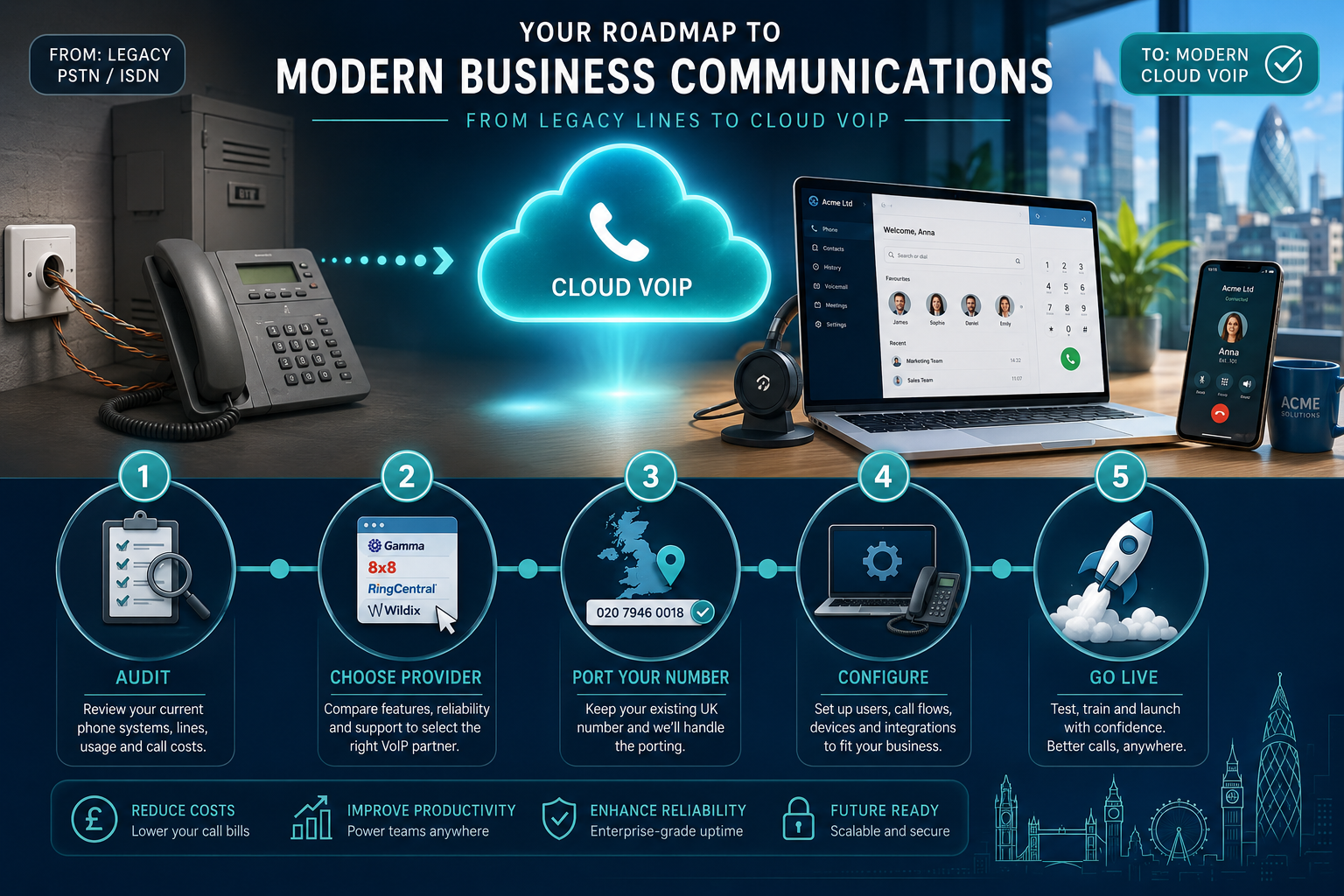
What You Need Before You Start the Switch
Getting the migration right starts with an honest audit of your current setup. Rushing straight to a provider comparison without this groundwork is one of the most common, and costly, mistakes businesses make.
1. Audit Your Current Phone Infrastructure
List every phone line your business uses, including:
- Main office lines and DDI (Direct Dial In) numbers
- Fax machines
- Card payment terminals (PDQ machines)
- Alarm systems or door entry systems connected to a phone line
This matters because fax machines, alarms, and some card terminals don’t work reliably over VoIP. You’ll need to discuss alternatives with your provider, usually a dedicated analogue telephone adapter (ATA) or a fully digital replacement.
2. Check Your Broadband Connection
VoIP doesn’t demand a superfast connection. Each call uses approximately 80-100 kbps, so a 10 Mbps broadband line can comfortably handle 10 simultaneous calls with bandwidth to spare. What matters more than raw speed is consistency and low latency.
Run a speed and latency test during peak business hours. If you’re regularly seeing latency above 150ms or significant packet loss, address that before migrating, not after. For specifics, our guide on what internet speed you need for VoIP covers the numbers in detail.
3. Decide on Hardware vs. Softphones
You have two main options for how staff will make and receive calls:
| Option | What It Is | Best For |
|---|---|---|
| Desk IP phones | Physical VoIP-enabled handsets | Reception, customer service, fixed desks |
| Softphones | App on laptop or mobile | Remote workers, flexible teams |
| Hybrid | Mix of both | Most SMEs |
Both work well. The right choice depends on how your team works. For a balanced breakdown, see VoIP phones vs softphones: pros and cons.
How to Switch Your Business Phone Line to VoIP UK: Step by Step
Step 1: Choose the Right VoIP Provider
Not all business VoIP providers are equal. Evaluate them on:
- UK-based support: critical when something goes wrong
- Uptime SLA: look for 99.9% or better
- Number porting support: they should handle this for you
- Scalability: can you add lines without a new contract?
- Integrations: CRM, Microsoft Teams, helpdesk software
For a full breakdown of the UK market, the best UK VoIP provider for small business guide is a solid starting point.
Don’t choose on price alone. A provider saving you £5/month per line that drops calls or takes three days to answer support tickets will cost you far more in lost business.
Step 2: Port Your Existing Numbers
Keeping your business phone numbers is non-negotiable for most companies. The good news: number porting is a regulated process in the UK, and you’re entitled to take your numbers with you.
The process typically takes 5-10 working days and involves:
- Providing your current provider’s account details to your new VoIP provider
- Submitting a porting request (your new provider handles this)
- A brief switchover window, usually scheduled outside business hours
Your new provider manages the technical side. Your job is to ensure you don’t cancel your existing service before porting is complete. For a detailed timeline, see the complete guide to VoIP number porting.
Step 3: Configure Your System
Once porting is underway, your provider will configure the system. This includes:
- Setting up hunt groups (call queues that ring multiple phones)
- Configuring auto-attendant / IVR menus (“Press 1 for sales…”)
- Voicemail-to-email routing
- Call recording (if required)
- Mobile and desktop app setup for remote workers
This is also the point to think about how you want to customise your business phone system – VoIP gives you far more control than a traditional PBX ever did.
Step 4: Test Before You Go Live
Never cut over on a Monday morning without testing. Run parallel systems for a few days if possible, keep the old lines active while testing the new VoIP setup with internal calls and controlled external tests.
Check:
- ✅ Call quality on all handsets and softphones
- ✅ Inbound calls reaching the right extensions
- ✅ Voicemail and call recording working correctly
- ✅ Mobile apps functioning on 4G/5G (not just Wi-Fi)
Step 5: Train Your Team and Go Live
VoIP systems are generally more intuitive than legacy PBX hardware, but a 30-minute walkthrough for staff prevents unnecessary frustration. Cover the basics: transferring calls, accessing voicemail, using the mobile app, and who to contact if something isn’t working.
For a broader view of what the transition experience looks like, switching to VoIP: what to expect during transition is worth reading before go-live day.
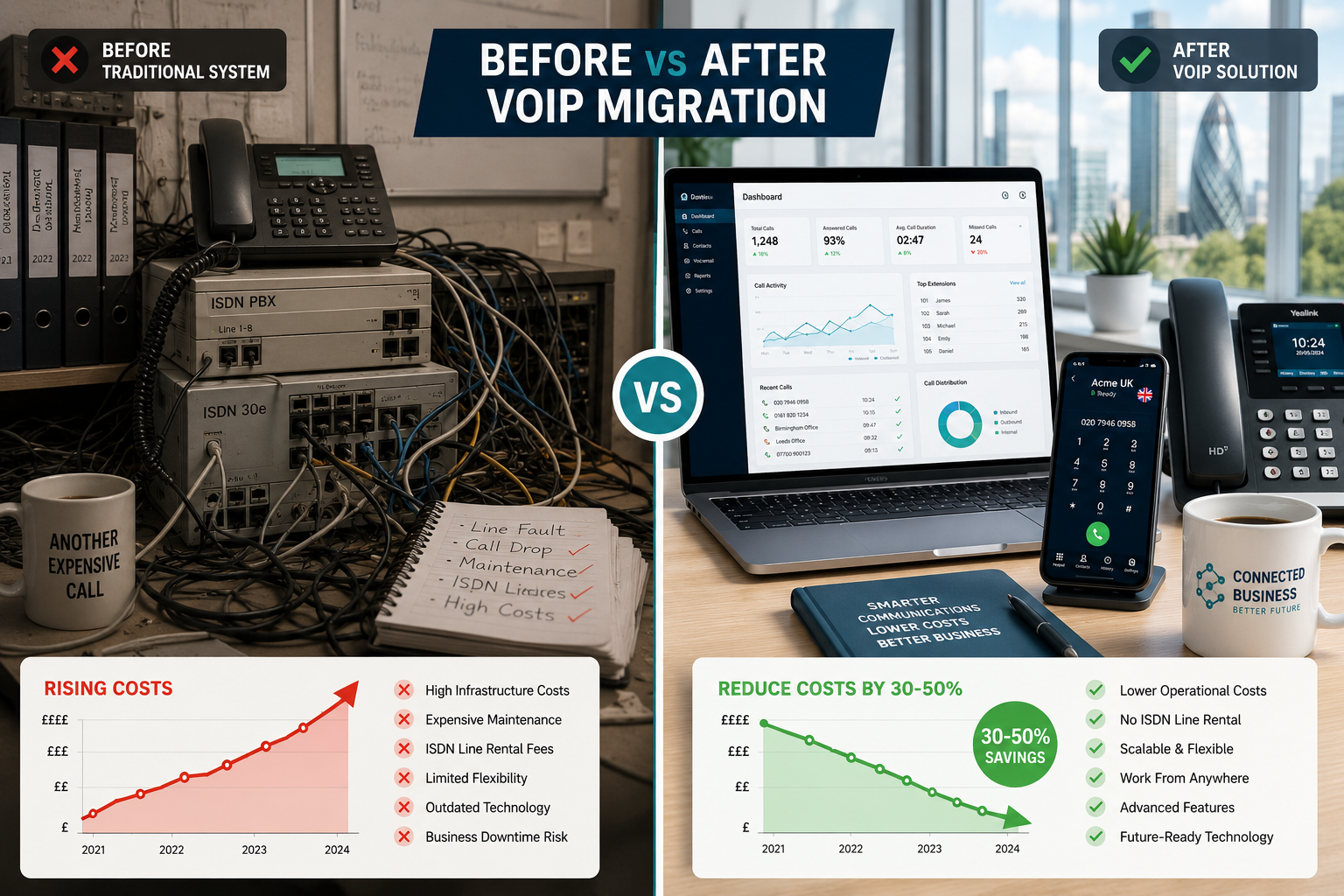
The Real Costs of Switching to VoIP
Here’s an honest breakdown of what switching business phone lines to VoIP in the UK typically costs:
| Cost Item | Traditional Landline | VoIP |
|---|---|---|
| Line rental (per line/month) | £15-£30 | £0 (uses existing broadband) |
| Per-user/extension (per month) | N/A | £8-£25 |
| UK landline calls | Varies; often bundled | Often included free |
| Hardware (IP phones) | N/A (existing) | £40-£150 per handset (one-off) |
| Maintenance / engineer visits | Regular cost | Minimal (cloud-managed) |
The hardware cost is a one-off. Ongoing savings typically outweigh it within 6-12 months for most SMEs.
Choosing a Provider Who Manages the Handover
The technical side of migrating from a traditional landline to VoIP, especially when analogue equipment like alarms or payment terminals is involved, is where many businesses hit unexpected snags. Working with a provider who has genuine experience managing these transitions end-to-end makes a significant difference.
Businesses that prefer a single point of contact for both their existing fixed-line services and the VoIP migration often benefit from working with a specialist B2B telecoms provider. Halstone Mobile & Technology, a Staffordshire-based telecoms provider with over 30 years of experience, is one example of a company that handles exactly this kind of managed migration for SMEs, covering the technical handover so business owners don’t have to navigate it alone.
Common Mistakes to Avoid
🚫 Skipping the network audit: VoIP quality problems almost always trace back to network issues, not the VoIP system itself.
🚫 Cancelling your old lines too early: always confirm porting is complete before terminating existing services.
🚫 Ignoring non-phone devices: fax machines, alarms, and card terminals need specific solutions. Don’t assume they’ll work.
🚫 Choosing purely on price: a £5/month saving per line means nothing if call quality is poor or support is unreachable.
🚫 Not planning for scalability: choose a system that can grow with you. Adding a new employee should take minutes, not a week and an engineer visit.
FAQ: Switching Business Phone Line to VoIP UK
Q: Can I keep my existing phone number when switching to VoIP? Yes. Number porting is a regulated right in the UK. Your new VoIP provider handles the process, which typically takes 5-10 working days. Don’t cancel your existing service until porting is confirmed complete.
Q: What happens if my broadband goes down, do I lose all phone calls? Most business VoIP providers offer failover options: calls can automatically divert to a mobile number or another site if your internet connection drops. It’s worth confirming this feature is configured before go-live.
Q: Do I need to replace all my existing phones? Not necessarily. If you have existing analogue handsets you want to keep, an analogue telephone adapter (ATA) can connect them to a VoIP system. Alternatively, softphone apps on laptops and mobiles mean you may not need any new hardware at all.
Q: How long does the full migration take? A straightforward migration for a small business typically takes two weeks from sign-up to go-live, covering assessment, configuration, number porting, and staff training. More complex setups with multiple sites or legacy equipment may take longer.
Q: Is VoIP secure for business use? Yes, when properly configured. Reputable providers use encryption (TLS and SRTP) to protect calls. Businesses should also ensure their network is secured and staff are trained on avoiding social engineering attacks. For more detail, see our guide on VoIP security risks and how to protect your business.
Q: What about GDPR compliance for call recording? Call recording via VoIP is subject to GDPR. You must inform callers that calls may be recorded, store recordings securely, and have a clear retention policy. Most enterprise VoIP platforms include GDPR-compliant recording features.
Conclusion: Make the Switch Before the Deadline Forces Your Hand
The PSTN switch-off is confirmed. The deadline is January 31, 2027. Businesses that plan their migration now, rather than scrambling in late 2026, will have time to choose the right provider, port their numbers cleanly, and train their teams properly.
The practical steps are straightforward:
- Audit your current lines and connected devices
- Test your broadband for VoIP readiness
- Choose a provider with strong UK support and a clear SLA
- Port your numbers – don’t cancel old lines prematurely
- Configure and test before going live
- Train your team
The businesses that treat this as a strategic upgrade, rather than a compliance checkbox, will come out the other side with lower phone bills, better features, and a communications setup that actually supports how modern teams work.