

That £15 per user per month VoIP quote looks perfect until the first invoice arrives at £23.47. A 2024 study by Metrigy found that 68% of businesses reported their actual VoIP costs exceeded initial quotes by 20 to 40 percent within the first year. The gap between advertised rates and real-world spending isn’t accidental, it’s built into how business VoIP providers structure their pricing.
Understanding voip hidden fees before signing a contract can save your business thousands annually. Most providers advertise clean, simple per-user pricing while burying additional charges in terms of service documents, implementation quotes, and monthly billing statements. These aren’t necessarily deceptive practices, but they do require buyers to ask the right questions upfront.
This guide breaks down the specific costs that rarely appear in headline pricing, explains why they exist, and shows you how to calculate the true total cost of ownership for business phone systems.
Key Takeaways
- Setup and implementation fees can add £500 to £2,000+ to your first-year costs, even when providers advertise “no setup fees”
- Regulatory and compliance charges typically add 10 to 18 percent to your monthly bill and vary by location and call types
- Number porting, premium support, and hardware costs are almost never included in advertised per-user pricing
- Usage overages and international calling can dramatically increase bills if your plan doesn’t match actual usage patterns
- Contract terms and early termination fees can lock you into paying for services that no longer fit your needs
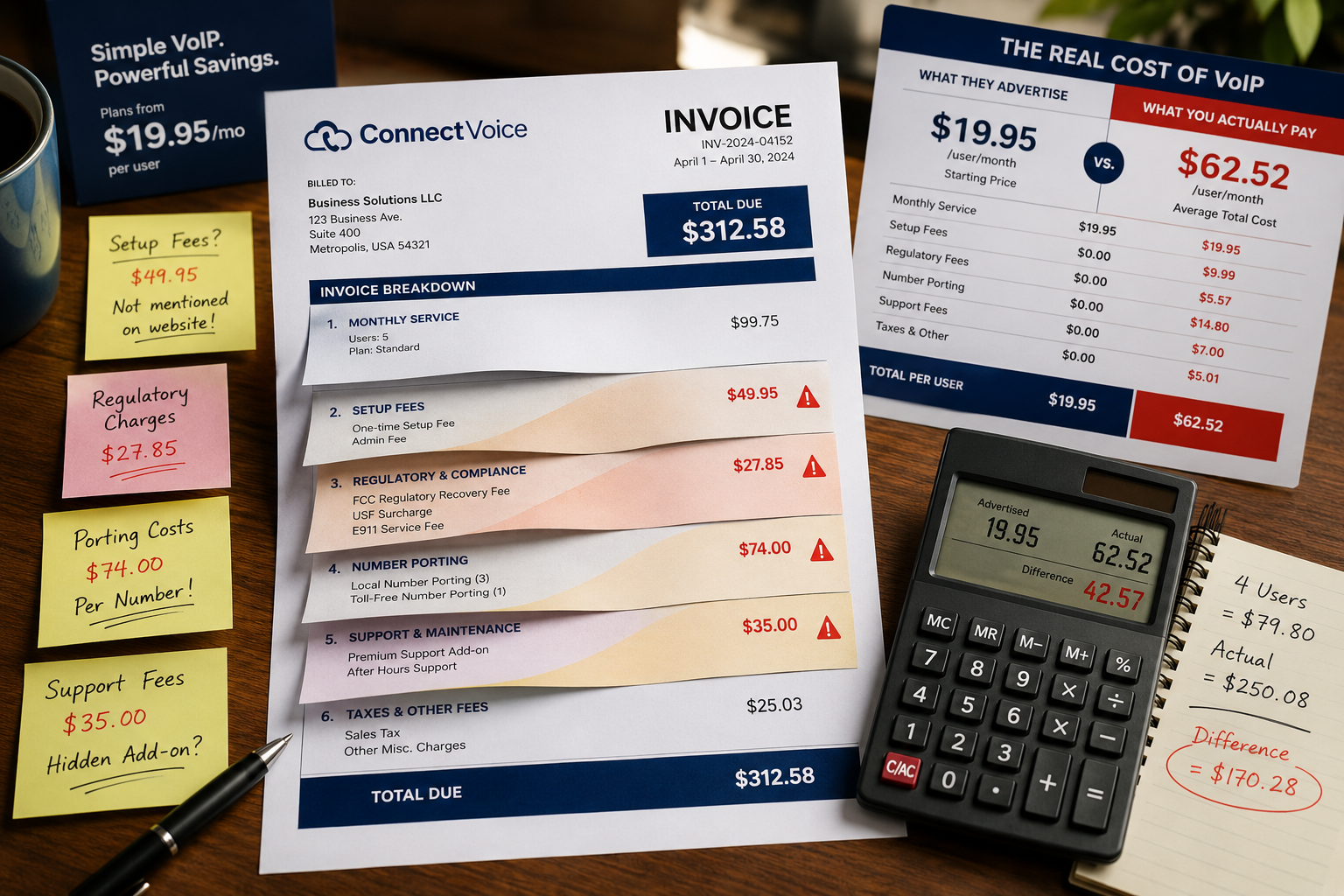
The Most Common VoIP Hidden Fees Businesses Encounter
Setup and Implementation Charges
Most business VoIP providers advertise monthly per-user rates without mentioning one-time setup costs. These implementation fees cover system configuration, user provisioning, and initial training. Expect to pay:
- Basic setup: £200 to £800 for straightforward deployments with standard features
- Custom configuration: £1,000 to £3,000+ for complex routing rules, integrations, or multi-location setups
- Professional installation: £500 to £2,000 if you need on-site technician support for desk phone deployment
Some providers waive setup fees for annual contracts or minimum user commitments. Others bundle implementation into higher monthly rates. Always ask for a complete first-year cost projection that includes these charges.
The VoIP billing models article explains how different pricing structures handle setup costs differently.
Regulatory Recovery Fees and Taxes
Telecommunications services carry regulatory obligations that providers pass to customers. These charges appear as separate line items on your bill:
- E911/999 fees: £0.50 to £1.50 per user monthly for emergency service access
- Regulatory recovery charges: 5 to 12 percent of your base service cost to cover compliance expenses
- VAT and local taxes: Standard 20 percent VAT in the UK, plus any applicable local telecommunications taxes
- Number portability fees: One-time charges of £5 to £25 per number when you transfer existing numbers
These fees are legitimate costs, but they’re rarely included in advertised pricing. A £20 per user plan becomes £24 to £26 after regulatory charges and taxes. Multiply that across 50 users over 12 months, and you’re looking at an additional £3,600 to £4,800 annually.
Number Porting and Migration Costs
Moving your existing phone numbers to a new VoIP provider involves administrative and technical work. Providers charge for this service:
- Per-number porting fees: £5 to £25 per number, depending on number type (local, toll-free, international)
- Bulk porting discounts: Some providers waive fees for 20+ numbers or include a set number of free ports
- Expedited porting: £50 to £150 extra if you need faster than standard 7 to 14 day porting timelines
- Failed port fees: £10 to £30 if porting fails due to incorrect account information
For a business with 30 phone numbers, porting costs alone can add £150 to £750 to your migration expenses. Our guide on how to port your number to a VoIP provider covers the complete process and typical timelines.
Premium Support and Service Level Agreements
Basic support is usually included, but businesses requiring guaranteed response times or dedicated account management pay extra:
- Standard support: Email and ticket-based help during business hours (included in base pricing)
- Priority support: £5 to £15 per user monthly for phone support with faster response times
- 24/7 support: £10 to £25 per user monthly for round-the-clock assistance
- Dedicated account manager: £100 to £500 monthly for businesses with 50+ users
- Enhanced SLA guarantees: Additional 5 to 10 percent monthly cost for contractual uptime commitments beyond standard 99.9%
The importance of SLA in VoIP services explains what these agreements actually cover and when they’re worth paying for.
Hardware and Equipment Costs
Cloud-based communications services don’t require traditional PBX hardware, but desk phones and networking equipment still cost money:
- Basic IP desk phones: £60 to £120 per unit for entry-level models
- Executive phones with touchscreens: £200 to £400 per unit for advanced features
- Conference room phones: £300 to £800 per unit for speakerphone systems
- Headsets: £30 to £150 per user depending on quality and wireless capabilities
- Network switches with PoE: £200 to £1,500 depending on port count and quality of service features
Some providers offer phone leasing at £3 to £8 per device monthly, which adds up over multi-year contracts. Others include basic phones with annual commitments. Softphone apps eliminate hardware costs but require reliable devices and may not suit all work environments.
Check our comparison of VoIP phones versus softphones to determine which option makes financial sense for your team.
Usage Overages and Per-Minute Charges
“Unlimited calling” plans often have geographic or usage restrictions that trigger additional charges:
- International calling: £0.02 to £0.50 per minute depending on destination country
- Premium rate numbers: £0.10 to £2.00 per minute for 0870, 0871, and similar numbers
- SMS/text messaging: £0.05 to £0.15 per message if not included in your plan
- Toll-free number usage: £0.02 to £0.08 per minute for inbound calls to 0800/0808 numbers
- Overage minutes: £0.03 to £0.10 per minute if you exceed plan limits
A team making regular international calls can easily add £200 to £500 monthly in usage charges. Our article on using VoIP for international calls shows how to minimize these costs.
Integration and Add-On Features
Basic business phone systems include standard calling features, but advanced functionality costs extra:
- CRM integration: £5 to £20 per user monthly for Salesforce, HubSpot, or similar connections
- Call recording: £3 to £10 per user monthly for automatic recording and storage
- Advanced analytics: £5 to £15 per user monthly for detailed reporting dashboards
- Video conferencing: £5 to £20 per user monthly if not included in base plan
- Contact center features: £10 to £40 per agent monthly for queue management, wallboards, and advanced routing
These add-ons can double your effective per-user cost. The guide to customizing your business phone system helps prioritize which features deliver actual business value.
How to Identify VoIP Hidden Fees Before Signing
Request a Complete Cost Breakdown
Don’t accept simple per-user pricing. Ask providers for:
- First-year total cost including setup, porting, hardware, and all fees
- Itemized monthly invoice example showing every line item you’ll see
- Year-two and year-three projections accounting for price increases and contract terms
- Overage rate sheet listing per-minute costs for international calls and premium numbers
Reputable providers will provide this information readily. Hesitation or vague answers are red flags worth noting in our VoIP contract red flags guide.
Compare Total Cost of Ownership, Not Monthly Rates
A £15 per user plan with £2,000 setup fees and £8 monthly in hidden charges costs more over three years than a £22 per user plan with no setup fees and transparent pricing. Calculate:
Total Cost = (Monthly Rate + Regulatory Fees + Add-ons) × Users × Months + Setup Fees + Hardware
For a 25-user business over 36 months:
- Provider A: £15 base + £3 fees + £5 add-ons = £23 × 25 × 36 = £20,700 + £1,500 setup + £2,000 hardware = £24,200
- Provider B: £22 base + £2 fees + £0 add-ons = £24 × 25 × 36 = £21,600 + £0 setup + £0 hardware = £21,600
Provider B costs less despite higher advertised rates. The complete guide to VoIP pricing models explains how to perform these calculations accurately.
Understand Contract Terms and Exit Costs
Month-to-month contracts offer flexibility but typically cost 15 to 30 percent more than annual commitments. Annual contracts lock in lower rates but include:
- Early termination fees: £100 to £500 per user for breaking contracts early
- Minimum commitment penalties: Charges if you reduce user count below contracted levels
- Auto-renewal clauses: Automatic contract extensions unless you provide 30 to 90 days notice
- Price increase provisions: Annual rate increases of 3 to 8 percent built into multi-year agreements
Our article on how to cancel your VoIP contract without paying fees provides strategies for negotiating better terms.
Test With a Pilot Program
Many providers offer 30 to 90 day trials or pilot programs. Use these to:
- Verify actual call quality on your network infrastructure
- Test real-world usage patterns to identify potential overage charges
- Evaluate support responsiveness before committing to long-term contracts
- Review actual invoices to confirm all fees match what was quoted
A pilot with 5 to 10 users costs £100 to £500 but can prevent expensive mistakes on full deployments.
Monitor Usage and Costs Continuously
After implementation, track your actual spending against projections:
- Review monthly invoices line by line for unexpected charges
- Monitor usage reports to identify cost-driving behaviors
- Set up billing alerts for overage thresholds
- Conduct quarterly cost reviews to ensure your plan still fits your needs
The guide to monitoring VoIP usage and costs efficiently provides specific tools and processes for ongoing cost management.
Real-World Cost Examples: Advertised vs. Actual
Small Business Scenario (10 Users)
Advertised: £18 per user monthly = £180 monthly, £2,160 annually
Actual first-year costs:
- Base service: £180 × 12 = £2,160
- Regulatory fees (12%): £259
- Setup and porting: £800
- Desk phones (8 units): £720
- Premium support: £600
- International calling: £480
- Total: £5,019 (132% more than advertised annual cost)
Mid-Size Business Scenario (50 Users)
Advertised: £22 per user monthly = £1,100 monthly, £13,200 annually
Actual first-year costs:
- Base service: £1,100 × 12 = £13,200
- Regulatory fees (15%): £1,980
- Setup and implementation: £2,500
- Hardware and equipment: £4,200
- CRM integration: £3,600
- Call recording: £1,800
- Enhanced SLA: £3,000
- Total: £30,280 (129% more than advertised annual cost)
These examples reflect typical scenarios from businesses that didn’t account for voip hidden fees during evaluation.
Questions to Ask Every VoIP Provider
Before committing to any business VoIP provider, get clear answers to these specific questions:
Pricing and Fees
- What is the total all-in cost per user including all fees, taxes, and required add-ons?
- Are there any one-time setup, implementation, or activation fees?
- What regulatory recovery fees and taxes will appear on my bill?
- Do you charge for number porting, and if so, how much per number?
Contract Terms
- What is the minimum contract length, and what are early termination penalties?
- How much notice is required to cancel or modify service?
- Are there annual price increase provisions in the contract?
- What happens if I need to reduce user count mid-contract?
Usage and Overages
- What exactly does “unlimited calling” include and exclude?
- What are per-minute rates for international calls to our key markets?
- Are toll-free numbers included, or charged separately?
- What happens if we exceed any usage limits?
Support and Service
- What level of support is included in base pricing?
- What are response time commitments for different issue severities?
- Is 24/7 support available, and does it cost extra?
- What uptime guarantee do you provide, and what remedies exist for outages?
Frequently Asked Questions
What are the most common hidden fees in VoIP services?
The most common voip hidden fees include regulatory recovery charges (5 to 15 percent of base cost), number porting fees (£5 to £25 per number), setup and implementation costs (£500 to £2,000+), premium support charges (£5 to £25 per user monthly), and international calling rates (£0.02 to £0.50 per minute). These fees can increase your actual costs by 30 to 50 percent compared to advertised rates.
How can I avoid unexpected VoIP charges?
Request a complete itemized cost breakdown before signing, including all one-time and recurring fees. Ask for sample invoices showing every line item. Calculate total cost of ownership over your expected contract period, not just monthly rates. Start with a pilot program to verify actual costs match projections. Review invoices monthly and set up usage alerts to catch overages early.
Are VoIP setup fees negotiable?
Yes, setup fees are often negotiable, especially for businesses with 20+ users or those willing to commit to annual contracts. Many providers will waive or reduce setup fees to win your business. Ask directly about setup fee waivers or request them as part of contract negotiations. Some providers bundle setup costs into slightly higher monthly rates instead of charging upfront.
Do all VoIP providers charge regulatory fees?
Yes, virtually all business VoIP providers charge regulatory recovery fees to cover telecommunications compliance costs, emergency service access, and number portability obligations. These fees typically range from 5 to 18 percent of your base service cost and are legitimate pass-through charges. However, the exact percentage varies significantly between providers, so compare total costs including these fees rather than base rates alone.
What’s the difference between advertised and actual VoIP costs?
Advertised VoIP costs typically show only the base per-user monthly rate for standard calling features. Actual costs include regulatory fees, taxes, setup charges, number porting, hardware, premium support, integrations, and usage overages. Real-world costs commonly run 30 to 50 percent higher than advertised rates in the first year, and 20 to 30 percent higher in subsequent years once setup costs are absorbed.
Should I choose month-to-month or annual VoIP contracts?
Month-to-month contracts offer flexibility but cost 15 to 30 percent more than annual commitments. Choose month-to-month if you’re uncertain about user count, testing VoIP for the first time, or expect significant business changes. Choose annual contracts if you’re confident in your requirements and want lower rates. Consider starting with a short pilot, then committing to annual terms once you’ve verified the service meets your needs.
Conclusion
The gap between advertised VoIP rates and actual costs isn’t always deceptive, but it does require buyers to ask detailed questions and calculate total cost of ownership carefully. Setup fees, regulatory charges, number porting, premium support, hardware, and usage overages can easily add 30 to 50 percent to your first-year expenses compared to headline pricing.
Protect your budget by requesting complete cost breakdowns before signing, comparing total three-year costs rather than monthly rates, and starting with pilot programs to verify actual expenses match projections. The most cost-effective phone solution isn’t the one with the lowest advertised rate, it’s the one with transparent pricing that matches your actual usage patterns and business requirements.
For businesses evaluating providers in 2026, our complete guide to the best UK VoIP providers for small business provides detailed comparisons including total cost analysis and hidden fee disclosures.
Take the time to understand voip hidden fees upfront, and you’ll avoid budget surprises while building reliable, cost-effective business communications that scale with your growth.