

Most UK businesses waste £2,000 to £5,000 annually on their business phone systems because they compared prices instead of quotes. There’s a critical difference: a price list shows what you might pay; a quote reveals what you will pay once setup fees, per-minute charges, number porting costs, and support premiums get added. When evaluating a business voip provider uk option, that distinction determines whether your cloud-based communications become a cost-effective solution or a budget drain.
The UK VoIP market in 2026 is crowded with providers offering seemingly identical packages at £8 to £15 per user monthly. Yet businesses routinely discover their actual costs hit £25 to £35 per user once reality sets in. The problem isn’t dishonest providers, it’s buyers who don’t know which questions to ask before signing contracts.
This guide shows you how to compare VoIP quotes properly, focusing on total cost of ownership, hidden charges, and the specific factors that matter for UK businesses. No sales pitches, just the practical framework you need to evaluate providers and avoid expensive mistakes.
Key Takeaways
- Price lists show starting costs; quotes reveal total expenses including setup, porting, support tiers, and usage charges that can double your monthly spend
- UK-specific factors matter: geographic number availability, PSTN switch-off readiness, GDPR compliance, and local support hours significantly impact reliability
- Contract terms hide costs: minimum commitments, auto-renewal clauses, exit fees, and upgrade restrictions often cost more than the service itself
- Call quality depends on infrastructure: UK data center locations, SIP trunk capacity, and guaranteed uptime SLAs determine whether your business phone systems actually work when needed
- Support structure affects downtime: 24/7 UK-based support, response time guarantees, and dedicated account management prevent costly outages
Why Most Business VoIP Provider UK Comparisons Fail
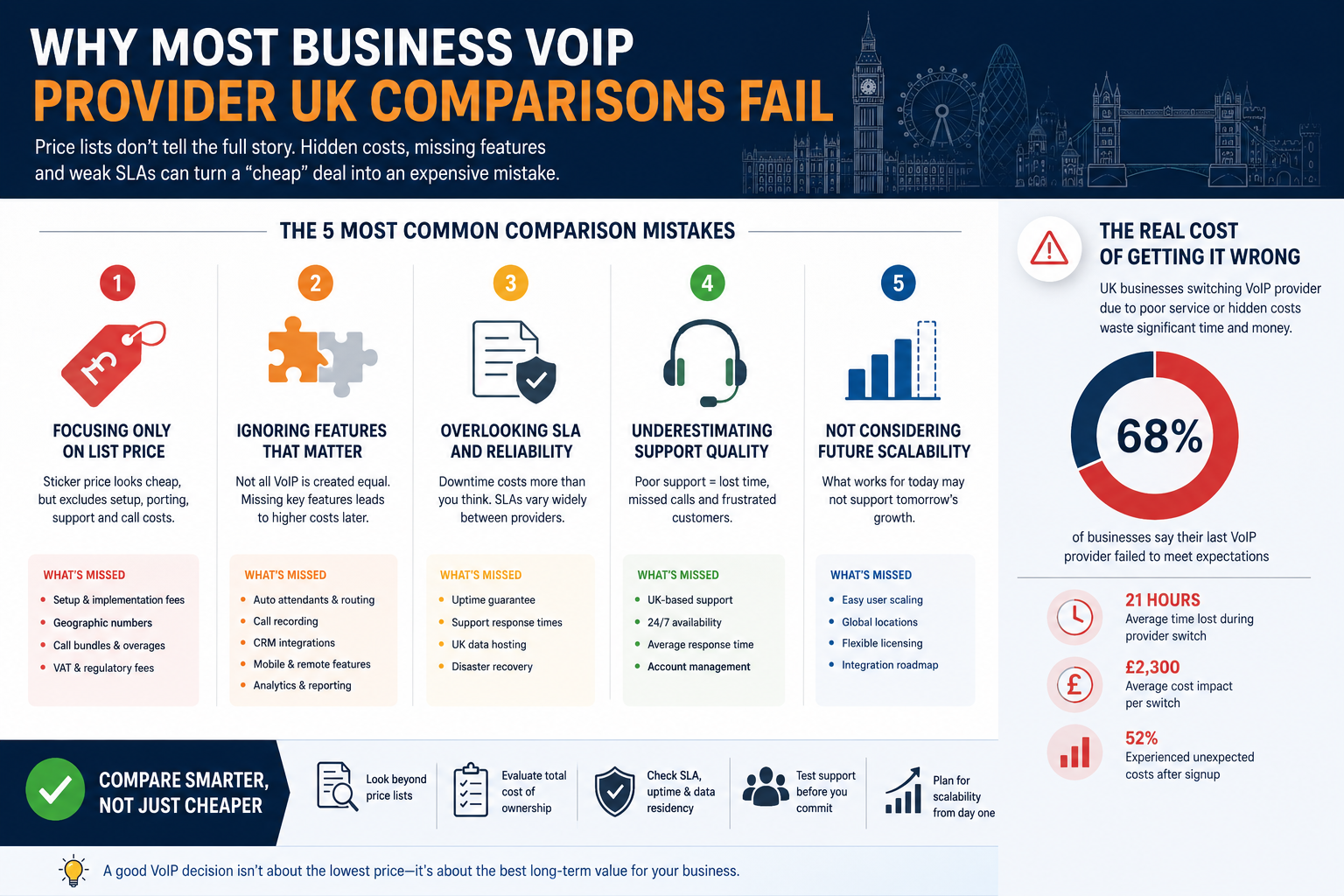
The typical approach to choosing a business voip provider uk option looks like this: search “VoIP providers UK,” open five tabs, scan the pricing pages, pick the cheapest one. This method guarantees disappointment.
Price lists are marketing tools designed to get you interested, not informed. They show the absolute minimum you’ll pay under perfect conditions, conditions that rarely exist for actual businesses. A provider advertising £9.99 per user monthly might be entirely accurate, but that figure assumes you already have compatible desk phones, don’t need number porting, require zero setup assistance, never call mobiles, and accept email-only support during business hours.
The real cost structure includes:
- Setup and activation fees: £50 to £500 depending on complexity
- Number porting charges: £5 to £25 per number transferred from your existing provider
- Hardware costs: £80 to £300 per desk phone if you need physical handsets
- Call charges beyond allowances: £0.02 to £0.15 per minute for mobiles and international calls
- Support tier upgrades: £5 to £20 per user monthly for priority or 24/7 assistance
- Integration fees: £100 to £1,000 for CRM, helpdesk, or Microsoft Teams connections
A business with 10 users might see that £9.99 price and budget £100 monthly. The actual first-year cost often reaches £3,500 to £5,000 when you include setup, hardware, porting, and realistic usage patterns.
The Geographic Trap
UK businesses face specific challenges that generic international providers don’t address well. Geographic numbers (01 and 02 prefixes) matter for local credibility, but not all providers offer comprehensive UK coverage. Some VoIP services can’t provide numbers in certain area codes, forcing you to use 03 or 0800 alternatives that don’t match your business location.
The PSTN switch-off, the UK’s transition from traditional phone lines to digital-only by 2027, adds urgency. Providers with robust UK infrastructure and proven migration support become essential, not optional. Those still relying on legacy systems or lacking UK data centers will struggle as the deadline approaches.
For businesses evaluating VoIP for small business needs, understanding these UK-specific factors prevents choosing a provider that works brilliantly in the US but fails basic requirements here.
What to Actually Request in a Business VoIP Provider UK Quote
A proper quote isn’t a price list, it’s a detailed breakdown of your specific costs based on your actual requirements. Before contacting providers, document your needs clearly:
Current usage profile:
- Number of users (desk-based, mobile, remote)
- Average monthly call minutes (landline, mobile, international)
- Existing phone numbers to port
- Current hardware inventory
- Required integrations (CRM, helpdesk, productivity tools)
Service requirements:
- Uptime guarantee needed (99.9% vs 99.99% makes a real difference)
- Support hours required (business hours vs 24/7)
- Call recording necessity (legal and storage implications)
- Conference calling capacity
- Mobile app requirements
Armed with this information, request quotes that include:
Itemized First-Year Costs
Demand a complete breakdown showing:
- Monthly per-user fees (specify exact user count)
- Setup and activation charges
- Number porting costs (per number)
- Hardware requirements and costs
- Installation or configuration fees
- Training or onboarding charges
- First-month vs ongoing costs
Usage Allowances and Overage Rates
“Unlimited” rarely means unlimited. Clarify:
- Included minutes per user monthly (landline, mobile, international separately)
- Fair usage policy limits
- Per-minute charges beyond allowances
- Peak vs off-peak rate differences
- International calling zones and rates
Contract Terms and Flexibility
The contract structure often costs more than the service:
- Minimum contract length
- Auto-renewal terms and notice periods
- Early termination fees
- Price increase clauses (annual RPI+X is common)
- User addition/removal flexibility
- Upgrade and downgrade options
- Exit process and data portability
Infrastructure and Reliability Guarantees
Technical specifications determine whether your business phone systems actually work:
- UK data center locations
- Uptime SLA with compensation terms
- Redundancy and failover mechanisms
- Bandwidth requirements per user
- Call quality guarantees (jitter, latency, packet loss)
- Disaster recovery provisions
For detailed guidance on ensuring continuity, see our VoIP disaster recovery guide.
Support Structure and Response Times
Support quality varies dramatically between providers:
- Support hours (UK business hours vs 24/7)
- Support channels (phone, email, chat, ticket)
- Response time guarantees by priority level
- UK-based vs offshore support teams
- Dedicated account manager availability
- Self-service portal capabilities
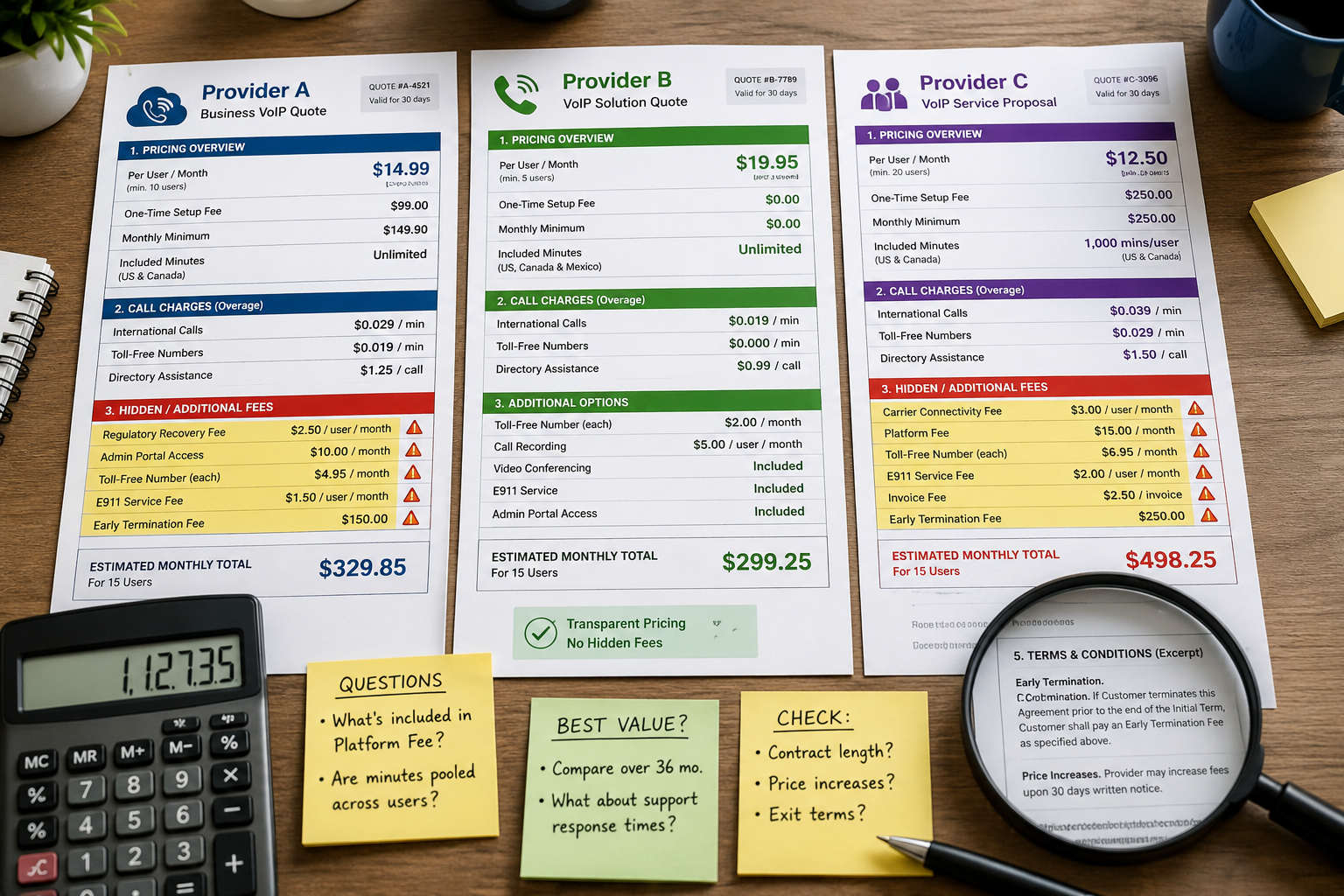
The Hidden Costs That Double Your VoIP Bill
Even with detailed quotes, certain costs remain obscure until you’re locked into a contract. Knowing where providers hide charges helps you ask the right questions upfront.
Per-Minute Mobile Charges
Most UK VoIP packages include “unlimited” landline calls but charge per minute for mobiles. Given that 70% of business calls now go to mobile numbers, this matters enormously. A provider charging £0.05 per minute to mobiles adds £150 monthly for a team making 3,000 minutes of mobile calls, that’s £1,800 annually not reflected in the base price.
Ask specifically:
- Are mobile calls included or charged separately?
- What’s the per-minute rate to UK mobiles?
- Are there mobile minute bundles available?
- How are mobile calls billed (per second, per minute, minimum duration)?
Support Tier Premiums
Basic packages typically include email support during business hours with 24 to 48-hour response times. When your phones stop working at 4:30 PM on Friday, that’s unacceptable. Priority support costs £5 to £20 per user monthly but becomes essential for businesses that can’t afford downtime.
Some providers bundle 24/7 support at higher package tiers. Others charge separately. Compare the total cost of the package tier you actually need, not the cheapest option you can’t realistically use.
Number Porting Complications
Porting existing numbers should be straightforward but often isn’t. Providers charge £5 to £25 per number, but complications arise with:
- Geographic numbers from legacy providers
- Numbers originally from BT requiring special handling
- Porting timeframes extending beyond quoted periods
- Failed ports requiring resubmission fees
Request a detailed porting quote including timeline, success guarantees, and contingency plans. For step-by-step guidance, see our complete guide to porting your number.
Integration and API Costs
Modern businesses need VoIP systems that connect with existing tools. CRM integration, helpdesk connectivity, and Microsoft Teams compatibility often carry additional charges:
- One-time integration setup: £100 to £1,000
- Monthly API access fees: £10 to £50
- Premium integration tiers for advanced features
- Custom integration development costs
Check whether your required VoIP integrations are included or cost extra.
Compliance and Recording Fees
Call recording is legally required for some industries and useful for many others. Providers handle this differently:
- Included in premium tiers
- Charged per recorded user (£3 to £10 monthly)
- Storage limits with overage charges
- Retention period restrictions
- Export and retrieval fees
GDPR compliance for call recording and data storage adds complexity. Ensure your provider offers UK-based storage and proper data handling. Our VoIP and GDPR guide covers compliance requirements.
How to Compare Business VoIP Provider UK Quotes Side-by-Side
Once you have detailed quotes from three to five providers, systematic comparison prevents overlooking critical differences. Create a comparison spreadsheet with these categories:
Total Cost of Ownership (Years 1-3)
Calculate the complete cost over three years, not just monthly fees:
Year 1:
- Setup and activation fees
- Hardware purchases
- Number porting costs
- Monthly fees × 12
- Estimated usage charges
- Support tier costs
- Integration fees
Years 2-3:
- Monthly fees × 24 (accounting for likely price increases)
- Estimated usage charges
- Support costs
- Potential upgrade needs
Divide the three-year total by 36 to get your true monthly cost. This figure often runs 40% to 80% higher than the advertised price.
Feature Parity Verification
Ensure you’re comparing equivalent capabilities:
| Feature Category | Provider A | Provider B | Provider C |
|---|---|---|---|
| Call Management | |||
| Call forwarding | ✓ | ✓ | ✓ |
| Voicemail to email | ✓ | ✓ | ✓ |
| Auto attendant | ✓ | ✓ | Premium only |
| Call recording | Premium | ✓ | £5/user |
| Mobility | |||
| Mobile apps | iOS/Android | iOS/Android | iOS only |
| Desktop softphone | ✓ | ✓ | ✓ |
| Hot desking | ✓ | Premium | ✓ |
| Integrations | |||
| Microsoft Teams | £15/user | ✓ | Not available |
| Salesforce | ✓ | ✓ | ✓ |
| Zendesk | Premium | ✓ | Custom only |
| Support | |||
| UK-based support | Business hours | 24/7 | 24/7 |
| Phone support | ✓ | ✓ | Email only |
| Response time SLA | 4 hours | 1 hour | 24 hours |
Reliability and Infrastructure Comparison
Technical specifications determine whether your system works when needed:
- Uptime SLA: 99.9% allows 8.7 hours downtime yearly; 99.99% allows just 52 minutes
- UK data centers: Multiple locations provide redundancy
- Bandwidth requirements: 100 kbps per call is standard; verify your internet capacity
- Failover options: Automatic rerouting to mobiles during outages
- Call quality metrics: Jitter <30ms, latency <150ms, packet loss <1%
For businesses concerned about reliability, our guide on avoiding common VoIP problems provides troubleshooting strategies.
Contract Flexibility Assessment
Rigid contracts create expensive problems as your business evolves:
- Minimum term: 12 months is reasonable; 36 months is risky
- User flexibility: Can you add/remove users monthly without penalties?
- Feature upgrades: Can you change package tiers mid-contract?
- Exit terms: What notice period and fees apply?
- Price protection: Are increases capped or unlimited?
Understanding how to cancel VoIP contracts before signing prevents expensive surprises later.
Red Flags That Indicate a Bad Business VoIP Provider UK Deal
Certain warning signs indicate a quote that looks good on paper but delivers poorly in practice:
Vague or Missing SLAs
Providers confident in their infrastructure publish specific uptime guarantees with compensation terms. Vague promises like “industry-leading reliability” or “best-effort uptime” mean no accountability when problems occur.
Look for:
- Specific uptime percentage (99.9% minimum)
- Compensation structure for SLA breaches
- Exclusions clearly defined
- Measurement and reporting methodology
Offshore-Only Support for UK Businesses
Nothing wrong with offshore support teams, but UK businesses need support during UK hours with staff who understand UK telecommunications infrastructure. Providers offering only offshore support often struggle with:
- UK number porting processes
- BT and Openreach coordination
- UK regulatory requirements
- Time zone coverage during UK business hours
Unclear Pricing for Common Scenarios
If a provider can’t give you a straight answer about mobile call charges, number porting costs, or support tier pricing, they’re either hiding something or don’t know their own pricing structure. Both are problems.
Locked-In Hardware Requirements
Some providers require you to purchase or lease their specific hardware at inflated prices. This creates vendor lock-in and prevents you from using existing equipment or choosing better alternatives.
Prefer providers that:
- Support standard SIP phones from multiple manufacturers
- Offer softphone options for computer and mobile use
- Allow BYOD (bring your own device) approaches
- Provide hardware options without mandating them
Automatic Renewal Without Clear Notice
Contracts that auto-renew for another full term without explicit consent trap businesses in outdated agreements. Look for:
- Clear notice periods (90 days minimum)
- Written confirmation requirements before renewal
- Automatic conversion to month-to-month after initial term
- No penalties for non-renewal
For more on hidden VoIP costs, see our detailed breakdown of what providers don’t advertise.
Questions to Ask Before Signing Any Business VoIP Provider UK Contract
Armed with detailed quotes and comparison data, these final questions clarify remaining uncertainties:
About Costs and Billing
“What’s my guaranteed maximum monthly cost for typical usage?” Forces providers to commit to a ceiling rather than hiding behind “from” pricing.
“Show me a sample invoice for a business like mine.” Reveals how charges actually appear and what extras get added.
“What costs will increase in year two, and by how much?” Many providers offer discounted first-year pricing then increase rates significantly.
“What happens if I exceed my usage allowances?” Understand overage charges before they appear on your bill.
About Service and Support
“What’s your average response time for critical outages?” SLAs state maximums; ask about typical performance.
“Can I speak with your support team now?” Tests accessibility and quality before committing.
“What’s your customer retention rate?” High churn indicates problems; established providers should retain 85%+ of customers annually.
“How do you handle the PSTN switch-off transition?” UK-specific question that reveals preparedness for 2027 deadline.
About Flexibility and Exit
“Can I reduce users mid-contract without penalties?” Business circumstances change; inflexible contracts create problems.
“What’s the complete exit process, including timeline and costs?” Know how to leave before you commit to staying.
“Will you provide that in writing before I sign?” Verbal promises mean nothing; documented commitments matter.
“What happens to my data and call recordings if I leave?” Data portability and retention policies affect your ability to switch providers.
Frequently Asked Questions
How much should I budget for business VoIP per user in the UK?
Budget £20 to £35 per user monthly for realistic total costs including setup, support, and typical usage. The advertised £8 to £15 prices rarely reflect actual expenses once you add necessary features, adequate support, and realistic call volumes. First-year costs run higher due to setup and hardware expenses.
What’s the difference between a VoIP price list and a proper quote?
A price list shows starting prices under ideal conditions. A proper quote itemizes your specific costs including setup fees, number porting, hardware, support tiers, integration costs, and usage charges based on your actual requirements. Always request detailed quotes, never rely on website pricing alone.
Do I need UK-based data centers for my business VoIP?
UK data centers significantly improve call quality by reducing latency and provide better GDPR compliance for data storage. They’re not strictly required, but providers with UK infrastructure typically deliver better performance and reliability for UK businesses. This becomes increasingly important as the PSTN switch-off progresses.
How long does it take to switch business VoIP providers?
Number porting typically takes 7 to 14 working days, though complications can extend this to 4 to 6 weeks. Complete system setup including configuration, testing, and training usually requires 2 to 4 weeks. Plan for a 6 to 8-week transition period to avoid rushing and making mistakes.
What uptime SLA should I expect from a business VoIP provider?
Minimum 99.9% uptime (8.7 hours downtime yearly) for basic business use. Mission-critical applications require 99.99% (52 minutes downtime yearly). Ensure the SLA includes compensation terms for breaches and clearly defines exclusions. Providers confident in their infrastructure publish specific guarantees.
Can I keep my existing phone numbers when switching VoIP providers?
Yes, UK regulations require number portability. Expect to pay £5 to £25 per number and allow 7 to 14 working days for the transfer. Geographic numbers (01/02) and non-geographic numbers (03/0800) can all be ported, though processes vary. Request a detailed porting quote including timeline and success guarantees before committing.
Conclusion
Comparing business voip provider uk options effectively means looking beyond price lists to understand total costs, contract terms, and service quality. The £9.99 per user advertised rate becomes £25 to £35 once you add setup fees, adequate support, realistic usage charges, and necessary features.
Start by documenting your specific requirements: user count, call volumes, integration needs, and support expectations. Request detailed quotes that itemize first-year costs, usage allowances, contract terms, and infrastructure specifications. Compare total three-year costs, not monthly prices, to understand true expenses.
Watch for red flags: vague SLAs, offshore-only support, unclear pricing, locked-in hardware, and automatic renewals. Ask direct questions about maximum costs, typical response times, customer retention, and exit processes. Get commitments in writing before signing.
The UK’s PSTN switch-off by 2027 makes choosing the right VoIP provider more critical than ever. Providers with robust UK infrastructure, proven migration support, and flexible contracts position your business for reliable communications through the transition and beyond.
Take time to compare properly. The hours spent evaluating quotes thoroughly save thousands of pounds and prevent years of frustration with inadequate business phone systems. For more guidance on choosing the right solution, explore our complete guide to UK VoIP providers and learn why VoIP is essential for business growth.