

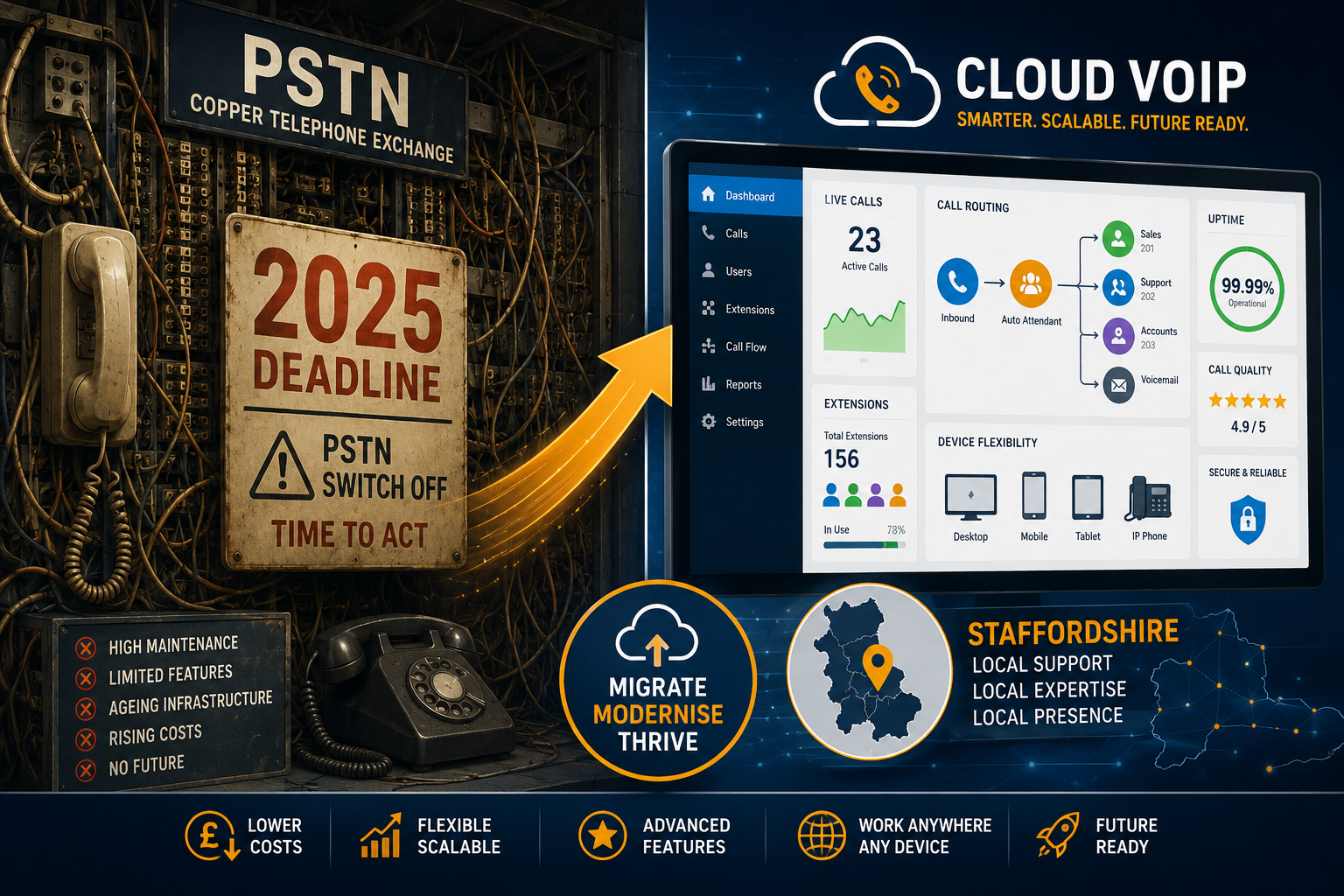
Every Staffordshire business still running on a traditional landline is now on a countdown clock. The UK’s Public Switched Telephone Network (PSTN) shuts down permanently in January 2027, and that deadline makes choosing the right business telephone systems in Staffordshire one of the most pressing decisions local SMEs face right now.
Whether you’re running a manufacturing firm in Tamworth, a professional services practice in Stafford, or a startup in one of the county’s 261 enterprise centre units, your phone infrastructure needs a rethink. This guide cuts through the noise and helps you make a confident, cost-effective decision.
Key Takeaways
- ⏰ The PSTN switch-off is January 2027: Staffordshire businesses must migrate to digital phone systems before then or risk losing service.
- ☁️ VoIP and cloud-based systems are the practical replacement, offering lower costs, greater flexibility, and scalability.
- 📍 Local providers exist: Staffordshire has several established regional specialists who understand the area’s connectivity landscape.
- 💷 Costs are lower than most expect, hosted VoIP typically runs £8-£20 per user per month, with no costly hardware refresh.
- 🔌 Broadband quality matters: your VoIP performance is only as good as your internet connection.
Why Staffordshire Businesses Need to Act Now
The PSTN switch-off isn’t a rumour – it’s a confirmed infrastructure retirement. BT Openreach is decommissioning the analogue copper network that has underpinned UK business calls for decades. After January 2027, traditional landlines simply won’t work.
For Staffordshire businesses, this creates both urgency and opportunity. The urgency is obvious: migrate or lose your phones. The opportunity is that modern cloud-based communications systems are genuinely better, and often cheaper, than what they replace.
Staffordshire’s business community is also growing. Meeting room and hot desk bookings across the county’s enterprise centres rose 33% in 2025, reflecting a clear shift toward flexible working. That shift demands phone systems that move with your people, not systems tied to a fixed desk in a fixed office.
Businesses that migrate early avoid the last-minute rush, and get time to properly configure their system before the deadline hits.
If you’re still on an ISDN line (Integrated Services Digital Network, the older digital version of the PSTN), the same deadline applies. ISDN lines are also being retired.
For a plain-English breakdown of how modern alternatives work, the beginner’s guide to VoIP for businesses is a solid starting point.
What Are Your Options? Understanding Business Telephone Systems in Staffordshire
When traditional landlines go away, three main system types step in. Here’s what each means in practice:
1. Hosted VoIP (Cloud PBX)
VoIP stands for Voice over Internet Protocol: it routes calls over your broadband connection instead of copper phone lines. A hosted VoIP system means the PBX (Private Branch Exchange, essentially the brain of your phone system) lives in the cloud, managed by your provider.
Best for: Most SMEs. Low upfront cost, minimal hardware, easy to scale.
2. SIP Trunking
SIP (Session Initiation Protocol) trunking connects an existing on-site phone system to the internet. It’s useful if you’ve already invested in a physical PBX and want to keep it running while ditching the analogue lines.
Best for: Businesses with existing on-premise hardware they want to retain.
3. Unified Communications (UC) Platforms
These go beyond calls, combining voice, video, messaging, and file sharing in one platform. Think Microsoft Teams Phone or RingCentral. They’re increasingly popular with businesses that need to support hybrid and remote teams.
Best for: Businesses prioritising collaboration and remote working.
📊 Quick Cost Comparison| System Type | Typical Monthly Cost | Upfront Hardware | Scalability |
|---|---|---|---|
| Hosted VoIP | £8-£20/user | Low | ⭐⭐⭐⭐⭐ |
| SIP Trunking | £5-£15/channel | Medium (existing PBX) | ⭐⭐⭐⭐ |
| UC Platform | £15-£35/user | Low | ⭐⭐⭐⭐⭐ |
Want to dig deeper into whether cloud suits your setup? This guide to cloud phone systems for business covers the key decision points.
Local Providers: Business Telephone Systems in Staffordshire
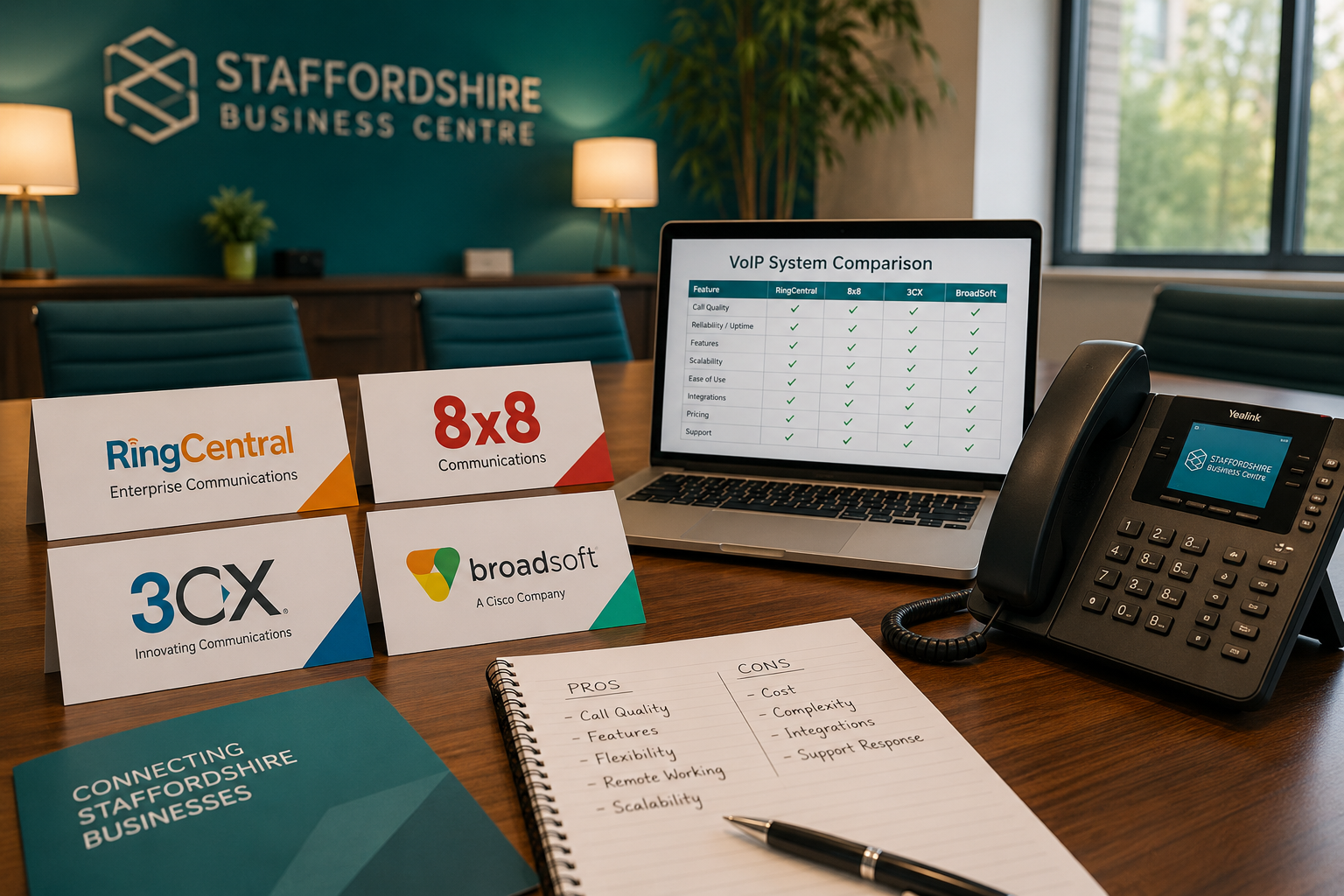
Choosing a local provider has real advantages: faster on-site support, knowledge of regional broadband infrastructure, and accountability. Here are four genuine options worth evaluating:
Halstone Mobile & Technology (Newcastle-under-Lyme)
With over 30 years in the industry, Halstone is one of the most established telecoms specialists in the region. Based in Newcastle-under-Lyme, they serve businesses across North Staffordshire and the wider area with a full range of communications services.
Their VoIP solutions for business cover hosted systems, mobile integration, and broadband, which matters because a VoIP system is only as reliable as the internet connection it runs on. For businesses in the Stoke-on-Trent area specifically, their local service coverage for Stoke-on-Trent is worth reviewing. The longevity of the business is a genuine trust signal in a market where smaller resellers come and go.
Allcomms Telecom (Stoke-on-Trent)
Allcomms specialises in helping businesses navigate the PSTN switch-off, offering broadband, VoIP, and SIP solutions with a focus on minimising downtime during the transition. A solid choice if your primary concern is a smooth migration from analogue.
Complete ICT (Newcastle-under-Lyme)
Complete ICT offers hosted VoIP on a per-extension basis with no long-term contracts, a flexible model that suits growing businesses that don’t want to be locked in. Their pricing structure is transparent and scales cleanly as headcount changes.
Datasharp Central (Tamworth)
Covering the southern end of the county, Datasharp Central provides telephony solutions for businesses of varying sizes. They emphasise integration with modern communication technologies, which is useful if you’re looking at unified communications rather than a straight VoIP swap.
What to ask any provider before signing:
- What happens to my service if your platform has downtime?
- Do you manage number porting, or do I handle that myself?
- What broadband speed do you recommend for my call volume?
- Is there a minimum contract, and what are the exit terms?
For guidance on keeping your existing number when you switch, the VoIP phone number porting guide covers the process clearly.
Features Worth Prioritising in 2026
Not all business VoIP providers offer the same feature set. These are the capabilities that genuinely move the needle for Staffordshire SMEs:
- Auto-attendant: routes calls professionally without a receptionist. Essential for small teams. (Why your business needs auto-attendant features)
- Mobile app integration: lets staff take business calls on their mobile without giving out personal numbers.
- Call recording: useful for compliance, training, and dispute resolution.
- CRM integration: connects your phone system to your customer database for smarter sales and service. (Integrating your CRM with VoIP systems)
- Disaster recovery: calls automatically reroute if your office loses power or internet. (VoIP disaster recovery planning)
- Analytics and reporting: track call volumes, wait times, and missed calls to manage your team better.
Getting the Basics Right: Connectivity and Security
A VoIP system running on a poor broadband connection will frustrate everyone. As a rough guide, each simultaneous call needs around 100 Kbps of bandwidth. A 10-person office making calls concurrently needs at least 1 Mbps dedicated to voice, ideally with Quality of Service (QoS) settings on your router to prioritise call traffic.
Security is the other non-negotiable. VoIP fraud, where attackers exploit poorly secured systems to rack up international call charges, is a real risk. Strong passwords, encrypted SIP connections, and regular audits are baseline requirements. The guide on how to avoid common VoIP phone system problems covers both connectivity and security pitfalls in practical detail.
FAQ: Business Telephone Systems in Staffordshire
Q: Do I really need to switch before January 2027? Yes. The PSTN and ISDN networks will be switched off entirely. After that date, traditional landlines will not function. Early migration gives you time to test and configure properly.
Q: Can I keep my existing phone number? In most cases, yes. Number porting transfers your current number to the new VoIP system. Your provider handles this, though it typically takes 2-4 weeks.
Q: What internet speed do I need for VoIP? A minimum of 10 Mbps broadband is recommended for small teams, with at least 100 Kbps per simultaneous call. Fibre broadband is strongly preferred.
Q: Is VoIP reliable enough for a business-critical phone system? Modern hosted VoIP platforms typically offer 99.99% uptime SLAs. Reliability is comparable to traditional systems, and often better, with automatic failover built in.
Q: How much will switching to VoIP actually cost? Most SMEs pay £8-£20 per user per month for hosted VoIP. Hardware costs are minimal if staff use softphones (apps on their laptop or mobile). Total cost of ownership is usually lower than legacy systems within 12 months.
Q: What’s the difference between VoIP and a unified communications platform? VoIP handles calls over the internet. A unified communications (UC) platform adds video, messaging, and collaboration tools on top. UC suits businesses with hybrid teams; straight VoIP suits those who primarily need reliable calls.
Conclusion: Make the Switch Count
The PSTN deadline isn’t just a compliance deadline – it’s a genuine prompt to upgrade to cost-effective phone solutions that serve your business better than the analogue systems they replace.
For Staffordshire businesses, the practical next steps are straightforward:
- Audit your current setup: how many lines, extensions, and features do you actually use?
- Check your broadband: confirm your connection can support VoIP reliably before committing.
- Get quotes from at least two local providers: compare contract terms, not just monthly cost.
- Plan your number porting: don’t leave this to the last minute.
- Test before you go live: run VoIP alongside your existing system for 2-4 weeks if possible.
The businesses that treat this as an upgrade rather than a chore will come out ahead, with more flexible, more scalable, and more affordable business telephone systems in Staffordshire than they had before.
For a broader view of the UK market, the best UK VoIP provider guide for 2026 is worth bookmarking alongside your shortlist of local options.