
Over 40% of businesses that switch to VoIP report losing their existing phone number during the transition — not because porting is impossible, but because they skipped critical steps. Knowing exactly how to port your number to a VoIP provider can mean the difference between a seamless cutover and days of missed calls. This guide walks through every stage of the process, from gathering the right documents to avoiding the mistakes that derail most transfers.
Key Takeaways
- ✅ Number porting is a legal right in the U.S. — carriers cannot block you from transferring your number to a VoIP provider.
- ✅ The process typically takes 5–10 business days, but preparation can speed it up significantly.
- ✅ A Letter of Authorization (LOA) is the single most important document in any port request.
- ✅ Do NOT cancel your old service before the port completes — this will permanently lose your number.
- ✅ Most VoIP providers handle the heavy lifting, but you must supply accurate account information.
What Is Number Porting and Why Does It Matter?
Number porting (officially called Local Number Portability, or LNP) is the process of transferring an existing phone number from one carrier to another. In the United States, the FCC mandated this right in 1996, meaning no carrier — landline, mobile, or VoIP — can legally prevent you from taking your number with you.
When businesses or individuals switch to a VoIP provider, keeping the same number protects:
- Brand continuity — clients and partners already have your number saved
- Marketing investments — printed materials, websites, and ads don’t need updating
- Customer trust — a familiar number signals stability
💡 “Your phone number is a business asset. Treat porting it with the same care you’d give a domain name transfer.”
Step-by-Step: How to Port Your Number to a VoIP Provider
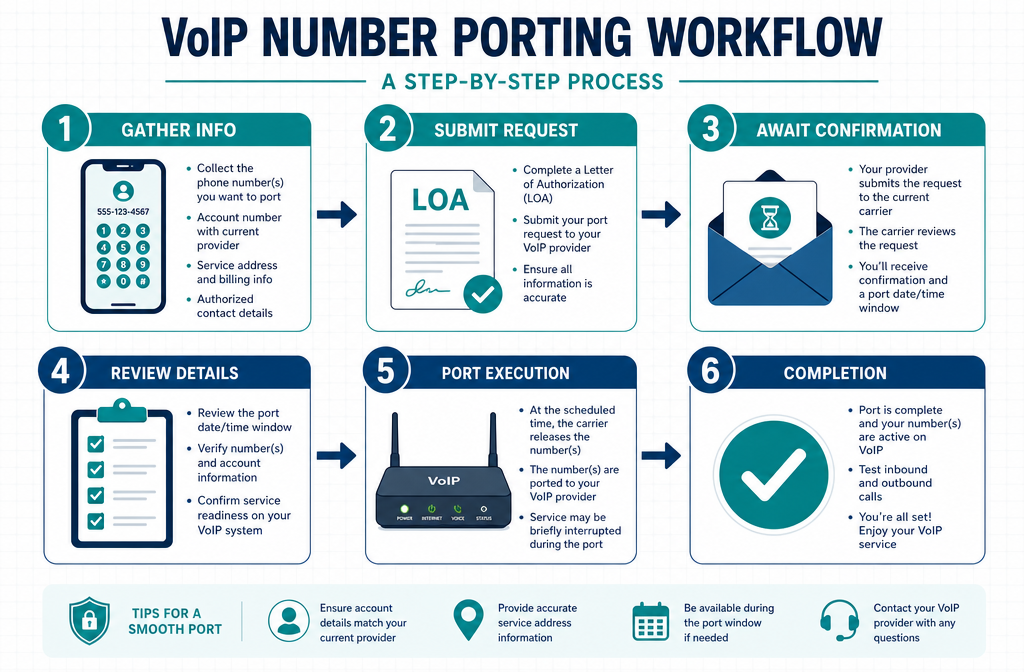
The process is more straightforward than most people expect. Follow these six steps carefully.
Step 1: Confirm Your Number Is Portable
Not every number can be ported. Before starting, verify:
| Number Type | Portable? | Notes |
|---|---|---|
| Mobile (cell) numbers | ✅ Yes | Most common and straightforward |
| Landline numbers | ✅ Yes | May require extra documentation |
| Toll-free numbers (800, 888, etc.) | ✅ Yes | Separate process via RespOrg |
| VoIP-to-VoIP transfers | ✅ Yes | Usually fastest |
| Virtual numbers (some) | ⚠️ Sometimes | Check with current provider |
Most VoIP providers offer a free number portability check on their website. Use it before committing.
Step 2: Gather Your Account Information
This is where most port requests fail. The information submitted must exactly match what your current carrier has on file.
Collect the following:
- 📄 Account number (found on your bill or carrier portal)
- 📄 Billing name (exactly as it appears on the account)
- 📄 Service address (the address associated with the number)
- 📄 Account PIN or password (set up with your current carrier)
- 📄 The phone number(s) you want to port
⚠️ Even a single mismatched character — like “St.” vs “Street” — will cause the port to be rejected.
Step 3: Do NOT Cancel Your Current Service
This is the most critical rule in the entire process. Keep your old account active until the port is fully complete. Canceling early permanently releases the number back into the pool, making it unrecoverable.
Step 4: Submit a Port Request to Your New VoIP Provider
Contact your chosen VoIP provider and initiate the porting process. You will need to complete a Letter of Authorization (LOA) — a legal document that:
- Authorizes the new provider to request the number on your behalf
- Confirms you are the authorized account holder
- Specifies which number(s) to transfer
Most providers offer a digital LOA form. Fill it out carefully using the exact account details gathered in Step 2.
Step 5: Wait for the Firm Order Commitment (FOC) Date
Once your VoIP provider submits the port request to your current carrier, you’ll receive a Firm Order Commitment (FOC) date — the confirmed date and time the number will officially transfer.
Typical timelines:
- Mobile to VoIP: 3–5 business days
- Landline to VoIP: 7–10 business days
- Complex or multi-number ports: Up to 4 weeks
During this window, your old number continues to work normally.
Step 6: Configure Your VoIP System Before the Port Date
Use the waiting period productively. Before the FOC date arrives:
- ✅ Set up your VoIP account and test it with a temporary number
- ✅ Configure call routing, voicemail, and auto-attendants
- ✅ Train staff on the new system
- ✅ Set up any call recording or CRM integrations
When the port completes, your number will automatically route through the new VoIP system with zero downtime — if configured correctly.
Common Mistakes That Derail Number Porting (And How to Avoid Them)
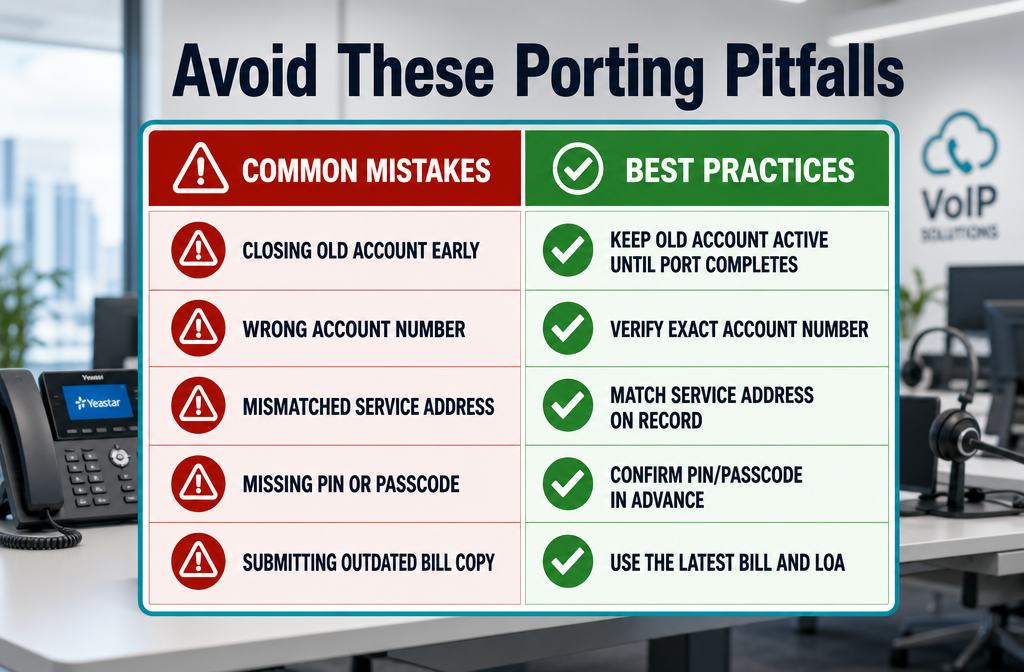
Understanding how to port your number to a VoIP provider also means knowing what can go wrong. These are the most frequent failure points:
❌ Mistake 1: Mismatched Account Information
Fix: Call your current carrier before submitting the LOA and confirm every field verbally.
❌ Mistake 2: Porting a Number Under a Contract
Some carriers charge early termination fees (ETFs) if you’re mid-contract. The port will still go through — but you may owe fees. Review your current contract first.
❌ Mistake 3: Choosing the Wrong VoIP Provider
Not all VoIP providers have the same porting infrastructure. Look for providers that:
- Have a dedicated porting team
- Offer real-time port status tracking
- Provide a clear SLA (Service Level Agreement) for porting timelines
Top VoIP providers known for smooth porting in 2026: RingCentral, Vonage, Nextiva, Ooma, and Google Voice (for personal use).
❌ Mistake 4: Forgetting to Port Numbers on a Business Account
If your business has multiple lines, each number must be listed separately on the LOA. Missing even one number means it stays with the old carrier.
❌ Mistake 5: Not Having a Backup Plan
Even smooth ports can have brief interruptions. Have a call forwarding rule set up on your old account as a safety net during the transition window.
How to Port Your Number to a VoIP Provider: Special Scenarios
Porting a Toll-Free Number
Toll-free numbers use a separate system managed by Responsible Organizations (RespOrgs). Your new VoIP provider must be a registered RespOrg or work with one. The process is similar, but expect slightly longer timelines (up to 5 business days).
Porting International Numbers
International porting rules vary by country. In the EU, regulations similar to the U.S. FCC mandate apply. Always confirm with both your current carrier and the new VoIP provider before attempting an international port.
Porting After a Carrier Merger or Acquisition
If your current carrier was acquired, account numbers may have changed. Contact the new parent company to confirm current account details before submitting any LOA.
What Happens After the Port Completes?
Once the number transfers successfully:
- Calls to your old number route through your VoIP system automatically
- Your old carrier account can now be safely canceled or downgraded
- Test all features — inbound calls, outbound calls, voicemail, and any integrations
- Update your number in Google Business Profile, your website, and any directories
Most VoIP providers send a confirmation email or SMS the moment the port completes.
Conclusion: Take Control of Your Number Today
Learning how to port your number to a VoIP provider is one of the highest-ROI tasks a business or individual can complete when switching phone systems. The process is legally protected, well-supported by reputable providers, and entirely manageable with the right preparation.
Actionable next steps:
- 🔍 Run a portability check with your target VoIP provider today
- 📋 Pull your current carrier bill and note your exact account details
- 📝 Choose a VoIP provider with a dedicated porting team
- 📅 Submit your LOA and mark your FOC date on the calendar
- ⚙️ Configure your VoIP system before the port date arrives
Don’t let the fear of losing your number keep you on an outdated, overpriced phone system. With the right steps, the transfer is smooth, fast, and permanent.
References
- Federal Communications Commission. (2003). Local Number Portability. FCC Consumer Guide. https://www.fcc.gov/consumers/guides/porting-your-phone-number
- North American Numbering Plan Administrator (NANPA). (2019). Number Portability Overview. https://nationalnanpa.com
- RingCentral. (2022). How Number Porting Works: A Complete Business Guide. RingCentral Blog.
- Vonage. (2021). VoIP Number Porting: What You Need to Know. Vonage Resource Center.
- CTIA – The Wireless Association. (2020). Consumer Guide to Wireless Number Portability. https://www.ctia.org