
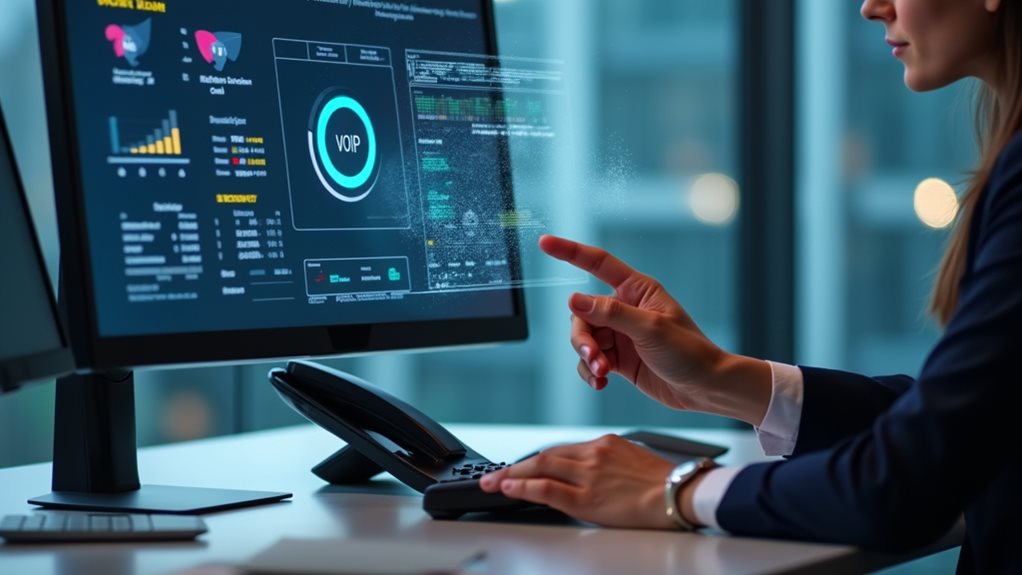
VoIP systems greatly reduce phone fraud through multiple security layers. You’ll benefit from real-time analytics that flag suspicious call patterns, robust encryption that protects sensitive conversations, and multi-factor authentication that verifies caller identities. Geographic call restrictions can block high-risk countries, while automated alerts notify you of unusual activities. Unlike traditional phone systems, VoIP solutions integrate seamlessly with existing security infrastructure while offering cost-effective scalability. Discover how these advanced features can transform your business’s communication security posture.
Understanding the Rising Threat of Phone Fraud in 2023
You’re likely facing more sophisticated attacks than ever before, with 2023 bringing unprecedented emerging threats that target your company’s voice networks.
Today’s fraud trends show a concerning shift toward social engineering and AI-powered voice manipulation, allowing criminals to bypass traditional security measures.
Voice deepfakes, caller ID spoofing, and toll fraud now represent substantial risks to your bottom line and reputation.
What makes these attacks particularly dangerous is their ability to mimic legitimate business communications.
You’ll need to recognize that modern phone fraud isn’t just about financial loss—it also threatens customer trust and data security, making proactive protection more essential than ever. Vishing scams can exploit emotional triggers, making it crucial to educate your employees about recognizing fraudulent tactics.
VoIP Security Features That Combat Sophisticated Scams
Modern VoIP systems offer robust encryption that shields your business calls from potential eavesdroppers attempting to steal sensitive information.
You’ll benefit from sophisticated fraud detection algorithms that can identify suspicious calling patterns before they develop into costly security breaches.
Perhaps most impressively, cutting-edge biometric voice authentication guarantees that only authorized personnel can access your communication systems, effectively eliminating the risk of impersonation attacks. Additionally, implementing robust encryption protocols ensures that voice packets are secure during transmission, further safeguarding against unauthorized access and potential breaches.
Encryption Prevents Eavesdropping
Sophisticated eavesdroppers can intercept unsecured phone calls, but VoIP’s encryption capabilities create a formidable barrier against these intrusions. When you implement VoIP solutions with robust encryption protocols, you’re fundamentally wrapping your communications in an impenetrable digital shield.
Standard VoIP systems employ TLS (Transport Layer Security) and SRTP (Secure Real-time Transport Protocol) to safeguard your conversations from malicious listeners. Additionally, utilizing encryption protocols enhances the security of your voice data, making it significantly harder for unauthorized users to access your communications.
You’ll notice the difference immediately when switching to encrypted VoIP—no more concerns about sensitive information being compromised during client calls or internal discussions.
These secure communications prevent criminals from accessing valuable data that could facilitate fraud or identity theft. By maintaining encrypted channels, you’re not only protecting individual conversations; you’re safeguarding your company’s reputation and preserving client trust.
This protective layer represents one of VoIP’s most significant advantages in today’s security-conscious business environment.
Fraud Detection Algorithms
Beyond basic encryption protocols, VoIP systems now incorporate advanced fraud detection algorithms that constantly monitor your communication patterns to identify potential threats.
These intelligent systems analyze call data in real-time, flagging suspicious activities like unusual international calls or multiple failed authentication attempts.
By implementing robust fraud prevention strategies, you’ll dramatically reduce vulnerability to costly scams.
Most premium VoIP providers offer customizable call monitoring tools that let you establish normal usage parameters and receive instant alerts when deviations occur. You can set thresholds for specific call destinations, durations, and volumes to prevent exploitation.
What makes these algorithms particularly effective is their adaptive nature—they learn from your business’s unique communication habits, continuously refining their detection capabilities.
This personalized approach guarantees you’re protected against evolving threats without disrupting legitimate business operations, ensuring compliance with stringent regulations and emphasizing the importance of maintaining trust in communication infrastructure.
Biometric Voice Authentication
While traditional authentication methods rely on passwords or PINs, biometric voice authentication represents a considerable leap forward in VoIP security technology. Your unique voice print functions like a vocal fingerprint, providing a security layer that’s nearly impossible to replicate by fraudsters. This technology analyzes over 100 voice characteristics in real-time, verifying your identity without requiring you to remember complex passwords.
Key advantages of voice biometrics include:
- Frictionless authentication during natural conversation
- Noticeably reduced false acceptance rates compared to PINs
- Improved user privacy through encrypted voice templates
- Ability to detect recorded voice attacks with liveness detection
Additionally, implementing robust encryption protocols ensures that voice data remains secure throughout the authentication process.
You’ll find this technology particularly valuable when handling sensitive transactions or accessing confidential information.
Real-Time Analytics: Detecting Suspicious Call Patterns
Real-time analytics transform your VoIP system into a vigilant guardian through sophisticated pattern recognition systems that flag unusual calling behavior before damage occurs.
You’ll receive immediate alerts when the system detects anomalies like unexpected international calls or unusual call volumes, giving your security team critical response time.
These behavioral analysis tools continuously learn from your company’s typical communication patterns, creating an increasingly personalized security profile that distinguishes between legitimate business activities and potential fraud attempts. Additionally, this proactive monitoring helps mitigate risks associated with VoIP fraud schemes, ensuring that your organization remains one step ahead of scammers.
Pattern Recognition Systems
Modern pattern recognition systems form the backbone of VoIP’s fraud detection capabilities.
These sophisticated systems employ advanced pattern analysis to identify suspicious behaviors before they impact your business. You’ll find that today’s VoIP solutions can monitor call patterns across your network and flag anomalies that might indicate fraud attempts.
Voice recognition technology further improves security by:
- Identifying known fraudulent voices in your system
- Comparing caller voices against a database of known scammers
- Detecting synthetic or AI-generated voices that might indicate spoofing
- Analyzing vocal stress patterns that could signal deceptive intentions
Additionally, leveraging robust encryption protocols can further bolster your defenses against potential VoIP fraud.
Anomaly Alert Mechanisms
Three critical components form the foundation of effective anomaly alert mechanisms in VoIP systems.
First, advanced anomaly detection algorithms continuously monitor call patterns, identifying deviations from established baselines without requiring predefined threat signatures. You’ll benefit from these systems flagging unusual calling times, unexpected international connections, or sudden volume spikes.
Second, customizable thresholds allow you to adjust sensitivity based on your business needs—balancing security against false positives. You can set parameters specific to departments or user groups, guaranteeing appropriate monitoring across your organization.
Finally, multi-channel alert notifications guarantee security teams receive immediate warnings through email, SMS, or dashboard alerts. This rapid response capability enables your team to investigate potential threats before notable damage occurs, potentially saving thousands in fraudulent charges and protecting your company’s reputation. Additionally, implementing multi-factor authentication can significantly enhance the security of your VoIP system, further mitigating risks associated with fraud.
Behavioral Analysis Tools
Behavioral analysis tools form the cornerstone of effective VoIP security strategies, enabling your business to identify fraudulent activities before they escalate into costly breaches.
These sophisticated systems continuously monitor your call patterns, leveraging behavioral insights to establish what’s normal for your organization.
When implementing these fraud prevention tools, you’ll benefit from:
- Real-time analytics that flag unusual calling volumes or destinations
- Machine learning algorithms that adapt to your unique communication patterns
- Contextual analysis that examines call timing, duration, and frequency
- Automated risk scoring that prioritizes potential threats based on severity
You’ll find these tools particularly valuable during non-business hours when suspicious activities often occur. Additionally, they can significantly reduce the risk of data breaches by alerting you to potential vulnerabilities in your VoIP system.
Call Encryption: Securing Sensitive Business Communications
While traditional phone systems transmit calls as unprotected data across networks, VoIP technology offers robust encryption capabilities that can shield your business communications from prying eyes.
By implementing advanced call encryption methods, you’ll create a secure environment where sensitive information remains confidential during transmission.
You’ll want to adopt secure communication practices such as Transport Layer Security (TLS) and Secure Real-time Transport Protocol (SRTP) to protect both signaling and media streams.
These protocols guarantee that your voice data can’t be intercepted or manipulated by unauthorized parties.
Don’t overlook the importance of end-to-end encryption for your most confidential calls.
This guarantees that only the intended recipients can decode the conversation, even if someone manages to infiltrate your network.
Your business deserves this extra layer of protection against increasingly sophisticated eavesdropping attempts, especially considering that strong passwords and multi-factor authentication are also vital for preventing unauthorized access to your VoIP systems.
Multi-Factor Authentication for Enhanced Caller Verification

Encryption alone can’t fully shield your business from sophisticated phone fraud schemes.
That’s why implementing multi-factor authentication (MFA) has become crucial for verifying caller identity in today’s VoIP systems. By requiring multiple verification methods, you’ll create layered security protocols that greatly reduce the risk of unauthorized access.
Multi-factor authentication creates essential defense layers that protect your VoIP system from today’s sophisticated identity threats.
Your VoIP system can incorporate MFA through:
- Biometric verification using voice recognition technology
- One-time passwords sent to mobile devices
- PIN codes that change periodically
- Physical security tokens that generate unique access codes
When someone attempts to access sensitive information or systems, they’ll need to provide multiple credentials rather than just a password.
This approach creates formidable barriers against impersonation attempts, guaranteeing that your team can confidently verify who’s actually on the other end of each call.
Implementing Geographic Call Restrictions to Prevent International Fraud
Many international fraud schemes target U.S. businesses through VoIP systems, particularly from regions known for cybercriminal activity.
You can mitigate this risk by implementing geographic call limitations, which allow you to block incoming and outgoing calls from high-risk countries where you don’t conduct business.
Your VoIP provider should offer tools to set country-specific restrictions that integrate seamlessly with your existing security framework.
These geographic boundaries serve as a critical component of thorough fraud prevention strategies. You’ll find that restricting calls to necessary regions not only diminishes fraud attempts but also minimizes unauthorized international charges that might otherwise go unnoticed.
Consider reviewing your call patterns quarterly to refine these restrictions based on legitimate business needs, guaranteeing protection without hampering operations.
This targeted approach provides a balance between security and accessibility.
Automated Alert Systems for Unusual Call Activity

Beyond regional restrictions, automated alert systems represent the next layer of VoIP security defense. These systems continuously monitor your call patterns and trigger automated notifications when unusual activity is detected.
You’ll gain real-time insights into potential security breaches before they escalate into costly fraud incidents.
The most effective VoIP alert systems include:
- Threshold-based alerts for calls exceeding predetermined duration or cost limits
- Pattern recognition that identifies deviations from your company’s typical calling behavior
- After-hours activity monitoring that flags calls made outside business operations
- Geographical anomaly detection that identifies unexpected international connections
Integrating Voip With Existing Security Infrastructure
When implementing VoIP solutions, your organization’s overall security posture depends heavily on how seamlessly these systems integrate with your existing security framework.
Successful VoIP integration requires a thorough assessment of your current security architecture to identify potential vulnerabilities and compatibility issues.
You’ll need to configure your firewalls, intrusion detection systems, and authentication protocols to recognize and protect VoIP traffic specifically.
Many modern security solutions offer dedicated VoIP protection modules that you can enable without overhauling your entire infrastructure.
Consider implementing SIEM (Security Information and Event Management) tools that can correlate VoIP events with other security data, providing a unified view of potential threats across all communication channels.
This holistic approach guarantees your phone systems don’t become the weak link in your security chain.
Cost-Benefit Analysis: VoIP Security vs. Traditional Phone Systems

Although traditional phone systems have been the business standard for decades, they often carry hidden costs that VoIP security solutions can greatly reduce. When you’re calculating the true financial impact, VoIP security offers considerable cost savings through streamlined management and reduced vulnerability to fraud.
Your business benefits from VoIP security in multiple ways:
- Lower maintenance expenses compared to hardware-intensive traditional systems
- Reduced fraud-related financial losses through advanced authentication features
- Improved user experience with seamless integration across devices
- Scalability without proportional cost increases as your business grows
While traditional systems require notable upfront investment in physical infrastructure, VoIP solutions distribute costs more efficiently through subscription models.
You’ll find that the improved security features of modern VoIP systems pay for themselves through fraud prevention alone, making them increasingly attractive for businesses of all sizes.
Frequently Asked Questions
Can Small Businesses Implement Voip Security Measures Affordably?
Yes, you can implement cost-effective solutions for VoIP security. Many providers offer budget-friendly options with built-in protection features. You’ll find affordable encryption, authentication tools, and regular security updates suitable for small businesses.
How Quickly Can Voip Security Features Be Deployed?
You’ll find VoIP security features can be deployed within hours or days, not weeks. Most providers offer rapid VoIP deployment speed with instant VoIP feature integration once your account is activated and configured.
Does Voip Security Impact Call Quality or Business Operations?
Yes, but properly implemented VoIP encryption benefits your security without sacrificing performance. You’ll need call quality optimization strategies to balance protection and functionality, guaranteeing your business operations remain seamless while keeping communications secure.
What Training Do Employees Need for Voip Security Protocols?
You’ll need to train your employees on security best practices, including strong password creation, phishing awareness, secure Wi-Fi usage, proper handling of sensitive information, and recognizing suspicious call patterns. Regular employee awareness refreshers are vital.
Can Voip Systems Detect Social Engineering Attempts?
Yes, advanced VoIP systems can detect social engineering attempts through fraud detection features that analyze call patterns, voice characteristics, and suspicious behaviors. You’ll need properly configured security settings to maximize this protection capability.
Final Thoughts
VoIP technology offers you a robust defense against the evolving environment of phone fraud. By implementing encrypted communications, multi-factor authentication, and real-time analytics, you’ll not just protect your business’s sensitive information but also realize considerable cost savings compared to traditional systems. Don’t wait for a security breach to take action—embrace VoIP’s advanced security features today and stay one step ahead of sophisticated scammers targeting your business communications.