

Neither cloud nor on-premise VoIP is inherently “better”—your choice depends on specific business needs. Cloud solutions offer flexibility, minimal upfront costs, and automatic updates, making them ideal for growing companies with limited IT resources. On-premise systems provide greater control over security and customization but require considerable initial investment and ongoing maintenance. Consider your budget constraints, growth projections, security requirements, and in-house IT capabilities to determine which deployment model aligns with your long-term communication strategy.
Understanding the Core Differences Between Cloud and On-Premise VoIP
When diving into the world of Voice over Internet Protocol (VoIP) systems, you’ll quickly encounter two distinct deployment models: cloud-based and on-premise solutions. The fundamental difference lies in where your system resides—cloud VoIP operates on remote servers, while on-premise systems live within your physical location.
This distinction greatly impacts your user experience. Cloud solutions offer flexibility with minimal upfront investment; you’ll access your system from anywhere with an internet connection. On-premise options provide greater control over your hardware and potentially more customization. Furthermore, cloud systems can implement advanced features that enhance productivity without the need for extensive hardware.
Your deployment choice shapes your entire VoIP experience—flexibility with cloud solutions or control with on-premise systems.
Any feature comparison should consider scalability—cloud systems easily grow with your business, while on-premise installations may require hardware upgrades.
Security approaches differ too; on-premise gives you direct control over protections, while cloud providers handle security updates and maintenance on your behalf.
Cost Analysis: Initial Investment vs. Long-Term Expenses
Although both VoIP deployment options deliver similar functionalities, they present dramatically different financial models that’ll impact your bottom line for years to come.
With on-premise systems, you’ll face substantial initial costs for hardware, installation, and licensing—often requiring capital expenditure approval and depreciation over time.
Cloud VoIP, conversely, operates on a predictable subscription model with minimal upfront investment. You’ll pay recurring fees based on users or features, avoiding the steep initial outlay while gaining automatic updates and maintenance.
Your decision should consider your cash flow situation and growth projections. Choosing a VoIP service should also account for the scalability of the system you select, ensuring it can adapt to your business’s evolving needs.
On-premise might prove more economical for stable, long-term operations where you control upgrade timing, while cloud solutions offer flexibility for growing businesses that prefer operational expenses to capital investments.
Scalability and Flexibility Considerations for Growing Businesses

Beyond the financial framework of VoIP systems lies another critical business evaluation—how well your communication infrastructure can adapt to changing organizational needs.
When implementing scalability strategies, cloud-based VoIP solutions typically offer superior adaptability, allowing you to add or remove users without considerable hardware investments.
On-premise systems, while robust, often require more planning for growth. You’ll need to assess hardware capacities and potential upgrade costs when designing your expansion roadmap.
Cloud flexibility options include rapid deployment of new features and locations, which proves invaluable during seasonal fluctuations or sudden growth periods.
Your choice ultimately depends on your projected growth trajectory. If you’re anticipating steady, predictable expansion, on-premise might suffice.
However, for businesses with variable growth patterns or multiple locations, cloud solutions provide agility that traditional systems simply can’t match. Additionally, the ability to integrate multiple communication methods into one platform enhances the efficiency of your operations.
Security and Compliance: Protecting Your Communication Data
When choosing between cloud and on-premise VoIP systems, you’ll need to evaluate how each solution protects your sensitive communication data.
Cloud providers typically offer robust encryption and redundant security protocols, though you’ll want to verify their compliance with regulations specific to your industry. Additionally, implementing strong credentials and two-factor authentication can further enhance the security of VoIP systems against unauthorized access. On-premise systems give you greater control over your security infrastructure, which may be vital if you’re operating under strict regulatory frameworks like HIPAA or GDPR.
Data Protection Mechanisms
How effectively your VoIP system safeguards sensitive communications can make or break your business’s security posture. Both cloud and on-premise systems offer robust data encryption capabilities, but they implement these protections differently.
Cloud VoIP providers typically handle encryption automatically through their infrastructure, while on-premise systems require your IT team to configure and maintain these safeguards.
When evaluating options, you’ll need to contemplate which solution better aligns with your industry’s compliance standards.
Cloud providers often maintain certifications like HIPAA, SOC 2, and GDPR compliance as part of their service offering. On-premise systems give you complete control over your compliance framework, but you’ll shoulder the responsibility of implementing and documenting all security measures. This distinction becomes particularly vital if you operate in highly regulated industries where data protection requirements are stringent, especially considering that over 25% of networks lack encryption, increasing the risks of data interception.
Regulatory Framework Adherence
As your business expands globally, regulatory compliance for VoIP systems becomes increasingly complex with each market you enter.
Cloud VoIP providers typically handle compliance responsibilities, staying current with evolving regulations like GDPR, HIPAA, and PCI DSS, which can greatly reduce your administrative burden.
With on-premise systems, you’ll shoulder the full responsibility for guaranteeing regulatory compliance and meeting industry standards.
This requires dedicated resources to monitor changing regulations, implement necessary updates, and conduct regular audits—tasks that often demand specialized expertise.
When evaluating VoIP options, consider your industry’s specific requirements.
Healthcare organizations need HIPAA compliance, while financial institutions must meet stringent data protection standards.
Your choice should align with your compliance needs while balancing operational flexibility and control over sensitive communication data. Additionally, ensure that your VoIP systems adopt strong authentication methods to safeguard against unauthorized access.
Reliability and Uptime Comparisons
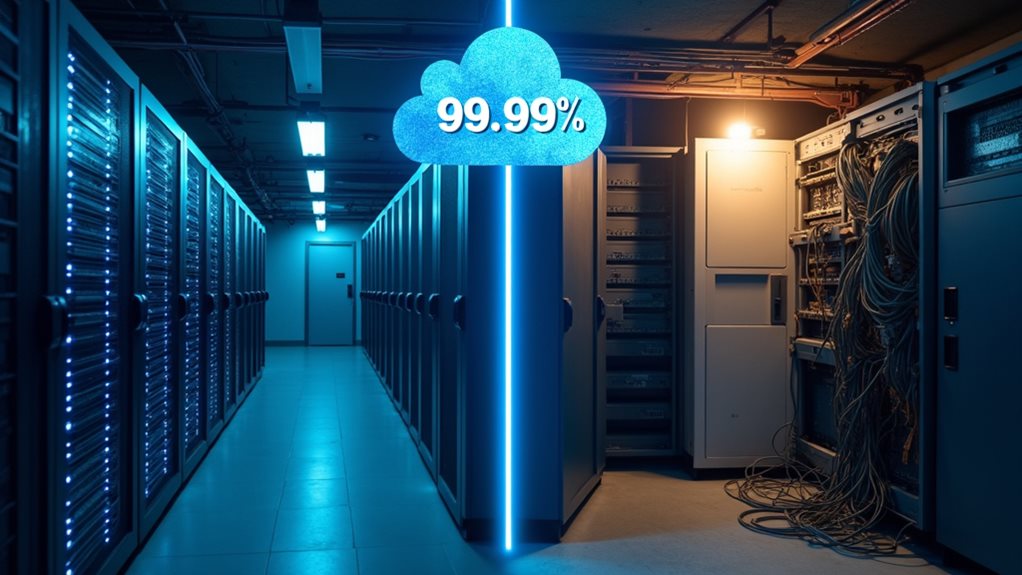
Cloud and on-premise VoIP systems differ greatly in their network dependency, with cloud solutions relying on your internet connection while on-premise systems depend on your local infrastructure.
Your vulnerability to outages varies accordingly—cloud systems might falter during internet disruptions, whereas on-premise installations could fail during power outages or hardware malfunctions.
When considering disaster recovery, you’ll find cloud solutions typically offer automatic failover and geographic redundancy, while on-premise systems require your team to implement and maintain separate backup infrastructure. Additionally, robust infrastructure is essential for high-quality service delivery, particularly in large-scale VoIP environments.
Network Dependency Differences
When evaluating VoIP systems, understanding network dependency reveals critical differences between cloud and on-premise solutions.
Cloud-based VoIP relies entirely on your internet connection, making network performance a critical factor in call quality. If your internet goes down, so does your phone system. You’ll need to guarantee consistent bandwidth requirements are met to maintain clear communications. Moreover, switching to VoIP can lead to cost savings as businesses may save approximately 30% on phone bills compared to traditional lines.
On-premise systems, while still requiring network connectivity for external calls, can maintain internal communications even during internet outages.
However, you’re responsible for managing the infrastructure that supports this reliability. Your IT team must monitor and maintain local network resources to prevent bottlenecks.
Both options present distinct trade-offs: cloud solutions offer flexibility but demand robust internet connectivity, while on-premise systems provide more control at the cost of increased management responsibility.
Disaster Recovery Capabilities
Network reliability represents only part of the equation; your ability to recover from unexpected disruptions defines the true resilience of your VoIP system.
When evaluating disaster recovery capabilities, cloud solutions generally offer superior protection through geographically dispersed data centers that maintain service during localized outages. Your calls automatically reroute through alternative servers without intervention.
On-premise systems, conversely, require more extensive disaster recovery strategies that you must implement and maintain. Without redundant infrastructure at separate locations, you’re vulnerable to extended downtime during facility-affecting incidents.
However, you’ll have complete control over your business continuity solutions, potentially offering personalized recovery processes for your specific needs. Furthermore, dedicated VoIP networks ensure reliability, allowing for smoother restoration of communications in the event of disruptions.
The choice often hinges on balancing your organization’s resources against the consequences of potential downtime—cloud solutions provide built-in protection, while on-premise demands greater investment but offers customized control.
Implementation Timelines and Deployment Complexity
Choosing between cloud and on-premise VoIP systems often hinges on how quickly you’ll need your communication infrastructure up and running.
Cloud solutions typically offer superior implementation speed, with many platforms allowing you to configure and deploy within days rather than weeks or months.
On-premise systems present notable deployment challenges, requiring physical hardware installation, network configuration, and thorough testing before going live.
You’ll need IT staff with specialized knowledge or external consultants to manage this process.
Meanwhile, cloud VoIP providers handle the technical heavy lifting on their end, allowing your team to focus on user training rather than infrastructure setup.
This difference becomes particularly critical when you’re facing tight deadlines or lack robust IT resources.
The reduced complexity of cloud deployment can translate to faster adoption rates and less downtime during change periods. Additionally, proper network configuration is key to successful implementation, ensuring that the network requirements are assessed prior to setup.
Maintenance Requirements and IT Resource Allocation

The implementation speed differences between cloud and on-premise solutions directly impact another critical consideration: ongoing maintenance demands.
When choosing between these options, you’ll need to carefully evaluate how your IT resources will be allocated for day-to-day upkeep and troubleshooting.
With your VoIP system, consider these maintenance strategies for resource optimization:
- Personnel requirements – Cloud solutions reduce the need for specialized on-site staff, while on-premise systems typically require dedicated IT personnel with specialized telephony knowledge.
- Update management – Cloud providers handle updates automatically, whereas on-premise solutions require manual patching and upgrade scheduling.
- Problem resolution – With cloud systems, your provider handles most technical issues, freeing your team to focus on core business functions rather than telecom troubleshooting.
Integration Capabilities With Existing Business Systems
When selecting a VoIP system, you’ll need to assess how well it integrates with your existing business applications through API compatibility options.
Cloud-based solutions typically offer more robust and flexible APIs that connect seamlessly with CRM systems, helpdesk software, and collaboration tools you’re already using.
On-premise systems might require custom integration work, so you’ll want to verify how your current software ecosystem aligns with either option before making your final decision.
API Compatibility Comparison
How effectively your VoIP system connects with your existing business tools can dramatically impact operational efficiency.
When comparing cloud and on-premise VoIP solutions, you’ll find noteworthy differences in their API integration capabilities.
Cloud-based systems typically offer:
- Pre-built integrations with popular CRMs, helpdesks, and business applications that you can implement without extensive coding
- Regular API updates that guarantee compatibility with evolving third-party services
- Standardized RESTful APIs that simplify custom integration development
On-premise solutions often present compatibility challenges with newer applications, requiring custom development work.
You’ll need to evaluate whether your IT team has the expertise to manage these integrations.
While on-premise systems offer more control over integration security, they typically demand greater technical resources to maintain connectivity as your business software ecosystem evolves.
Software Ecosystem Alignment
Selecting a VoIP system that aligns with your current software ecosystem can dramatically reduce workflow disruptions and boost team productivity. When evaluating your options, you’ll want to conduct thorough compatibility checks with your existing applications, particularly CRM, email, and productivity tools.
Cloud-based VoIP solutions typically offer broader integration capabilities with modern business platforms, allowing for seamless user experience across systems. However, on-premise systems might better align with legacy software that your team has already mastered, potentially reducing user training requirements.
Consider how vendor support handles integration challenges and how frequently system updates deliver feature improvements.
You’ll also need to evaluate platform stability and performance metrics to guarantee your communications infrastructure remains reliable.
Don’t overlook user feedback from teams who’ll depend on these integrations daily—their insights often reveal practical concerns that technical specifications miss.
Disaster Recovery and Business Continuity Planning

Despite robust infrastructure, any communication system can fail during disasters, making thorough recovery planning essential for your business continuity strategy.
Cloud-based VoIP systems typically offer superior disaster readiness compared to on-premise solutions, as they’re distributed across multiple data centers.
When evaluating your options for business resilience, consider these vital factors:
- Recovery Time Objective (RTO) – Cloud systems often restore service within minutes, while on-premise recovery might take days depending on physical damage.
- Geographical redundancy – Cloud providers maintain multiple locations, protecting your communications from regional disasters.
- Automatic failover capabilities – How seamlessly your system shifts to backup resources without manual intervention.
You’ll need to weigh these considerations against your organization’s specific needs and risk tolerance when choosing between cloud and on-premise VoIP solutions.
Making the Right Choice: Assessment Criteria for Your Organization
When choosing between cloud and on-premise VoIP systems, your organization’s unique requirements must drive the decision-making process rather than following general market trends.
Begin by conducting a thorough feature comparison between your options, evaluating which solution aligns with your business objectives and communication needs.
Success in VoIP selection hinges on matching solution features to your organization’s specific communication requirements and strategic goals.
Consider how each option affects user experience—will your team adapt easily to the interface? Do they need specialized features that only certain providers offer?
You’ll want to assess your IT team’s capacity to manage on-premise hardware versus the convenience of cloud solutions. Additionally, factor in your growth projections, security requirements, and budget constraints.
Don’t forget to evaluate vendor reliability and support options, as these profoundly impact long-term satisfaction with your chosen system.
Frequently Asked Questions
How Do Cloud and On-Premise Voip Systems Affect Call Quality?
Your call clarity depends on internet quality with cloud systems, which can introduce latency issues. On-premise VoIP typically offers more consistent call quality since you’re not relying on external networks for voice transmission.
Can I Switch Between Cloud and On-Premise Systems Later?
Yes, you can switch between systems later, but you’ll face migration challenges with data transfer and integration. Consider cost implications including potential hardware losses, new licensing fees, and training needs for your team.
How Do Power Outages Impact Different Voip System Types?
During power outages, cloud systems keep working remotely while on-premise systems go down unless you’ve invested in backup power. You’ll need proper outage preparedness for on-premise, while cloud offers better power reliability automatically.
What Training Do Employees Need for Each System?
You’ll need basic user training for both systems, but on-premise requires additional system maintenance knowledge. Cloud solutions typically offer simpler interfaces with vendor-managed updates, while you’ll manage technical aspects yourself with on-premise systems.
How Do Voip Systems Handle International Calling Capabilities?
VoIP systems handle international calling through specialized international dialing plans. You’ll find cloud solutions often offer better rates, while on-premise systems may require additional configuration. Both options reduce cost considerations compared to traditional phone lines.
Final Thoughts
Your choice between cloud and on-premise VoIP ultimately depends on your unique business requirements. Consider your budget constraints, growth projections, security needs, and IT capabilities when deciding. Cloud solutions offer flexibility and minimal maintenance, while on-premise systems provide greater control and potentially lower long-term costs. Evaluate your priorities carefully—whether it’s scalability, customization, or compliance—to implement the VoIP system that’ll best support your communication goals.