

Two-thirds of UK SMEs ran out of mobile data at least once in the last two years, costing businesses an average of £3,400 per year in lost productivity. For a small team, that’s a significant hit that a better-chosen plan could prevent entirely. Choosing the best business mobile plans for UK SMEs isn’t just about finding the cheapest SIM. It’s about matching your team’s actual usage patterns, coverage needs, and growth trajectory to the right network and contract structure.
This guide cuts through the noise and gives you a practical, honest comparison of what’s available in 2026.
Key Takeaways
- EE leads on UK 5G coverage and network reliability, best for teams who need consistent connectivity anywhere.
- Vodafone is the strongest choice for SMEs with international travel requirements, covering 83 countries.
- O2 offers flexible, adaptable data plans with EU roaming included from £13/month.
- Sky Business Mobile’s Roll & Share feature is a smart solution for teams with uneven data usage.
- Regional B2B providers like Halstone Mobile can offer more hands-on account support than national call centres, worth considering if you’re in the Midlands or Staffordshire.
How to Evaluate the Best Business Mobile Plans for UK SMEs
Before comparing individual providers, it helps to know what you’re actually comparing. Business mobile plans differ from consumer contracts in several important ways: dedicated account management, VAT invoicing, multi-SIM discounts, and often better flexibility on contract length.
Here are the core criteria every SME should weigh up:
- 📶 Network coverage: Does the network perform well where your team actually works, not just in major cities?
- 💾 Data allowance: Are you buying enough data, or paying for more than you need?
- 🌍 Roaming: If your team travels, which countries are included without extra charges?
- 📞 Call and text inclusions: Most business plans include unlimited calls and texts, but confirm this.
- 🔄 Contract flexibility: 12-month vs 24-month; SIM-only vs device bundles.
- 🧾 Account management: Can you manage multiple SIMs centrally? Is there a dedicated account manager?
- 📈 Scalability: How easy is it to add lines as your team grows?
Worth knowing: As of 2026, 54% of UK SMEs are actively using AI tools, up from 35% just a year ago. That shift means more data consumption across mobile devices, making data allowance planning more important than ever.
If your business also relies on desk-based calling, it’s worth exploring how mobile plans integrate with cloud-based phone systems, the two work best together when they’re designed to.
The Major Networks: Head-to-Head Comparison
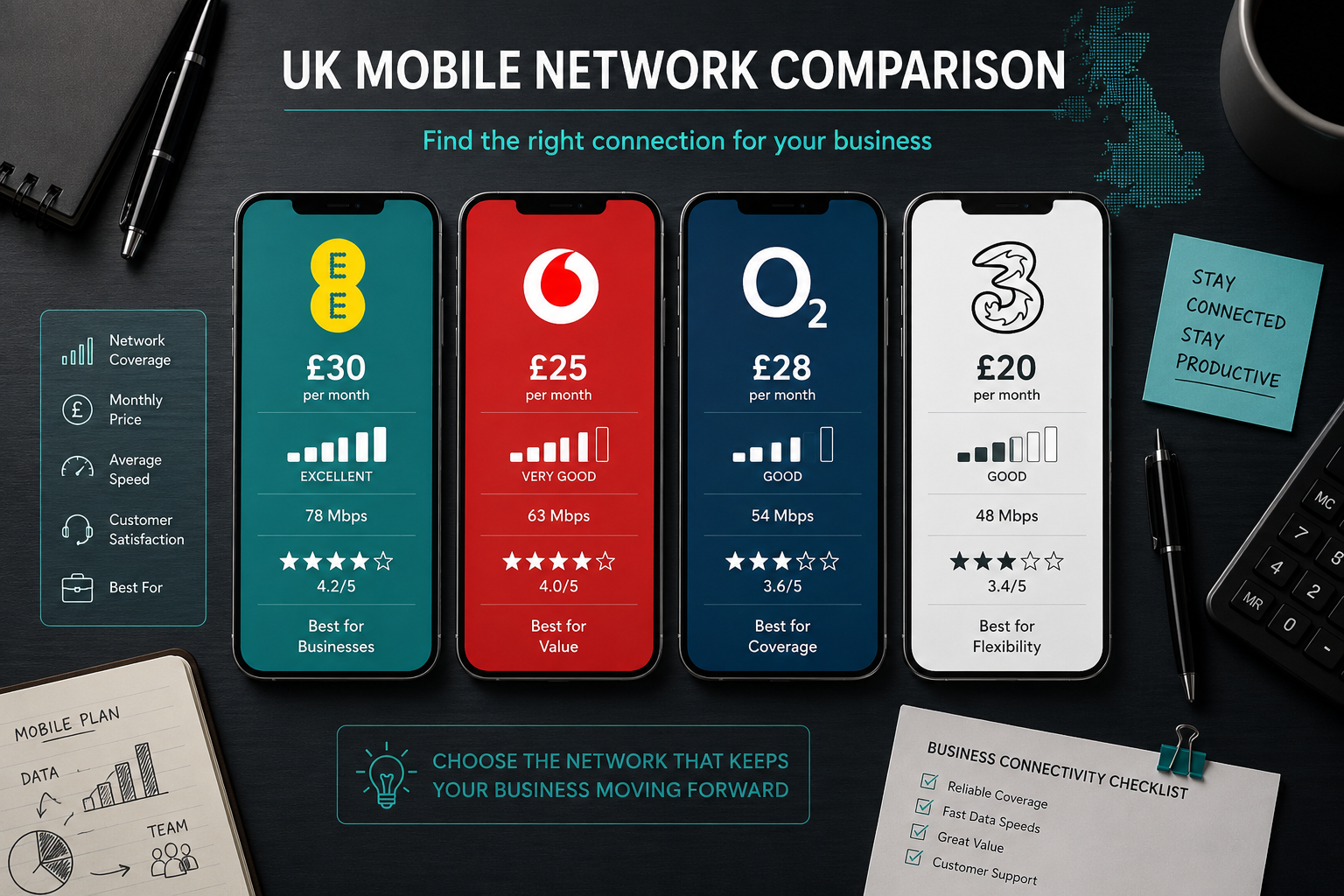
EE Business, Best for Network Reliability
EE consistently tops independent network reliability tests and offers the UK’s widest 5G coverage. For SMEs whose teams are spread across urban and rural areas, that breadth matters.
SIM-only plans start from around £10-£12 per month, making EE competitive on price as well as performance. Business customers also get access to dedicated business support lines and multi-SIM management tools.
Best for: Teams spread across the UK who can’t afford dead zones during client calls or field work.
Vodafone Business, Best for International Operations
Vodafone’s business plans include roaming in 83 countries, which is the strongest international offering among the major UK networks. If your team travels regularly to Europe, the US, or further afield, Vodafone removes the headache of managing roaming charges.
SIM-only plans start from £15-£20 per month. The higher starting price reflects the broader feature set, dedicated account management, device management tools, and solid 5G rollout in major business hubs.
Best for: SMEs with staff who travel internationally or operate across multiple countries.
O2 Business, Best for Flexibility
O2’s business plans are built around adaptability. EU roaming is included as standard, and the data plan structure gives SMEs room to adjust as their needs change. SIM-only plans start from £13 per month.
O2 also has a well-established business portal for managing multiple lines, making it practical for office managers handling a growing team’s devices.
Best for: SMEs that want flexible contracts without being locked into rigid data tiers.
Three Business, Best for Data-Heavy Teams
Three’s unlimited data plans start from £20 per month, one of the most competitive unlimited offerings in the market. For businesses running VoIP apps, video calls, or large file transfers over mobile, Three’s data-first approach is genuinely useful.
Best for: Remote or field-based teams with high data consumption who want predictable monthly costs.
Sky Business Mobile, The Smart Data Management Option
Sky Business Mobile’s Roll & Share feature, launched in late 2025, solves a real problem for SMEs: uneven data usage across a team. Unused data rolls over for up to 12 months and can be shared between team members. That means a team of five doesn’t waste data when two people are on holiday and three are in back-to-back video calls.
Given that running out of data costs SMEs thousands annually, this kind of plan design has genuine financial logic behind it.
Best for: Teams with variable data usage who want to eliminate waste without constantly upgrading their plan.
| Provider | Starting Price (SIM-only) | Key Strength | Best For |
|---|---|---|---|
| EE Business | ~£10-£12/mo | Widest 5G coverage | UK-wide reliability |
| Vodafone Business | ~£15-£20/mo | 83-country roaming | International travel |
| O2 Business | ~£13/mo | Flexible data plans | Adaptable contracts |
| Three Business | ~£20/mo | Unlimited data | Data-intensive teams |
| Sky Business Mobile | Varies | Roll & Share data | Variable usage teams |
Beyond the Big Networks: Specialist and Regional Providers
The major carriers aren’t the only option, and for many SMEs, they’re not the best one.
Multi-network resellers like WicommsMobile let businesses mix connections across all four major UK networks within a single account. That’s genuinely useful for teams working across different regions where one network outperforms another.
Newer entrants are also shaking things up. In early 2026, Tide, the business banking app, launched embedded 5G mobile plans directly within its platform, offering a dedicated UK business number and unlimited 5G data on higher tiers. The appeal is obvious for startups already using Tide for banking: one less vendor, one less invoice.
Meanwhile, BT announced plans in mid-2026 to revive its BT Mobile brand with new eSIM offerings as part of a broader push to become the UK’s “digital backbone” for businesses. Worth watching, though it’s early days.

The Case for a Regional B2B Provider
There’s a genuine trade-off when buying direct from a national carrier: you get the brand name, but account support often means navigating a call centre. For SMEs that want a named contact who understands their business, a regional B2B telecoms provider can be a better fit.
Halstone Mobile & Technology’s business mobile services are a solid example of this model. Based in Newcastle-under-Lyme, Staffordshire, with over 30 years of B2B telecoms experience, Halstone serves SMEs across Staffordshire and the West Midlands, including Wolverhampton, Stafford, Stoke-on-Trent, Cannock, and Shrewsbury. The value isn’t just in the plan itself; it’s in having a local account manager who can sort issues quickly rather than queuing through a national helpline.
For SMEs in those areas weighing up personalised service versus self-serve national contracts, that distinction is worth factoring into the decision.
Mobile Plans and VoIP: Getting Both Right
A business mobile plan handles your team’s cellular connectivity, but it works best when it’s part of a broader communications setup. Many SMEs now run VoIP for small business alongside their mobile contracts, using apps like Microsoft Teams or RingCentral to make and receive calls over data rather than traditional voice minutes.
This approach has real advantages: one business number that rings on any device, lower call costs, and full integration with CRM and productivity tools. If you’re building out your communications stack, our complete guide to the best UK VoIP providers for small business covers the options in detail.
It’s also worth understanding how VoIP and mobile connectivity interact, particularly if your team relies on VoIP apps over 5G rather than Wi-Fi.
FAQ: Business Mobile Plans for UK SMEs
Q: Can I manage multiple SIMs under one business account? Yes. All major networks, EE, Vodafone, O2, and Three, offer multi-SIM business accounts with centralised billing and management portals. This is standard for business contracts, not consumer ones.
Q: Is a 12-month or 24-month contract better for an SME? 12-month contracts give more flexibility if your team size changes, but 24-month deals typically offer lower monthly costs and better device subsidies. If you’re confident in your team’s size, the longer term usually saves money.
Q: What’s the difference between a business mobile plan and a consumer plan? Business plans include VAT invoicing, dedicated business support, multi-line discounts, and often better roaming terms. They’re also easier to manage across a team from a single account.
Q: Do I need a separate plan if my team uses VoIP apps? Not necessarily, but you do need sufficient data. If your team makes most calls via a VoIP app over 4G/5G, prioritise data allowance over voice minutes. Setting up VoIP on mobile devices is straightforward once you have the right plan.
Q: Are unlimited data plans worth it for SMEs? For field-based or remote teams with heavy data usage, video calls, cloud file access, VoIP, unlimited plans from Three or similar providers remove the risk of overage charges and simplify budgeting. For office-based teams with good Wi-Fi, a capped plan is usually more cost-effective.
Q: What should I look for in a business mobile provider beyond price? Coverage in your specific area, quality of account support, contract flexibility, and how well the plan integrates with your existing phone system. A cheaper plan that drops calls in your main office isn’t a saving.
Conclusion: Choosing the Right Plan for Your Business
The best business mobile plans for UK SMEs in 2026 aren’t one-size-fits-all. EE wins on coverage breadth, Vodafone on international roaming, O2 on flexibility, and Three on data value. Sky Business Mobile’s Roll & Share feature is genuinely innovative for teams with uneven usage. And for SMEs in the Midlands who want a more hands-on relationship with their provider, regional specialists are worth a serious look.
Practical next steps:
- Audit your current usage: check actual data consumption per user before committing to a new plan tier.
- Test coverage in the locations your team works most, not just your postcode.
- Compare total cost, including roaming, overage charges, and device costs, not just the headline monthly rate.
- Consider your wider communications setup: if you’re not yet using a cloud-based business phone system alongside your mobile plan, 2026 is a good time to evaluate it.
- Get quotes from both national carriers and regional B2B providers: the difference in service quality and contract flexibility can be significant.
The right mobile plan keeps your team connected, your costs predictable, and your business moving. That’s worth taking the time to get right.