
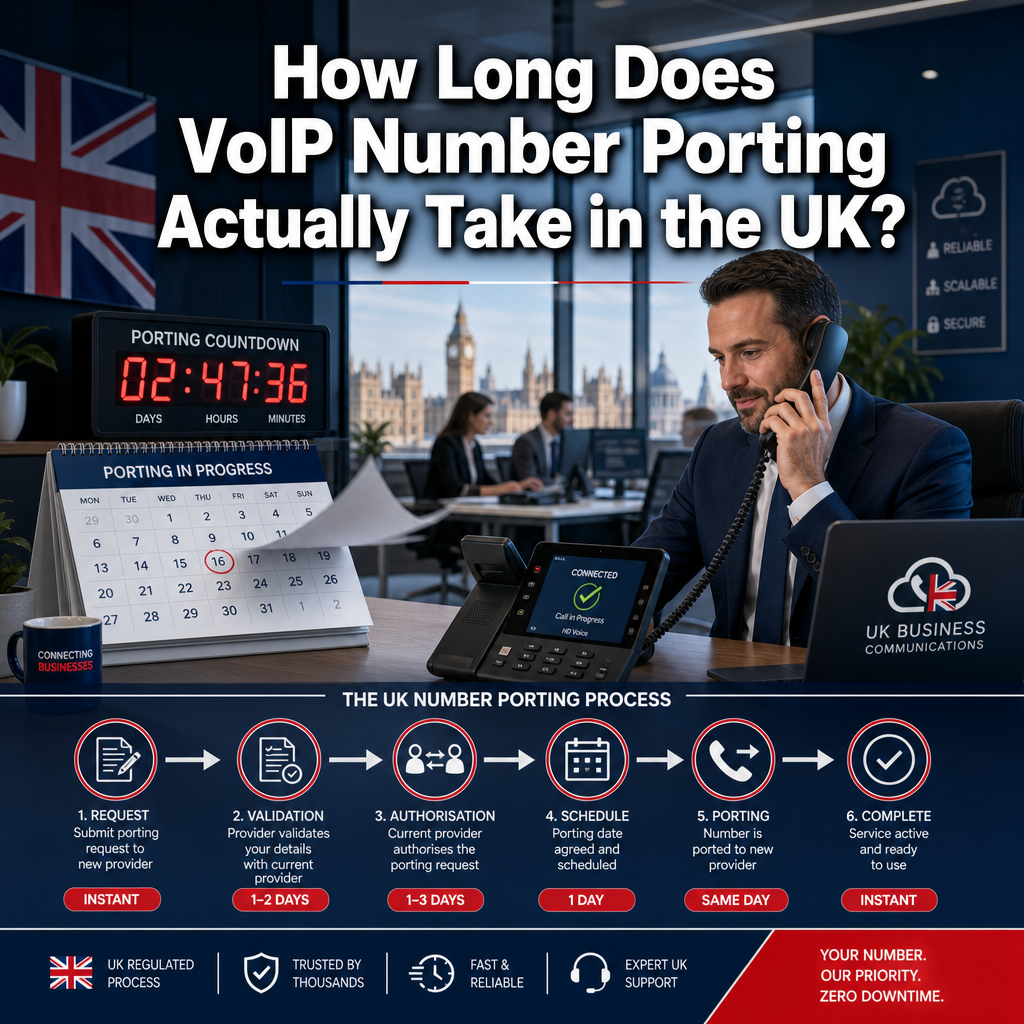
Most UK businesses switching to cloud-based communications expect their number port to complete in a week. The reality? VoIP number porting time ranges from 5 business days for straightforward single-line transfers to over 20 business days for complex multi-line migrations, and that’s when everything goes smoothly. Understanding what drives these timelines can save your business from costly downtime and frustrated customers.
The porting process involves coordination between your current provider (the losing carrier), your new VoIP provider (the gaining carrier), and Ofcom-regulated databases. Each step introduces potential delays, from paperwork errors to carrier disputes. For business owners evaluating business phone systems, knowing the real timelines, not the marketing promises, matters for planning your transition.
Key Takeaways
- Standard single-line ports in the UK typically complete in 5-7 business days, while multi-line business ports often require 10-20 business days
- Geographic numbers (01, 02, 03) port faster than non-geographic numbers (0800, 0845), which can add 5-10 extra days
- Incomplete paperwork and account mismatches cause 60% of porting delays, verification before submission is critical
- Losing carrier objections can extend timelines by 10-15 business days if disputes arise
- Planning buffer time of at least 2-3 weeks beyond quoted estimates prevents business disruption during migration
Understanding UK VoIP Number Porting Time: The Basics
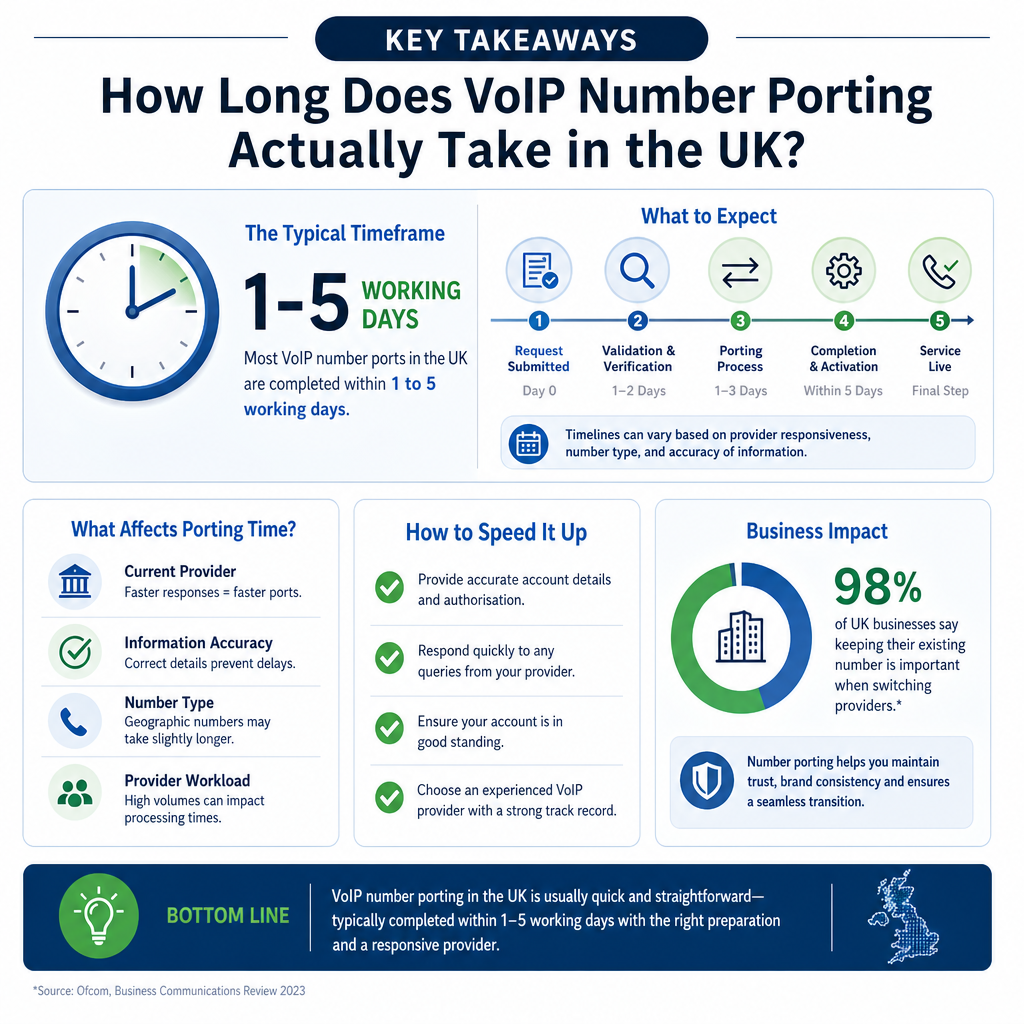
VoIP number porting, officially called number portability, lets you keep your existing phone numbers when switching to a new provider. In the UK, Ofcom regulations guarantee your right to port numbers, but the process isn’t instant.
Standard porting timelines break down by number type:
- Single geographic numbers (landlines): 5-7 business days
- Multiple geographic numbers: 7-10 business days
- Non-geographic numbers (0800, 0845, etc.): 10-15 business days
- Large business migrations (20+ lines): 15-20 business days
- Complex multi-site setups: 20-30 business days
These timelines assume perfect conditions, accurate paperwork, cooperative carriers, and no technical issues. Real-world experience often adds 20-30% to these estimates.
The process follows a structured workflow regulated by Ofcom’s General Condition 18. Your new VoIP provider submits a porting request to the UK Number Portability Database, which coordinates with your current provider. The losing carrier has specific timeframes to validate the request or raise objections.
Why it takes this long: Unlike switching email providers where you control the data, number porting requires coordination between competing companies. Your current provider must verify account ownership, check for outstanding contracts, update routing databases, and configure network switches to redirect calls to your new provider’s infrastructure.
For businesses planning their transition to VoIP for small business setups, this coordination period is unavoidable. The good news? Understanding the timeline lets you plan around it rather than being surprised by it.
Geographic vs Non-Geographic Numbers: Timeline Differences
Geographic numbers (those starting with 01, 02, or 03) port significantly faster than non-geographic numbers. The difference stems from database complexity and regulatory requirements.
Geographic number porting uses the UK’s established Local Number Portability (LNP) system. The infrastructure is mature, automated, and well-tested. Most geographic ports complete within the 5-7 day window because:
- Fewer carriers are involved in routing decisions
- Database updates are straightforward
- Validation processes are standardized
- Technical configurations are simpler
Non-geographic numbers (0800, 0845, 0870, etc.) require additional steps. These numbers aren’t tied to physical locations, so porting involves more complex routing arrangements. Expect 10-15 business days minimum because:
- Multiple carrier networks may need updating
- Revenue-sharing arrangements must be reconfigured
- Additional regulatory checks apply
- Database propagation takes longer across networks
Mobile numbers being ported to VoIP systems fall somewhere in between, typically requiring 7-10 business days. The Mobile Number Portability (MNP) system is efficient, but moving from mobile to VoIP infrastructure adds complexity.
Planning tip: If you’re porting a mix of number types, they won’t all complete simultaneously. Your VoIP provider should coordinate a cutover date when all numbers are ready, preventing partial service disruptions.
What Actually Affects VoIP Number Porting Time in the UK
Several factors beyond number type influence how long your port takes. Understanding these variables helps you anticipate delays and take preventive action.
Paperwork Accuracy and Account Verification
Incomplete or incorrect documentation causes the majority of porting delays. Your new provider needs exact matches between:
- Account holder name (must match billing records precisely)
- Service address (including postcode)
- Current provider account number
- Numbers being ported (including any sub-numbers or DDI ranges)
Even minor discrepancies, “Ltd” vs “Limited,” missing apartment numbers, or outdated addresses, trigger rejection. The losing carrier has regulatory grounds to refuse the port if details don’t match their records exactly.
Letter of Authorization (LOA) requirements vary by provider and number quantity. Single-line residential ports may not need formal LOAs, but business migrations typically require signed authorization on company letterhead. Some providers accept digital signatures; others demand wet signatures and posted documents, adding 2-3 days to the timeline.
Before submitting your port request, verify your current account details. Log into your existing provider’s portal or call billing support to confirm exactly how your name and address appear in their system. Use those exact details on your porting paperwork.
Current Provider Response Time
Your losing carrier controls a significant portion of the porting timeline. Ofcom regulations require them to process valid port requests within specific timeframes, but enforcement isn’t always immediate.
Cooperative providers process ports quickly, often completing their validation within 1-2 business days. They understand customer churn is inevitable and maintain efficient porting departments.
Difficult providers may use every available day in the regulatory window, or find creative reasons to object. Common tactics include:
- Claiming account details don’t match (even when they do)
- Citing outstanding balances or contract terms
- Requesting additional documentation beyond regulatory requirements
- Simply being slow to respond to validation requests
If you’re still under contract with your current provider, expect additional scrutiny. They may require early termination fees to be paid before approving the port. Some providers hold ports hostage until final bills are settled, even if you’re willing to pay.
Porting away from major carriers like BT, Virgin Media, or Sky typically follows predictable timelines, they process thousands of ports monthly and have established procedures. Smaller or regional providers may have less efficient systems, potentially adding days to the process.
Number Complexity and Quantity
The more numbers you’re porting, the longer the process takes. It’s not linear, porting 10 numbers doesn’t take 10 times as long as porting one, but complexity increases with scale.
Single number ports are straightforward. One validation, one database update, one cutover.
Multi-line business ports require coordinated cutover planning. If you’re porting 15 lines, they all need to switch simultaneously to avoid partial service disruption. This coordination adds time:
- Each number must be validated individually
- Database updates must be synchronized
- Cutover windows must be scheduled during low-traffic periods
- Rollback procedures must be planned in case of issues
DDI ranges and number blocks add another layer of complexity. If you have a block of 100 consecutive numbers, the port involves range validation and bulk database updates. Expect 15-20 business days minimum for range ports.
Special number types like premium rate numbers (09xx) or personal numbering (07xx ranges used for business) may require additional regulatory approvals, extending timelines by 5-10 days.
For businesses with multiple locations, porting numbers to a VoIP provider across different geographic areas requires separate port requests for each location, effectively multiplying the timeline.
Common Delays in UK VoIP Number Porting Time
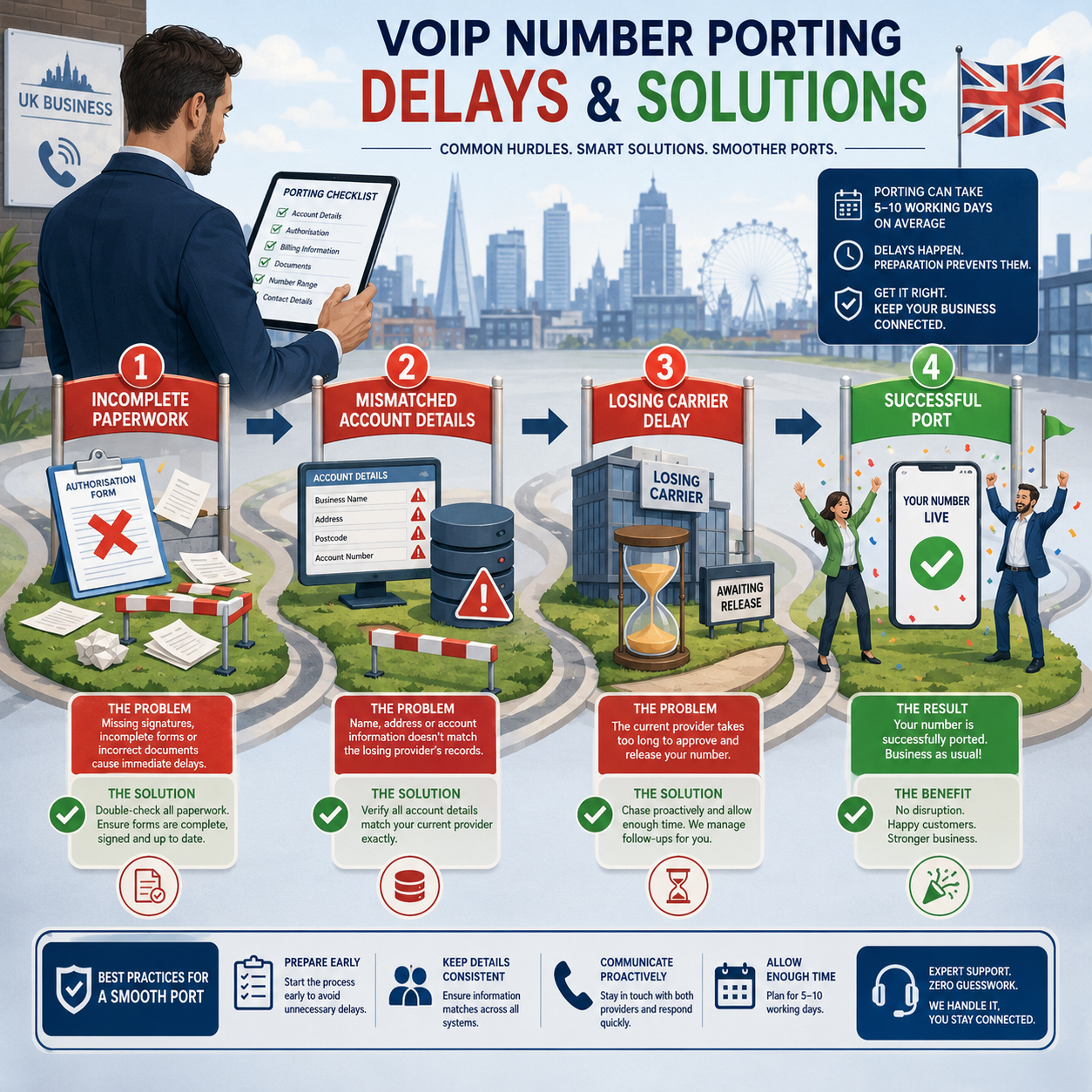
Even with perfect preparation, delays happen. Knowing the common culprits helps you troubleshoot when your port stalls.
Account Mismatches and Validation Failures
The single biggest cause of porting delays: information that doesn’t match between your port request and your current provider’s records.
Common mismatches include:
- Name variations: “John Smith” vs “J. Smith” vs “John A. Smith”
- Business name changes: Company rebrands or legal entity changes not updated with current provider
- Address discrepancies: Old addresses, missing flat numbers, postcode errors
- Account number confusion: Using customer reference numbers instead of actual account numbers
When validation fails, your new provider receives a rejection notice. They contact you for corrected information, you resubmit, and the clock starts over. Each rejection cycle adds 3-5 business days to your timeline.
Prevention: Request a recent bill from your current provider before starting the port. Use the exact name, address, and account number printed on that bill for your porting paperwork. Screenshot or photocopy the relevant sections to ensure perfect accuracy.
Losing Carrier Objections and Disputes
Your current provider can object to port requests for legitimate reasons, or sometimes questionable ones.
Valid objections include:
- Outstanding balance on the account
- Active contract with early termination penalties unpaid
- Fraud concerns or account security issues
- Technical limitations (rare but possible with certain legacy systems)
Questionable objections that sometimes occur:
- Claiming details don’t match when they clearly do
- Requesting documentation beyond regulatory requirements
- Citing vague “technical issues” without specifics
- Slow-walking responses to delay the inevitable
When an objection is raised, the porting process pauses. Your new provider must work with you to resolve the issue, then resubmit. Depending on the objection type, resolution can take anywhere from 2 days (paying an outstanding bill) to 15+ days (contract disputes requiring escalation).
If you face unreasonable objections: Ofcom’s dispute resolution process exists for exactly this situation. Escalate through your new provider first, they have established channels for challenging improper objections. Document everything: dates, names, specific objections raised, and your responses.
Technical Issues and Database Errors
Less common but still significant: technical problems during the porting process.
Database propagation delays occur when updates to the UK Number Portability Database don’t propagate correctly across all carrier networks. Calls may route incorrectly for hours or even days after the supposed cutover.
Routing configuration errors happen when the losing carrier’s network switches aren’t updated properly. Incoming calls continue routing to the old provider instead of your new VoIP system.
Number range conflicts emerge when there’s confusion about which specific numbers in a range are being ported, particularly with DDI blocks.
These technical issues typically surface during or immediately after cutover. Your new provider’s technical team must coordinate with the losing carrier’s network operations to resolve them, a process that can take 1-3 business days of troubleshooting.
Mitigation strategy: Schedule your cutover during low-traffic periods (evenings or weekends for most businesses). Test thoroughly immediately after cutover. Have a rollback plan if critical issues emerge.
How to Speed Up Your VoIP Number Porting Time
While you can’t eliminate the regulatory waiting periods, you can avoid the delays that are within your control.
Prepare Documentation in Advance
Three weeks before your desired cutover date, gather:
- Recent bill from current provider (within last 30 days)
- Account number and any customer reference numbers
- Complete list of all numbers to be ported
- Proof of business registration (for business accounts)
- Signed Letter of Authorization if required
Verify every detail matches your current provider’s records. Call their support line if needed to confirm exact spelling of names, address format, and account numbers.
Submit complete packages to your new VoIP provider. Incomplete submissions just delay the process while they request missing information.
Choose Your Timing Strategically
Avoid month-end and quarter-end periods when possible. Telecom providers process higher volumes of ports during these periods as businesses time transitions to billing cycles. This volume can slow processing times by 2-3 days.
Allow buffer time beyond the quoted estimate. If your provider says 7 business days, plan for 10. If they say 15, plan for 20. This buffer prevents panic if minor delays occur.
Consider temporary number forwarding if your timeline is tight. Some businesses port to their new VoIP system while temporarily forwarding their old numbers, then complete the port once the new system is tested and stable. This adds cost but eliminates cutover risk.
Work With Experienced VoIP Providers
Not all business VoIP providers handle porting with equal competence. Established providers with dedicated porting teams process requests more efficiently than providers who treat porting as an afterthought.
Questions to ask prospective providers:
- How many UK number ports do you process monthly?
- What’s your average porting timeline for my number type and quantity?
- Do you have a dedicated porting coordinator I’ll work with?
- What happens if the port encounters issues, who troubleshoots?
- Can you provide references from similar businesses you’ve ported?
Providers experienced with VoIP phone number porting know how to navigate carrier objections, prepare documentation correctly the first time, and escalate issues effectively when they arise.
Maintain Communication With Both Providers
Stay in contact with both your current and new providers throughout the process. Don’t assume silence means progress.
Weekly check-ins are appropriate for complex ports. Ask specific questions:
- Has the port request been submitted to the database?
- Has the losing carrier responded?
- Are there any pending issues requiring my attention?
- Is the scheduled cutover date still on track?
Document everything: dates, names of representatives you speak with, specific information provided. This documentation becomes critical if disputes arise or you need to escalate issues.
For detailed step-by-step guidance on the entire process, our complete 2026 timeline guide walks through each phase from initial request to final cutover.
What Happens During the Porting Process
Understanding the behind-the-scenes workflow helps set realistic expectations.
Phase 1: Submission and Validation (Days 1-3)
Your new VoIP provider submits your port request to the UK Number Portability Database with all your documentation. The system routes the request to your current provider for validation.
Your losing carrier checks the details against their records. If everything matches, they approve the request and propose a cutover date. If details don’t match, they reject it with specific reasons.
Phase 2: Coordination and Scheduling (Days 4-7)
Once validated, both providers coordinate the actual cutover date. This date must be:
- At least 1 business day after validation (often longer)
- During a maintenance window that works for both carriers
- Communicated to you for approval
Your new provider configures their systems to receive calls to your numbers. Your old provider prepares to release the numbers and update routing.
Phase 3: Cutover and Testing (Day 7+)
On the scheduled date, database updates occur. Your numbers are reassigned from your old provider to your new VoIP system. Routing tables across UK carrier networks update to direct calls to the new destination.
The cutover window typically occurs during off-peak hours (late evening or early morning) to minimize disruption. During this window, usually 1-4 hours, calls to your numbers may not connect reliably.
After cutover, both providers test to ensure calls route correctly. You should also test thoroughly: incoming calls, outgoing calls, SMS if applicable, and any special features like call forwarding.
Phase 4: Monitoring and Adjustment (Days 8-10)
The first 24-48 hours after cutover are critical. Database propagation across all UK networks can take time. Some callers may experience routing issues if their carrier’s systems haven’t updated yet.
Your new provider monitors for issues and coordinates with the losing carrier to resolve any routing problems. Most issues resolve within 24 hours as database updates propagate fully.
Frequently Asked Questions
Can I speed up VoIP number porting in the UK?
You can’t bypass the regulatory minimum timelines (typically 5-7 business days for standard ports), but you can avoid delays by submitting accurate documentation, paying any outstanding balances with your current provider, and working with experienced VoIP providers who process ports efficiently. The fastest realistic timeline for a single UK geographic number is 5 business days from submission to cutover.
What happens to my phone service during porting?
Your existing service remains active with your current provider until the cutover date. On cutover day, there’s typically a 1-4 hour window where service may be unreliable as database updates propagate. After cutover completes, all calls route to your new VoIP system. Plan for this brief disruption during low-traffic hours.
Can a number port fail completely?
Yes, though it’s uncommon. Ports fail when account validation issues can’t be resolved, when the losing carrier raises legitimate objections (like unpaid bills or active contracts), or when technical incompatibilities exist. If a port fails, your number remains with your current provider, and you’ll need to resolve the underlying issues before resubmitting. Working with providers experienced in reliable VoIP for small business setups minimizes this risk.
Do I need to pay my old provider during porting?
Yes, maintain service and payment with your current provider until the port completes. Canceling service or stopping payment before the port finishes will cause the port to fail. Once the cutover is complete, you can formally cancel with your old provider (though the port itself typically terminates your service with them automatically).
How much does number porting cost in the UK?
Most UK VoIP providers include basic number porting in their setup fees or offer it free with service contracts. Expect to pay £0 to £10 per number for standard geographic numbers. Complex ports (large number blocks, non-geographic numbers) may cost £20 to £50 per number. Your losing carrier cannot charge you a porting fee, Ofcom regulations prohibit this, though they may charge early termination fees if you’re under contract.
What if I need to port numbers from multiple providers?
Each current provider requires a separate port request. You can coordinate multiple simultaneous ports, but each follows its own timeline. The complexity increases significantly, if you’re porting 10 numbers from Provider A and 5 from Provider B, you’re managing two independent processes that need to complete around the same time. Allow extra buffer time (3-4 weeks minimum) for multi-provider migrations.
Conclusion
VoIP number porting time in the UK ranges from 5 business days for straightforward single-line transfers to 20+ days for complex business migrations. The timeline depends on number type, quantity, documentation accuracy, and how cooperative your current provider is. While you can’t eliminate the regulatory waiting periods, you can avoid the common delays that extend timelines by weeks.
Start your porting process early,at least 3-4 weeks before you need service active on your new system. Verify your account details match your current provider’s records exactly. Work with experienced business VoIP providers who have dedicated porting teams and established processes. Maintain communication throughout the process and build buffer time into your planning.
The transition to cloud-based communications delivers significant benefits, cost savings, flexibility, and advanced features that traditional phone systems can’t match. The porting process requires patience and attention to detail, but it’s a one-time investment that sets your business up for years of improved communications infrastructure.
Ready to start your migration? Gather your current account documentation, verify your details, and contact VoIP providers with proven UK porting experience. The sooner you begin the process, the sooner you’ll be operating on a modern, scalable business communications platform.