

Nearly 60% of small businesses that switch VoIP providers are surprised by early termination fees (ETFs) that can run into hundreds — sometimes thousands — of dollars. The good news? Many of these fees are avoidable. Knowing exactly how to cancel your VoIP contract without paying fees can save your business serious money and headaches. This guide breaks down every legal, practical strategy available in 2026 to exit your VoIP agreement without losing a cent. 📞
Key Takeaways
- ✅ Read your contract first — many VoIP agreements contain fee-waiver clauses you can legally use.
- ✅ Service failures and material breaches by the provider can void your obligation to pay ETFs.
- ✅ Proper written notice and documentation are essential to avoid disputes.
- ✅ Negotiating directly with your provider often yields better results than simply canceling.
- ✅ Comparing providers before signing a new contract prevents you from repeating the same mistake.
Understanding Your VoIP Contract: The Foundation of a Fee-Free Exit
Before taking any action, the single most important step is to read your existing contract carefully. Most people skip this step — and it costs them.
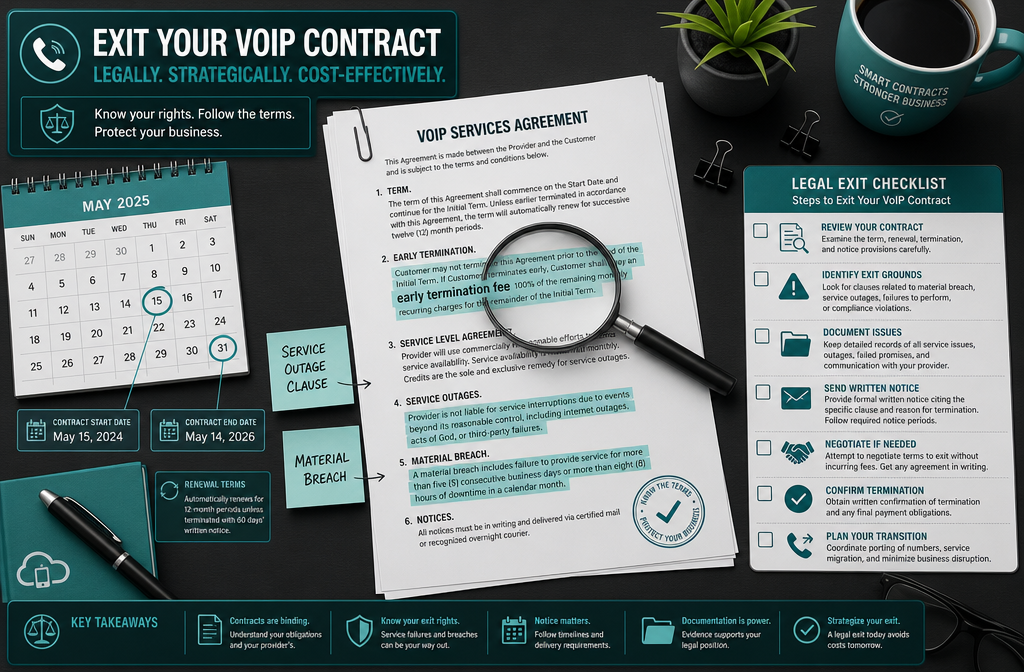
What to Look for in Your VoIP Agreement
Every VoIP contract contains specific language that governs how and when you can leave. Focus on these sections:
| Contract Section | What to Look For |
|---|---|
| Early Termination Clause | The exact ETF amount and how it’s calculated |
| Service Level Agreement (SLA) | Guaranteed uptime, response times, and remedies |
| Material Breach Clause | Conditions under which either party can exit |
| Auto-Renewal Terms | Deadlines to cancel before automatic renewal |
| Notice Requirements | How many days’ notice you must give and in what format |
💡 Pull Quote: “The fastest way to cancel your VoIP contract without paying fees is to find a clause your provider has already violated.”
The Most Powerful Exit Clauses
1. Material Breach by the Provider
If your VoIP provider has failed to deliver the service promised in the SLA — persistent outages, poor call quality, missed support response times — this may constitute a material breach. A material breach typically allows you to terminate the contract without penalty.
Keep records of:
- Outage logs and timestamps
- Support tickets and response times
- Written complaints you’ve submitted
- Any billing errors
2. Price Increase Clauses
Many VoIP contracts include language stating that if the provider raises prices mid-contract, you have the right to cancel without fees. Check your agreement for phrases like “right to terminate upon material change” or “price adjustment opt-out.”
3. Auto-Renewal Windows
Miss the cancellation window before auto-renewal and you could be locked in for another year. Most contracts require 30–90 days’ written notice before the renewal date. Mark this date in your calendar the moment you sign any VoIP agreement.
Step-by-Step: How to Cancel Your VoIP Contract Without Paying Fees
Once you’ve identified your exit strategy, follow these steps precisely to protect yourself legally and financially.
Step 1: Document Everything 📋
Before making a single call, build your paper trail:
- Screenshot all service outages from your provider’s status page
- Export all support tickets
- Save every invoice showing billing discrepancies
- Download your original contract and any amendments
Step 2: Send a Formal Written Notice
Never cancel by phone alone. Always send a written cancellation notice via:
- Certified mail (with return receipt)
- Email with read receipt to the official cancellation or billing department
- Registered post if your contract specifies it
Your notice should include:
- Your account number
- The reason for cancellation (referencing specific contract clauses)
- The effective cancellation date
- A request for written confirmation
Step 3: Reference the Specific Breach or Clause
Be specific. Instead of writing “your service has been bad,” write:
“Per Section 4.2 of our Service Level Agreement, you guaranteed 99.9% uptime. Our records show 14 hours of unplanned downtime between January and March 2026, constituting a material breach. We are therefore exercising our right to terminate without early termination fees.”
This approach signals that you know your rights and are prepared to act on them.
Step 4: Escalate If Necessary
If the front-line customer service team refuses to waive fees, escalate:
- Ask for a retention specialist — they often have authority to waive ETFs to keep your business.
- File a complaint with the FCC (in the US) or your country’s telecommunications regulator.
- Contact your state attorney general’s office if you believe the fees are deceptive.
- Dispute the charge with your credit card company if the fee is charged without justification.
Step 5: Get the Cancellation in Writing ✅
Never assume the cancellation is complete until you receive written confirmation. Confirm:
- The exact cancellation date
- That no further charges will be applied
- The status of any ported phone numbers
How to Cancel Your VoIP Contract Without Paying Fees: Provider-Specific Strategies
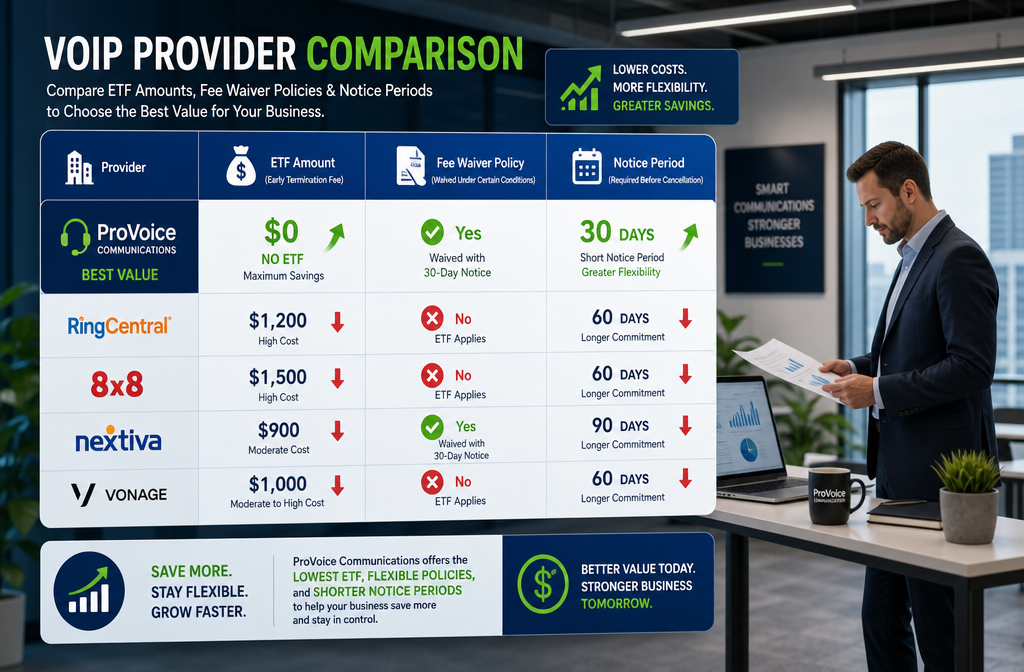
Different providers have different policies. Here’s what to know about common approaches in 2026:
Month-to-Month vs. Annual Contracts
| Contract Type | ETF Risk | Best Exit Strategy |
|---|---|---|
| Month-to-month | Low — usually no ETF | Give required notice (typically 30 days) |
| Annual contract | Moderate — ETF may apply | Use SLA breach or price change clause |
| Multi-year contract | High — ETFs can be significant | Negotiate, escalate, or use material breach |
Negotiating a Fee Waiver Directly
Even without a contractual basis, direct negotiation works more often than people expect. VoIP providers would rather keep you as a customer or part on good terms than chase unpaid fees.
Try these negotiation tactics:
- Offer to stay if conditions improve — providers may waive ETFs to retain business
- Mention competitor offers — competition motivates flexibility
- Ask for a pro-rated fee rather than the full ETF
- Request a credit toward a new service instead of a cash fee
🔑 Key Insight: Retention teams at most VoIP companies have discretion to waive up to 100% of ETFs. You just have to ask the right person.
Porting Your Number Without Triggering Fees
In many jurisdictions, number portability is a legal right. Initiating a port to a new provider does not automatically mean you’ve breached your contract — but it may trigger cancellation clauses. Check your agreement before porting and, where possible, complete the formal cancellation process first.
Avoiding VoIP Contract Traps in the Future
Knowing how to cancel your VoIP contract without paying fees is valuable — but avoiding the trap entirely is even better.
Red Flags to Watch Before Signing
- ❌ ETFs that don’t decrease over the contract term
- ❌ Auto-renewal clauses with short cancellation windows (less than 30 days)
- ❌ Vague SLA language with no defined remedies
- ❌ No price-lock guarantee for the contract term
- ❌ Cancellation processes that require in-person visits or certified mail only
Questions to Ask Every VoIP Provider
- What is the exact ETF if we cancel after 6 months? 12 months?
- Does the ETF decrease over time?
- What happens if you fail to meet your SLA?
- What is the auto-renewal notice window?
- Can we cancel penalty-free if you raise prices?
Conclusion: Take Action and Exit Smart
Canceling a VoIP contract without paying fees is entirely achievable — but it requires preparation, documentation, and knowing exactly which levers to pull. Here’s your action plan:
- Pull your contract today and identify your exit clauses.
- Start documenting service issues immediately if they exist.
- Send formal written notice referencing specific contract language.
- Escalate to retention teams if front-line agents refuse to waive fees.
- Get everything in writing before considering the cancellation complete.
The businesses that successfully exit VoIP contracts without fees aren’t lucky — they’re prepared. Use the strategies in this guide to protect your budget and move forward with a provider that actually delivers on its promises. 💼
References
- Federal Communications Commission. (2023). Consumer guide to VoIP services and your rights. https://www.fcc.gov/consumers/guides/voice-over-internet-protocol-voip
- Gartner. (2022). Magic Quadrant for Unified Communications as a Service. Gartner Research.
- National Consumer Law Center. (2021). Early termination fees in service contracts: Legal analysis and consumer remedies. NCLC Publications.
- Ofcom. (2023). Switching communications provider: Consumer rights guide. https://www.ofcom.org.uk/phones-and-broadband/switching-provider