
Nearly 30% of all porting requests are delayed — not because of technical failures, but because of a single mismatched character on a form. If you’re switching to a VoIP provider and wondering how long does VoIP number porting take, the honest answer is: anywhere from one business day to six weeks, depending on factors most people never think to ask about.
This guide breaks down every variable that controls your porting timeline, so you can plan your business transition without surprises.
Key Takeaways 📌
- Simple ports (single U.S. lines) can complete in as little as 1–7 business days once documentation is approved.
- Complex ports (multiple lines, PBX systems, toll-free numbers) can take 2–6 weeks.
- Canadian numbers take longer than U.S. numbers — typically 10–12 business days.
- LOA mismatches are the #1 cause of porting delays and are entirely preventable.
- Your existing service stays active throughout the entire process — there is no downtime during porting.
Understanding How Long VoIP Number Porting Takes: The Core Timeline
The porting process is governed by a combination of FCC regulations, carrier agreements, and the complexity of the numbers being transferred. Here’s what the data shows for 2026.
Standard U.S. Porting Timelines
| Port Type | Typical Duration |
|---|---|
| Simple single-line port (U.S.) | 1–7 business days |
| Standard multi-line port (U.S.) | 5–10 business days |
| Canadian number port | 10–12 business days |
| Complex PBX or multi-carrier port | 2–4 weeks |
| Toll-free number transfer | 4–6 weeks |
| Fax number port | ~2 weeks |
| International port (outside North America) | Varies widely |
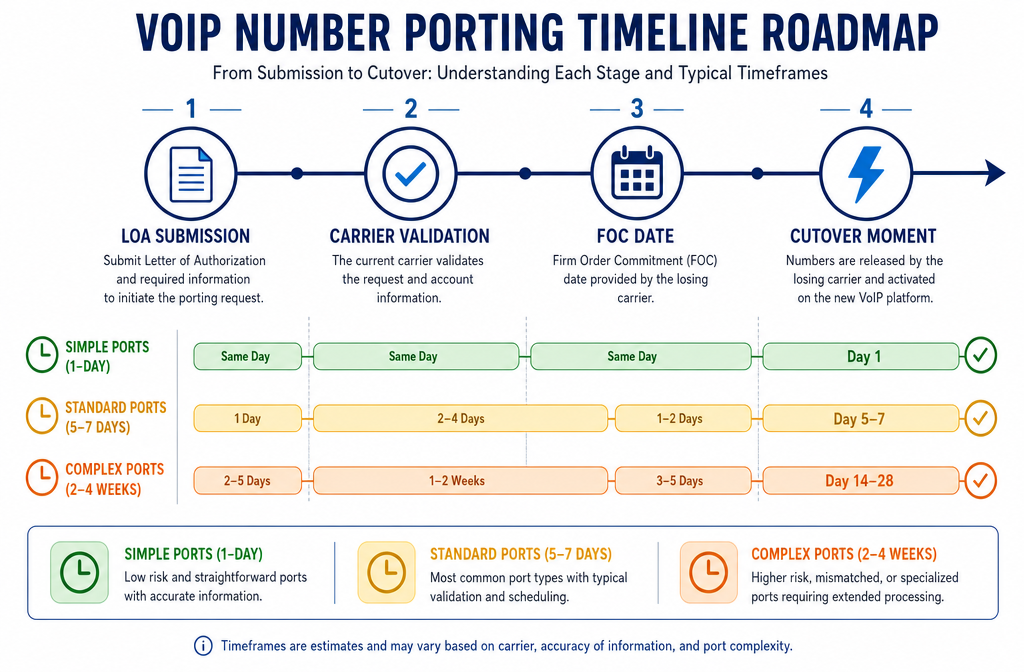
The FCC mandates that simple porting requests — defined as single lines without complex technical requirements — must complete within one business day once all documentation is approved. That’s the regulatory floor. In practice, most standard VoIP number ports for U.S.-based numbers take 5–7 business days from the moment a complete, accurate request is submitted.
💡 Pull Quote: “The FCC sets the minimum bar at one business day for simple ports — but ‘simple’ has a very specific legal definition that most business numbers don’t meet.”
What Makes a Port “Complex”?
A port becomes complex when it involves:
- Multiple phone numbers on the same account
- PBX systems with custom routing configurations
- Numbers spread across different carriers on a single account
- Toll-free numbers requiring additional verification steps
- Fax lines with separate provisioning requirements
Vonage, for example, estimates that U.S. number porting to their platform can take anywhere from 5 to 21 business days, with the wide range reflecting how much carrier cooperation and documentation quality matter.
Wireless vs. Wireline: A Critical Distinction
Not all porting is created equal. Wireless-to-wireless transfers (moving a number between mobile carriers) can complete in minutes to hours. VoIP and landline transfers — classified as wireline ports — require significantly more backend coordination between carriers, which is why the timelines are measured in days and weeks rather than hours.
What Factors Determine How Long VoIP Number Porting Takes?
Understanding the variables that affect your porting speed puts you in control. Here are the six most impactful factors.
1. 📄 Documentation Accuracy (The Biggest Factor)
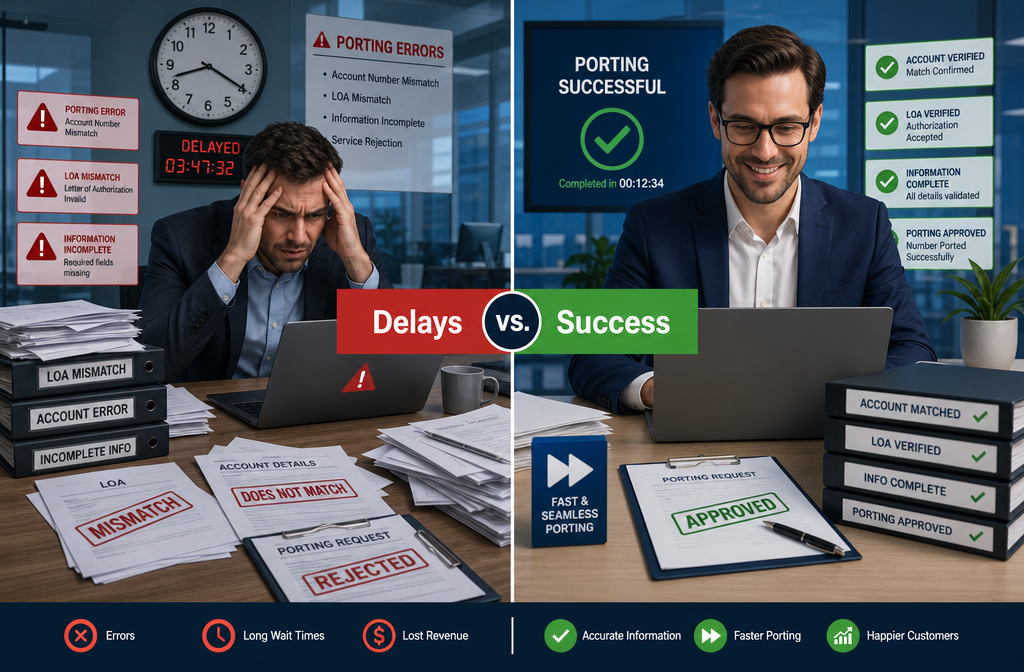
LOA mismatches are the leading cause of porting delays. The Letter of Authorization (LOA) must match your current carrier’s account records exactly — including the account holder’s name, service address, and account number. Even a minor discrepancy (like “St.” vs. “Street”) can trigger a rejection, sending the process back to square one and adding several business days.
Documents typically required:
- Signed Letter of Authorization (LOA)
- Current carrier account number
- Billing telephone number (BTN)
- Service address on file with current carrier
- PIN or passcode (if applicable)
2. 🏢 Losing Carrier Responsiveness
This is the factor that frustrates businesses most. Some carriers deliberately slow the porting process as a retention tactic when customers attempt to leave. While the FCC prohibits “port freezes” without customer consent, slow processing within technically legal timeframes is common. Choosing a gaining carrier (your new VoIP provider) with strong carrier relationships can help push the process forward.
3. 🌐 Geographic Location
U.S. numbers benefit from FCC oversight and standardized porting procedures. Canadian numbers operate under different regulatory frameworks, which is why they take 10–12 business days compared to the U.S. standard. International numbers outside North America can take substantially longer, with timelines heavily dependent on the specific countries and carriers involved — sometimes stretching to several weeks or more.
4. 📞 Number Type
| Number Type | Why It Takes Longer |
|---|---|
| Toll-free numbers | Extra verification steps, separate registry |
| Fax numbers | Separate provisioning requirements |
| PBX extensions | Require system reconfiguration |
| Virtual numbers | May have unique ownership verification |
5. 📋 Number of Lines Being Ported
Porting a single line is fundamentally different from porting 50 lines. Bulk porting requests require coordination across multiple systems and often involve staged cutover schedules. Complex scenarios involving multiple numbers, PBX systems, or numbers spread across different carriers on the same account typically take 2–4 weeks.
6. ✅ New Provider’s Porting Process Efficiency
Not all VoIP providers handle porting with equal efficiency. Providers with dedicated porting teams, automated documentation verification, and established carrier relationships consistently deliver faster results than those relying on manual processes.
The Porting Process Step by Step ⚙️
Knowing what happens during porting helps set realistic expectations.
Step 1: Submit Porting Request Provide your new VoIP provider with the LOA and all required account information from your current carrier.
Step 2: Carrier Validation Your new provider submits the request to the losing carrier. The losing carrier verifies the information against their records. This is where most delays occur.
Step 3: FOC Date Assignment Once approved, a Firm Order Commitment (FOC) date is assigned. This is the confirmed date your number will transfer.
Step 4: Cutover On the FOC date, the actual number switch happens. The cutover typically takes only seconds to minutes. Your existing phone service remains fully active right up until this moment — there is zero service interruption during the porting process.
🔑 Key Fact: The actual moment your number switches to the new VoIP platform takes seconds. The weeks of waiting are all pre-cutover coordination.
How to Speed Up Your VoIP Number Port 🚀
These steps can meaningfully reduce your porting timeline:
- Gather account details before submitting — call your current carrier to confirm exact account name, number, and address on file
- Submit a complete LOA the first time — every rejection adds 2–5 business days
- Avoid making changes to your current account during the porting process (adding lines, changing plans, or updating billing can trigger delays)
- Choose a VoIP provider with a dedicated porting team and ask about their average porting completion time
- Port during mid-week — submissions on Monday or Friday sometimes experience slight delays due to weekend processing gaps
- Start the process early — don’t wait until your contract with the old provider expires
Regional Porting Timelines at a Glance 🌍
| Region | Typical Timeline | Key Factor |
|---|---|---|
| United States (simple) | 1–7 business days | FCC-regulated |
| United States (complex) | 2–4 weeks | Number type, carrier cooperation |
| Canada | 10–12 business days | Different regulatory framework |
| Toll-free (U.S.) | 4–6 weeks | Registry verification |
| International | Varies widely | Country-specific regulations |
Conclusion: Plan Ahead and Port Smart
So, how long does VoIP number porting take? The realistic answer for most U.S. businesses is 5–10 business days for standard ports, with complex scenarios extending to 4–6 weeks for toll-free or multi-line transfers. The good news: your service never goes dark during the process, and the final cutover takes mere seconds.
Actionable next steps for 2026:
- ✅ Contact your current carrier today to confirm your exact account details before submitting any porting request.
- ✅ Ask your new VoIP provider for their average porting completion time and whether they have a dedicated porting support team.
- ✅ Build a buffer into your transition timeline — assume 2 weeks minimum for business planning purposes, even if your port completes faster.
- ✅ Never cancel your current service until the FOC date is confirmed and the cutover is complete.
- ✅ For toll-free or bulk ports, start the process at least 6 weeks before you need the transfer complete.
The difference between a smooth port and a frustrating one almost always comes down to preparation. Get the documentation right the first time, and the technology takes care of the rest.