

Over 20 million households once used Vonage to replace their landlines — and yet, most people have no idea whether the brand still exists today. If you’ve been asking is Vonage still in business, the short answer is yes, but the company looks very different from what it once was.
Vonage no longer trades on the stock market, no longer operates as an independent company, and no longer focuses on home phone service. In 2022, Swedish telecom giant Ericsson acquired Vonage for $6.2 billion. The brand survived the deal, but its identity shifted dramatically. In this article, I’ll walk you through exactly what happened, what Vonage offers in 2026, and what it all means for current and prospective customers.
Key Takeaways 📌
- ✅ Vonage is still in business as a wholly owned subsidiary of Ericsson
- 📅 Ericsson completed the acquisition on July 21, 2022, for $6.2 billion
- 🏠 Vonage’s residential VoIP service has been largely wound down for new customers
- 💼 Vonage Business Communications (VBC) and the Vonage API Platform remain active in 2026
- 🔄 Business customers are largely unaffected, though support now routes through Ericsson’s infrastructure
The Full Timeline: How Vonage Got Here
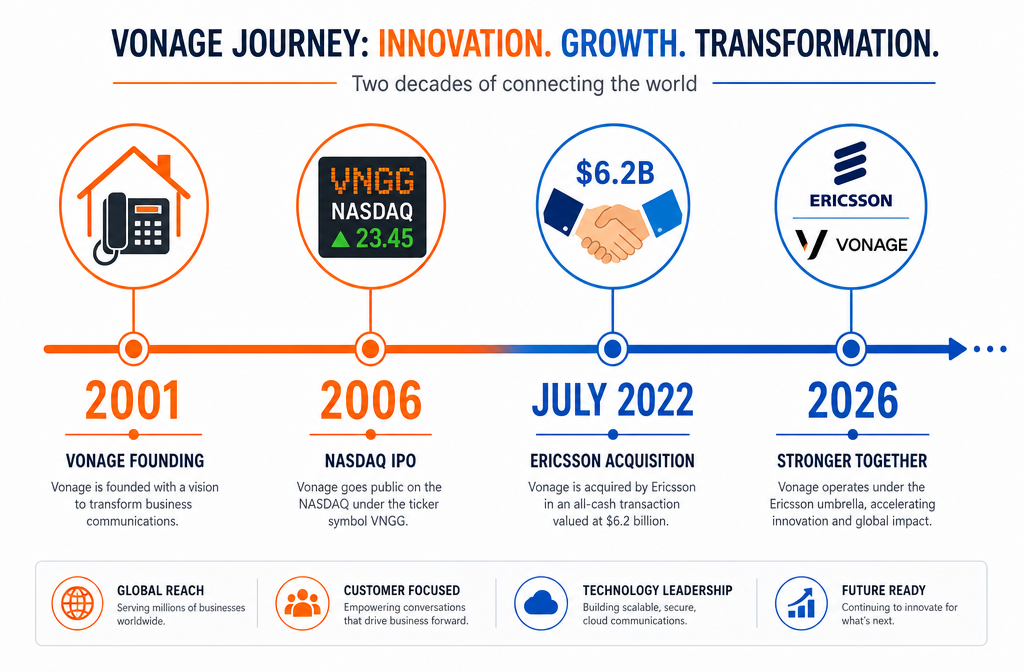
Understanding whether is Vonage still in business requires knowing how the company evolved over two decades.
2001–2006: The Disruptor Years
Vonage was founded in 2001 by Jeff Pulver and Jeffrey Citron in Holmdel, New Jersey. Its pitch was simple and powerful: ditch your landline and make phone calls over the internet for a fraction of the cost. The timing was perfect. Broadband adoption was exploding, and consumers were hungry for alternatives to expensive traditional phone carriers.
By 2006, Vonage went public on the Nasdaq under the ticker VG, raising roughly $531 million in one of the most talked-about tech IPOs of that year. The company was spending aggressively on marketing — those catchy “Woo-hoo!” TV commercials were impossible to miss.
2007–2018: Growing Pains and Pivot to Business
The post-IPO years were rocky. Vonage faced patent lawsuits from Verizon and Sprint, burning through cash and losing ground in the residential market as competitors multiplied. Leadership responded by pivoting hard toward business communications.
Between 2013 and 2018, Vonage made a series of strategic acquisitions — including Vocalocity, SimpleSignal, iCore Networks, and Nexmo — to build out a cloud-based business communications stack and a developer-facing API platform.
2019–2021: The CPaaS Bet
By 2019, Vonage had repositioned itself as a CPaaS (Communications Platform as a Service) company. The Vonage API Platform allowed developers to embed voice, SMS, video, and messaging directly into apps and workflows. Revenue topped $1.25 billion by 2020, and the business segment was growing steadily.
July 2022: Ericsson Closes the Deal
On July 21, 2022, Ericsson officially completed its $6.2 billion acquisition of Vonage. Vonage’s common stock was delisted from Nasdaq, and the company became a wholly owned subsidiary of Ericsson. Ericsson’s stated rationale was to accelerate its push into enterprise communications and 5G-enabled services.
Critically, Ericsson confirmed that Vonage would “continue to operate under its existing name and brand” as part of the Ericsson Group. Vonage’s financials now roll up into Ericsson’s Enterprise segment.
Is Vonage Still in Business in 2026? What the Brand Looks Like Now
Yes — Vonage is still in business in 2026, and it’s more active than many people realize.
In March 2026, Vonage — described officially as “part of Ericsson (NASDAQ: ERIC)” — announced its participation in Mobile World Congress (MWC) 2026 in Barcelona, showcasing network innovation and communications solutions. That’s not the behavior of a brand being quietly retired.
Vonage’s main website continues to market four core product areas:
| Product Area | Status in 2026 |
|---|---|
| Vonage Business Communications (VBC) | ✅ Active — UCaaS platform for businesses |
| Vonage API Platform | ✅ Active — CPaaS tools for developers |
| Contact Center Solutions | ✅ Active — Integrated with VBC |
| Residential Home Phone | ⚠️ Limited — Available but not actively promoted |
The business phone pricing page still lists active unified communications plans with 40+ features, CRM integrations, and a straightforward “no hidden fees” promise. New business customers can still sign up today.
💬 “Vonage didn’t disappear — it transformed. The question isn’t whether it exists, but whether it still fits your needs.”
If you’re evaluating cloud phone systems for your business, understanding this context matters before you commit to any platform.
What Happened to Vonage’s Products?
Residential VoIP: The Quiet Wind-Down
Vonage’s home phone service — the product that built the brand — has been significantly deprioritized. While a dedicated home service site with plans and pricing technically still exists, Vonage is not actively marketing residential VoIP to new customers the way it once did. Existing residential customers who were on legacy plans were either migrated to updated offerings or encouraged to find alternatives.
If you were a home phone customer, it’s worth reviewing your current plan status directly with Vonage support. The residential product isn’t officially “dead,” but it’s clearly not the company’s focus.
Vonage Business Communications: Still Going Strong
VBC remains the flagship product for small and mid-sized businesses. It includes:
- 📞 Cloud-hosted business phone lines
- 💬 Team messaging and video conferencing
- 🔗 Integrations with Salesforce, Microsoft 365, Google Workspace, and more
- 📊 Call analytics and reporting
For businesses already using VBC, the day-to-day experience has changed little since the Ericsson acquisition. Support now routes through Ericsson’s enterprise infrastructure, which some customers report as a slight shift in responsiveness — but the platform itself remains functional and regularly updated.
If you want to get the most from your business phone setup, exploring top VoIP integrations for business productivity can help you maximize what VBC already offers.
Vonage API Platform: The Developer Powerhouse
This is arguably where Vonage’s future lies. The API Platform (built largely on the Nexmo acquisition) lets developers embed communications — voice calls, SMS, WhatsApp messaging, video — directly into their applications. Under Ericsson’s ownership, this platform is being positioned as a key piece of the 5G enterprise communications puzzle.
Vonage vs. The Competition: How Does It Stack Up in 2026?
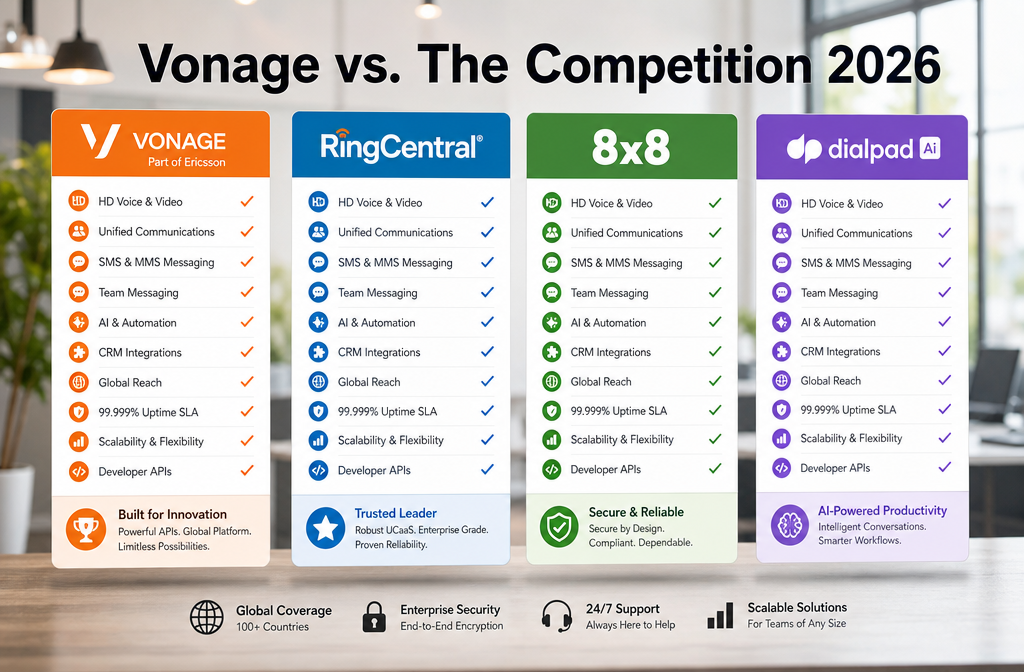
With the ownership change, it’s fair to ask whether Vonage Business Communications is still competitive. Here’s an honest comparison against the major alternatives.
| Feature | Vonage (VBC) | RingCentral | 8×8 | Dialpad |
|---|---|---|---|---|
| Pricing (entry) | ~$19.99/user/mo | ~$20/user/mo | ~$24/user/mo | ~$15/user/mo |
| Video Conferencing | ✅ | ✅ | ✅ | ✅ |
| API / Developer Tools | ✅ Strong | ⚠️ Limited | ⚠️ Limited | ✅ Good |
| CRM Integrations | ✅ | ✅ | ✅ | ✅ |
| AI Features | ⚠️ Developing | ✅ Strong | ✅ Strong | ✅ Strong |
| Support Quality | ⚠️ Mixed post-acquisition | ✅ Solid | ✅ Solid | ✅ Good |
Honest take: Vonage VBC is still a solid platform, particularly if you need strong API capabilities or are already embedded in the Vonage ecosystem. However, RingCentral and Dialpad have pulled ahead on AI-powered features in 2026, and some users report that post-acquisition support has been slower than it once was.
If you’re a small business weighing your options, our roundup of top RingCentral alternatives for small businesses gives you a broader view of the landscape.
For businesses focused on cost savings, it’s also worth understanding how VoIP can cut your business phone bills in half — regardless of which provider you choose.
What Existing Vonage Customers Should Know
If you’re a business customer on VBC: You’re in good shape. Your service continues, your features are intact, and Ericsson has shown no signs of retiring the platform. Monitor any communications from Vonage about plan changes, but there’s no urgent action required.
If you were a residential customer: Review your current plan. If you’re still being billed and service is working, you’re likely on a legacy plan that still functions. However, given the deprioritization of home VoIP, it may be worth exploring alternatives — especially if you’ve noticed any service degradation.
If you’re a developer using the Vonage API Platform: This is the most actively invested product under Ericsson. Expect continued development, especially around 5G and network APIs. The platform is not going anywhere.
For any business concerned about continuity, understanding VoIP disaster recovery and keeping your business connected is a smart precaution regardless of your provider.
Frequently Asked Questions About Vonage ❓
Is Vonage being shut down?
No. Vonage is not being shut down. As of 2026, it operates as an active subsidiary of Ericsson, participates in major industry events, and continues to onboard new business customers. The residential product has been deprioritized, but the business platform is fully operational.
Who owns Vonage now?
Vonage is owned by Ericsson, the Swedish multinational telecommunications company. The acquisition closed on July 21, 2022, for approximately $6.2 billion. Vonage operates as a wholly owned subsidiary within Ericsson’s Enterprise segment.
Is Vonage Business still available?
Yes. Vonage Business Communications (VBC) is still available and actively marketed to small and mid-sized businesses. Plans include unified communications features, video, messaging, and integrations with popular business tools.
Did Vonage change its name?
No — Vonage has not changed its name. Ericsson confirmed at the time of acquisition that Vonage would continue to operate under its existing brand. You’ll still see “Vonage” on products, marketing, and the company website, though some materials reference “Vonage, part of Ericsson.”
Is Vonage still good for small businesses?
It can be, particularly if you value strong API capabilities or need a reliable UCaaS platform with broad integrations. That said, competitors like Dialpad and RingCentral have made significant AI and feature advances. If you’re starting fresh, it’s worth comparing options. Our guide on top features every small business needs in their VoIP service can help you build your checklist.
What happened to Vonage residential?
Vonage’s home phone service has been significantly scaled back. While technically still available, it is no longer actively promoted to new customers. Existing residential users should verify their plan status directly with Vonage. If you’re looking for a home VoIP replacement, there are several strong alternatives on the market.
Conclusion: Vonage Is Alive — But It’s a Different Company
So, is Vonage still in business? Definitively, yes. But the Vonage of 2026 is not the scrappy VoIP disruptor that wanted to replace your home phone in 2001. It’s a business-focused communications platform operating under one of the world’s largest telecom companies.
For business customers, the news is largely positive: the platform is stable, supported, and actively developed. For residential customers, the picture is murkier — the product still technically exists but is clearly not a priority.
Actionable Next Steps 🚀
- Current VBC users: Log in, review your plan, and confirm your support contacts have been updated to reflect Ericsson’s structure.
- Residential users: Check your billing and service status. If you’re experiencing issues, now is a good time to evaluate alternatives.
- Businesses shopping for VoIP: Vonage deserves a spot on your shortlist, but compare it honestly against RingCentral, Dialpad, and 8×8 before deciding.
- Developers: The Vonage API Platform remains one of the stronger CPaaS options available — explore it if you’re building communications into your apps.
For a broader look at your options, our beginner’s guide to VoIP for businesses is a great place to start your research.